Where Strategic HR Stands Today, and Where It Should Move in the Age of AI Orchestration
One of the most important functions of HR is managing people.
For a long time, this work required an enormous amount of paperwork and patience from HR professionals.
Hiring.
Transfer.
Promotion.
Performance evaluation.
Compensation.
Training.
Retirement or exit.
Accurately recording these people-related events, retrieving them when needed, and connecting them to the appropriate processes has always been one of HR’s most basic and important responsibilities.
HRIS has significantly changed this work.
Before HRIS was introduced, each HR function often had its own database or management file.
Recruiting had recruiting data.
Performance management had performance data.
Compensation had compensation data.
Mobility had transfer histories.
Learning and development had training and participation records.
These pieces of information existed within HR, but they were not always connected in a single, common information platform.
The major contribution of HRIS has been to integrate these data points into a shared database.
People Events can now be recorded, managed centrally, and searched when needed.
Who belongs to which department?
Who reports to whom?
Which positions are open?
How many people are in each organization?
These things have become much easier to see than before.
An even larger change is that people-related information, which used to be visible only within HR, has become visible to business leaders as well.
Headcount by organization.
Open positions.
Mobility status.
Performance distribution.
Succession candidates.
Skills and experience data.
These are now displayed through dashboards, allowing business leaders to directly access people-related information.
For HRBPs in particular, the evolution of HRIS has had a major impact.
HRBPs, who were often forced to respond reactively to people and organizational issues, can now use objective data from HRIS to act more proactively.
With the introduction of AI Orchestration, there is also an expectation that HR will be able to support people and organizations in even more advanced ways.
But is that really the case?
Can HRIS truly manage the organization?
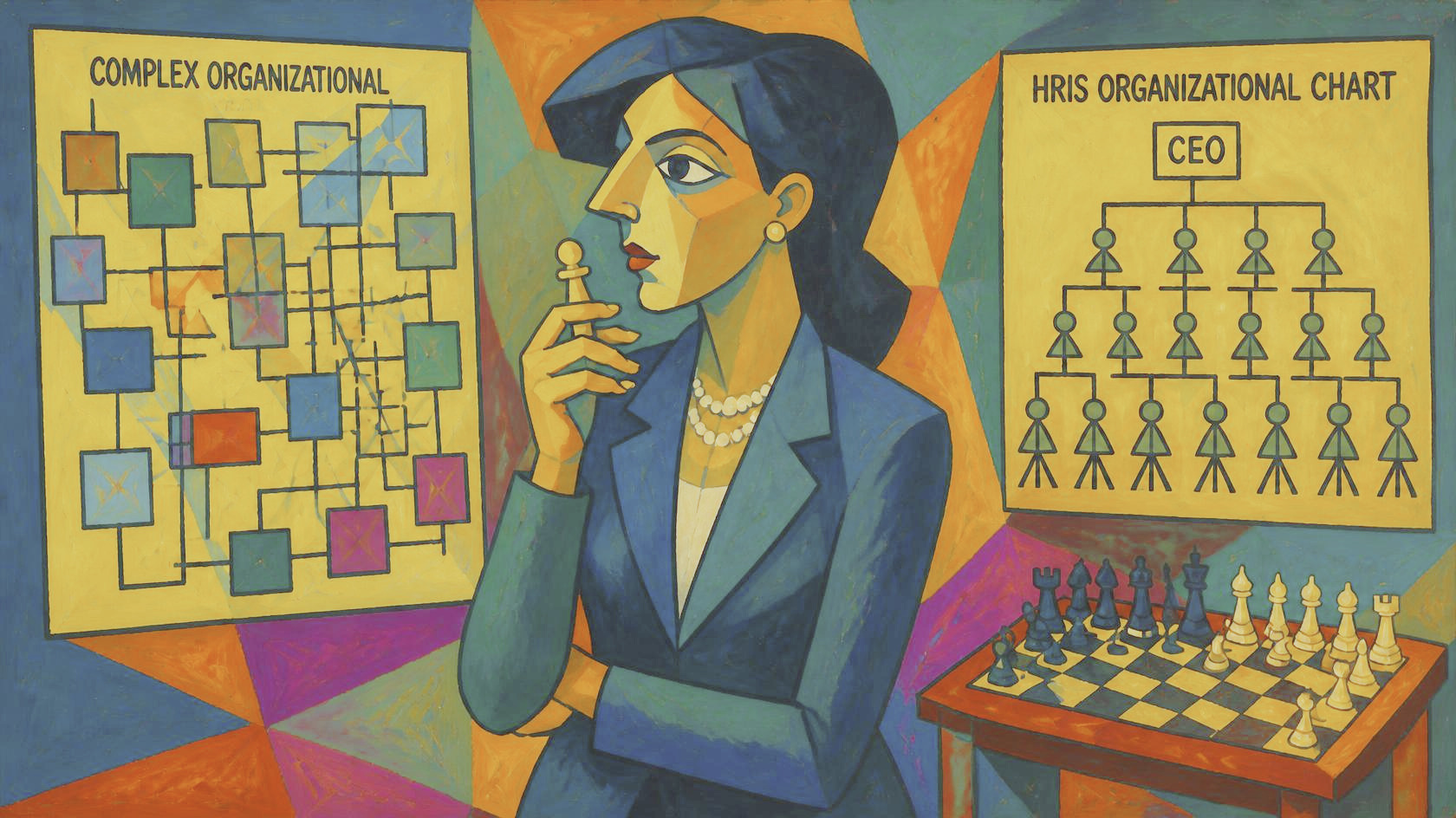
The organization chart displayed in the HRIS is often based on reporting lines.
Who reports to whom?
Who sits under whom?
Which position sits under which position?
This is extremely important information for managing people.
Who is the manager?
Who evaluates the employee?
Who approves decisions?
Who is responsible for the person’s placement and development?
The reporting line is essential for HR management.
But if the reporting line is visible, does that mean the organization is truly visible?
This is one of the most important cautions to keep in mind when using an HRIS-based organization chart.
HRIS appears to display the organization chart.
But what it mainly displays is not the organization itself.
It mainly displays people and reporting lines.
An organization is not moved by reporting lines alone.
There are several lines within an organization.
Reporting Line.
Who reports to whom?
Authority Line.
Who can approve what?
Decision Line.
In which meeting body are decisions made, by whom, and about what?
Budget Line.
Who holds budget responsibility?
Execution Line.
Which organization holds execution responsibility?
What HRIS is particularly good at displaying is the reporting line.
But managing an organization requires more than seeing reporting lines.
In Japanese companies, the organization charts traditionally used were not simply reporting-line charts.
They were also maps of governance lines as seen from the president or CEO.
Even a new employee could look at the organization chart and understand which department they belonged to, and where that department sat within the entire company.
Who is my direct manager?
That is important.
But what was even more important was understanding which line the person belonged to when seen from the top of the company.
Under which department head?
Within which division?
Under which executive?
What role does that department play within the company?
To which authority, budget, meeting bodies, and division of duties is that line connected?
Only when these elements are visible can we say that the organization is truly visible.
Even after introducing HRIS, some Japanese companies still have their General Affairs department prepare the organization chart.
This does not simply mean that General Affairs is responsible for drawing the chart.
General Affairs has traditionally handled the governance practices required for the company’s operations.
Organization rules.
Division of duties.
Authority rules.
Approval workflows.
Meeting bodies.
Board-related administration.
Document management.
For this reason, the organization chart prepared by General Affairs was not only a staffing chart.
It was also a map of authority and governance structure.
This is not a discussion about whether Japanese companies or Western companies are superior.
Western companies also have meeting bodies, authority structures, budget controls, governance mechanisms, and organizational designs.
However, these pieces of information are not managed by HR alone.
HR looks at people and reporting lines.
Finance looks at cost centers and budget responsibility.
Legal and Corporate Secretary look at authority, contracts, boards, and governance.
Business leaders look at organization design for business execution.
The CEO and the Board confirm final accountability.
In other words, in any company, HR does not manage the organization itself alone.
What HR has primarily managed is people.
And what HRIS has digitized is also mainly people and reporting lines.
If HR looks at an HRIS-based organization chart without understanding this broader picture, HR may think it is looking at the organization, while in reality it is looking mainly at the reporting line.
So what will change as AI Orchestration advances?
If AI is introduced into HRIS, will HRIS be able to design organizations?
We believe we should be cautious about that expectation.
AI may make HRIS smarter.
It may show succession risk.
It may show skill gaps.
It may suggest internal mobility candidates.
It may show attrition risk.
It may identify distortion in organization layers.
It may show bias or imbalance in reporting lines.
It may suggest options for talent allocation.
However, AI cannot suddenly read organization information that HRIS does not hold.
Orchestration across organizations requires more than People Events and reporting lines.
Which departments are connected through which business processes?
Where are the dependencies in decision-making?
Who holds budget responsibility?
Which meeting body decides what?
Which authority is placed in which organization?
Where are responsibility boundaries ambiguous?
Which organizational connections depend on personal trust or informal coordination?
Without this information, AI cannot truly orchestrate the organization.
HRIS manages people.
AI generates insights from HR data.
But organizations are not moved by HR data alone.
Reporting Line.
Authority Line.
Decision Line.
Budget Line.
Execution Line.
And the trust and experience that connect people to people and departments to departments.
Only when these elements are connected can the organization become readable.
This is where the HRBP’s role also changes.
HRBPs support leaders who hold accountability.
But simply being useful to accountable leaders is not enough.
HRBPs should assess whether the leader’s accountability is executable as an organizational capability.
The reporting line may be clear, but decision-making may be stuck.
There may be a budget owner, but execution responsibility may sit elsewhere.
A decision may have been made in a meeting body, but it may not be moving in the field.
We have talented people, but we lack experience connecting departments.
There may be succession candidates, but they may not have faced the actual organizational issues the role requires.
These frictions are difficult to see through an HRIS-based organization chart alone.
And they cannot be solved by one HRBP alone.
This is the difficulty of the HRBP role.
HRBPs are closest to the field, where they see frictions between people and the organization.
But if those frictions are handled only as individual HR consultations, they do not become organizational capability.
We need to hire.
We need to transfer someone.
There is a problem with performance evaluation.
The manager is weak.
There is no successor.
If the conversation ends there, HR is still only dealing with people issues.
We need to translate these frictions into organizational capability issues.
Is this a problem of individual capability?
Is it a problem of role design?
Is accountability ambiguous?
Is the issue in the Decision Line?
Is there a gap between the Budget Line and the Execution Line?
Is this a problem of cross-functional connection?
Is there a lack of experience that develops Leadership Utility?
HRBPs need to be able to ask these questions.
HRBPs should share the frictions they see in the field across the HR function, structure them, and turn them into information that can inform management decisions.
This is one of the key roles Strategic HR will play in the age of AI Orchestration.
We call this the mechanism that enables this Strategic HR Evolution.
Strategic HR Evolution is not about placing more responsibility on HRBPs.
It is not about turning HRBPs into superheroes.
It’s about creating a mechanism that enhances HRBP Utility.
HRBP Utility does not simply mean the individual capability of an HRBP.
It means helping HRBPs be useful to accountable leaders and support those leaders’ accountability as an organizational capability.
To do this, we need a mechanism that connects the information HRBPs see in the field with HRIS, rosters, the Human Balance Sheet, Leadership Utility, and management decision-making.
One HRBP does not need to change the organization alone.
But HRBPs should not allow the friction they see to be seen as people issues alone.
Those frictions need to be translated into gaps among the Reporting Line, Authority Line, Decision Line, Budget Line, and Execution Line.
And they need to be converted into information that the HR function can handle collectively.
Only then can HRBPs become Strategic Partners who help build organizational capability, rather than simply serving as consultants to business leaders.
This also connects to the discussion of Leadership Utility.
What does it mean to form organizational capability?
In the future, AI may visualize dependencies across organizations.
However, it is leaders who must read the visible situation and its complexity, hold themselves accountable, understand connections with other departments, functions, KPIs, and rosters, and turn that understanding into executable judgment.
This isn’t required solely because AI has been introduced.
Even before AI, capable leaders have always advanced work by reading not only their own area of responsibility, but also the surrounding organizational context, the constraints of other departments, the flow of decision-making, and the relationships among people.
We believe this is where a leader’s Utility exists.
As AI Orchestration advances, this Leadership Utility will become even more important.
However, Leadership Utility is difficult to develop within a single department.
Experiencing multiple departments, multiple functions, and multiple accountabilities.
Understanding, translating, and connecting different organizational contexts.
Handling the invisible friction between people, departments, strategy, and execution.
These multi-disciplinary experiences form the foundation of Leadership Utility.
And these experiences should not be left to chance.
They need to be designed as an organization, made visible, and connected to future placement and development.
HRBPs create the starting point for this in the field.
HRBPs should not let the frictions they see end as people issues.
They should reframe them as organizational capability issues.
Then that information needs to be connected to HRIS, rosters, the Human Balance Sheet, Leadership Utility, and management decision-making.
The mechanism that enables this is Strategic HR Evolution.
In the coming age of AI, Strategic HR can no longer be just a mindset or attitude guiding individual HRBPs.
Nor can it remain a CEO slogan designed to encourage HRBPs.
HRBPs should stay close to the business.
CHROs should move closer to management.
But that alone is not enough.
Within HR, there needs to be a clear Strategic HR function that connects people and organizational capability to management decision-making.
It connects the People Events recorded in HRIS with reporting lines, organization charts, job descriptions, Authority Lines, Decision Lines, cost centers, rosters, the Human Balance Sheet, and Leadership Utility.
It gives business leaders, CFOs, and CEOs judgment material on people and organizational capability when making decisions about organizational matters.
It converts AI-suggested organizational options and risks into a format humans can evaluate while maintaining accountability.
And it converts the frictions HRBPs see in the field into organizational capability and management decision-making.
That is the role of Strategic HR in the age of AI Orchestration.
HRIS manages people.
The HRIS-based organization chart displays reporting lines.
AI may generate various insights from that information.
But organizations are not moved by reporting lines alone.
Organizations are driven by authority, budget, meeting bodies, decision-making, execution responsibility, cross-functional connections, and people’s experience and trust.
So who manages the organization?
Management runs the organization.
HR should make the organization readable from the perspective of people and organizational capability.
In the age of AI Orchestration, Strategic HR must become the function that enhances HRBP Utility and turns HR data into information about organizational capability. Originally posted on LinkedIn on 2026-09-18)
About Errand Consulting
Errand Consulting explores organizational transformation
through the ERR& Philosophy.
Learn more → www.hrfd3.com
ERR& Tips Vol.6
HRISは人を管理する。では、組織は誰が管理するのか?
Strategic HRの現在地とAI Orchestrationによって向かうべき方向性
人事部門の一番重要なミッションの一つは、人を管理することです。
そしてその仕事は、長い間、膨大な量のペーパーワークと人事部員の忍耐力を必要としてきました。
入社。
異動。
昇格。
評価。
報酬。
研修。
退職。
こうした人に関する出来事を正確に記録し、必要なときに取り出し、適切な手続きにつなげる。
それは、人事部門にとって最も基本的な仕事であり、同時に最も重要な仕事の一つでした。
HRISは、その仕事を大きく変えました。
HRISが導入される前、人事部門の各機能はそれぞれ、個別のデータベースや管理表を有していました。
採用は採用のデータを持つ。
評価は評価のデータを持つ。
報酬は報酬のデータを持つ。
異動は異動の履歴を持つ。
人材開発は研修や受講履歴を有している。
それぞれの情報は人事部門内にありましたが、必ずしも一つの情報基盤としてつながっていたわけではありません。
HRISの大きな意味は、これらの情報を共通のデータベース上に統合したことです。
人に関するPeople Eventが、都度記録され、一元的に管理され、必要に応じて検索できるようになりました。
誰がどの部署にいるのか。
誰が誰にreportしているのか。
どのポジションが空いているのか。
どの組織に何人いるのか。
こうした情報も、以前よりはるかに見えやすくなりました。
さらに大きな変化は、人事部門の中でしか見ることができなかった人に関する情報が、組織のリーダーにも見えるようになったことです。
組織ごとのヘッドカウント。
空きポジション。
異動状況。
評価分布。
後継者候補。
スキルや経験に関する情報。
これらがダッシュボード化され、ビジネスリーダーが直接確認できるようになりました。
特にHRBPにとって、HRISの進化は大きな意味を持ちます。
これまで受動的になりがちだった人と組織に関する支援について、HRISが提供する客観的なデータを使うことで、よりプロアクティブに手を打てるようになってきたのではないでしょうか。
さらにAI Orchestrationが導入されれば、人事はより高度に人と組織を支援できるようになる。
そのような期待もあると思います。
しかし、本当にそうなのでしょうか。
HRISで、本当に組織を管理できるのでしょうか。
HRISが表示する組織図は、多くの場合、Reporting Lineをベースにしています。
誰が誰にレポートするのか。
誰の下に誰がいるのか。
どのpositionが、どのpositionの下にあるのか。
これは、人を管理するうえでは非常に重要な情報です。
誰が上司なのか。
誰が評価するのか。
誰が承認するのか。
誰がその人の配置や育成に責任を持つのか。
Reporting Lineは、人事管理において欠かせない情報です。
しかし、Reporting Lineが見えれば、本当に組織が見えているのでしょうか。
ここに、HRIS上の組織図を使うときの大きな注意点があります。
HRISは、組織図を表示しているように見えます。
しかし、そこで表示されているのは、組織そのものというより、主に人とReporting Lineです。
組織を動かしているのは、Reporting Lineだけではありません。
組織には、いくつもの線があります。
Reporting Line。
誰が誰にreportするのか。
Authority Line。
誰が何を承認できるのか。
Decision Line。
どの会議体で、誰が、何を決めるのか。
Budget Line。
誰が予算責任を持つのか。
Execution Line。
どの組織が実行責任を持つのか。
HRISが得意なのは、主にReporting Lineです。
しかし、組織を管理するには、Reporting Lineだけでは十分ではありません。
日本企業で伝統的に作成されてきた組織図は、単なるReporting Lineではありませんでした。
それは、社長から見た会社の統治ラインを示す地図でもありました。
新入社員であっても、組織図を見れば、自分がどの部門に属しているのか、自分の部門が会社全体の中でどこに位置しているのかを理解することができました。
自分は誰の直属の部下なのか。
それも重要です。
しかし、それ以上に重要だったのは、自分が社長から見てどのラインに属しているのかでした。
どの部門長の下にいるのか。
どの本部に属しているのか。
どの担当役員のラインに入っているのか。
その部門は、会社の中でどのような役割を担っているのか。
そのラインは、どの権限、予算、会議体、職務分掌に接続されているのか。
ここまで見えて初めて、「組織が見えている」と感じられるのではないでしょうか。
日本企業では、HRISを導入した後も、総務部が組織図を作成している会社があります。
それは、単に総務部が作図を担当しているということではありません。
総務部は、組織規程、職務分掌、権限規程、稟議、会議体、取締役会実務、文書管理など、会社を会社として動かすための統治実務を担ってきました。
そのため、総務部が作成する組織図は、人員配置図であると同時に、会社の権限と統治構造を示す地図でもありました。
一方で、これは日本企業と欧米企業のどちらが優れているかという話ではありません。
欧米企業でも、会議体、権限規程、予算管理、ガバナンス、組織設計は存在します。
ただし、それらの情報はHRだけで管理されているわけではありません。
HRは、人とReporting Lineを見る。
Financeは、Cost Centerと予算責任を見る。
LegalやCorporate Secretaryは、権限、契約、取締役会、ガバナンスを扱う。
Business Leaderは、事業実行における組織設計を重視する。
CEOやBoardは、最終的なAccountabilityを確認する。
つまり、どの企業であっても、人事部門が「組織」そのものを単独で管理しているわけではありません。
HRが管理してきたのは、主に人でした。
そしてHRISによってデジタル化された情報も、主に人とReporting Lineです。
この全体像を理解しないままHRIS上の組織図を見ると、人事は組織を見ているつもりで、実際にはReporting Lineだけを見ていることになります。
では、AI Orchestrationが進むと、この状況はどう変わるのでしょうか。
HRISにAIが導入されれば、組織設計までできるようになるのでしょうか。
私は、それには慎重であるべきだと思います。
AIは、HRISをより賢くするかもしれません。
後継リスクを示す。
スキルギャップを示す。
異動候補を示す。
離職リスクを示す。
組織の階層構造の歪みを示す。
Reporting Line上の偏りを示す。
人材配置の選択肢を示す。
しかし、HRISが持っていない組織情報を、AIが突然読み取れるようになるわけではありません。
組織をまたいだOrchestrationに必要なのは、People EventやReporting Lineだけではありません。
どの部門とどの部門が、どの業務で接続しているのか。
どこに意思決定の依存関係があるのか。
誰が予算責任を持っているのか。
どの会議体で何が決まるのか。
どの権限が、どの組織に置かれているのか。
どの責任境界が曖昧になっているのか。
どの組織間接続が、人の信頼関係や暗黙の調整に依存しているのか。
これらが見えなければ、AIは本当の意味で組織をOrchestrateすることはできません。
HRISは、人を管理する。
AIは、人事データから示唆を導く。
しかし、組織を動かしているのは、人事データだけではありません。
Reporting Line。
Authority Line。
Decision Line。
Budget Line。
Execution Line。
そして、人と人、部門と部門をつなぐ信頼と経験。
これらを接続して初めて、組織は読めるようになります。
ここで、HRBPの役割も変わります。
HRBPは、Accountabilityを持つリーダーを支援する役割を担っています。
しかし、Accountabilityを持ったリーダーに使えるだけでは十分ではありません。
そのリーダーのAccountabilityが、組織能力として実行可能になっているかを確認する必要があります。
Reporting Line上は明確でも、実際には意思決定が詰まっている。
予算責任者はいるが、実行責任を持つ組織が別にある。
会議体では決まっているが、現場では実行されていない。
優秀な人材はいるが、部門間をつなぐ経験が不足している。
後継者候補はいるが、実際の組織課題に耐えられる経験は積んでいない。
こうした違和感は、HRISの組織図だけでは見えにくいものです。
そして、HRBP一人で解決できるものでもありません。
ここに、HRBPの難しさがあります。
HRBPは現場に最も近いところで、人と組織の間の違和感を見えています。
しかし、その違和感を個別の人事相談として処理するだけでは、組織能力には変わりません。
採用が必要です。
異動が必要です。
評価に問題があります。
マネージャーが弱いです。
後継者がいません。
それだけで終わってしまうと、人事は人の問題を扱っているだけになってしまいます。
本当に必要なのは、その違和感を組織能力の課題として読み替えることです。
これは個人能力の問題なのか。
役割設計の問題なのか。
Accountabilityの曖昧さなのか。
Decision Lineの問題なのか。
Budget LineとExecution Lineのずれなのか。
部門間接続の問題なのか。
Leadership Utilityが育つ経験が不足しているのか。
HRBPがこうした問いを持てるようになること。
そして、HRBPが見ている現場の違和感を、人事部門全体で共有し、整理し、経営判断に接続できる情報に変換すること。
これが、AI Orchestration時代におけるStrategic HRに期待される重要な役割ではないでしょうか。
私たちは、それを実現する仕組みをStrategic HR Evolutionと呼んでいます。
Strategic HR Evolutionとは、HRBPに多くの責任を負わせることではありません。
HRBPをスーパーマンにすることでもありません。
むしろ、HRBPのUtilityを高める仕組みをつくることです。
ここでいうHRBPのUtilityとは、単なるHRBP個人の能力ではありません。
HRBPが、Accountabilityを持つリーダーに使えるだけでなく、そのリーダーのAccountabilityを組織能力として実行可能にする支援機能を持つことです。
そのためには、HRBPが現場で見ている情報を、HRIS、ロースター、Human Balance Sheet、Leadership Utility、そして経営判断に接続する仕組みが必要になります。
HRBP一人が組織を変える必要はありません。
しかし、HRBPが見ている違和感を、人の問題だけで終わらせてはいけません。
その違和感を、Reporting Line、Authority Line、Decision Line、Budget Line、Execution Lineのずれとして読み替える。
そして、それを人事部門全体で扱える情報に変える。
これができて初めて、HRBPは単なるビジネスリーダーの相談相手ではなく、組織能力を形成するためのStrategic Partnerになれると思います。
それでは、組織能力を形成するとはどういうことでしょうか。
今後、AIは組織間の依存関係を可視化するかもしれません。
しかし、可視化された状況とその複雑性を読み取り、自分のAccountabilityを持ちながら、他部門、他機能、他KPI、他ロースターとの接続を理解し、実行可能な判断に変えるのはリーダーです。
これは、AIが導入されたから初めて求められるものではありません。
これまでも、仕事のできるリーダーは、自分の担当領域だけでなく、その周辺にある組織の事情、他部門の制約、意思決定の流れ、人と人の関係を読みながら仕事を進めてきました。
私たちは、そこにリーダーのUtilityがあると考えています。
AI Orchestrationが進むことで、このLeadership Utilityはさらに重要になるのではないでしょうか。
しかし、Leadership Utilityは、一つの部門の中だけでは育ちにくいものです。
複数の部門、複数の機能、複数のAccountabilityを経験すること。
異なる組織文脈を理解し、翻訳し、接続すること。
人と人、部門と部門、戦略と実行の間にある見えにくい摩擦を扱うこと。
こうしたMulti-disciplinaryな経験が、Leadership Utilityの土台になります。
そして、その経験を偶然に任せるのではなく、組織として設計し、見えるようにし、次の配置や育成につなげる。
その起点を現場でつくるのはHRBPです。
HRBPが、現場で見ている違和感を人の問題だけで終わらせず、組織能力の課題として捉え直す。
その情報を、HRIS、ロースター、Human Balance Sheet、Leadership Utility、経営判断に接続する。
それを可能にする仕組みこそ、Strategic HR Evolutionです。
そして重要なことは、AIが導入されるこれからの時代において、Strategic HRは、もはやHRBP個人の行動を律する考え方や姿勢、あるいは彼らを鼓舞するためのCEOのスローガンだけでは足りないということです。
HRBPが事業に寄り添う。
CHROが経営に近づく。
それだけでも足りません。
HRの中に、人と組織能力を経営判断に結び付ける明確な機能としてのStrategic HRが必要になるでしょう。
HRISが記録するPeople Eventを、Reporting Line、組織図、JD、Authority Line、Decision Line、Cost Center、ロースター、Human Balance Sheet、Leadership Utilityに接続する。
Business Leader、CFO、CEOが組織を決定する際に、人や組織能力の観点から判断材料を提示する。
AIが示す組織の選択肢やリスクを、人間がAccountabilityを持って判断できる形に変換する。
そして、HRBPが現場で見ている違和感を、組織能力と経営判断に変換する。
それが、AI Orchestration時代のStrategic HRの役割だと思います。
HRISは人を管理します。
HRIS上の組織図は、Reporting Lineを表示します。
AIは、そこからさまざまな示唆を導き出すかもしれません。
しかし、組織を動かしているのは、Reporting Lineだけではありません。
組織を動かしているのは、権限、予算、会議体、意思決定、実行責任、部門間接続、そして人の経験と信頼です。
では、組織は誰が管理するのでしょうか。
組織を決めるのは経営です。
しかし、人と組織能力の観点から、組織が機能しているかを読み取るのは人事ではないでしょうか。
そして、AI Orchestration時代のStrategic HRは、HRBPのUtilityを高め、人事データを組織能力の情報に変換する機能でなければならないのではないでしょうか。(Originally posted on LinkedIn on 2026-09-18)
About Errand Consulting
Errand Consulting explores organizational transformation
through the ERR& Philosophy.
Learn more → www.jp.hrfd3.com