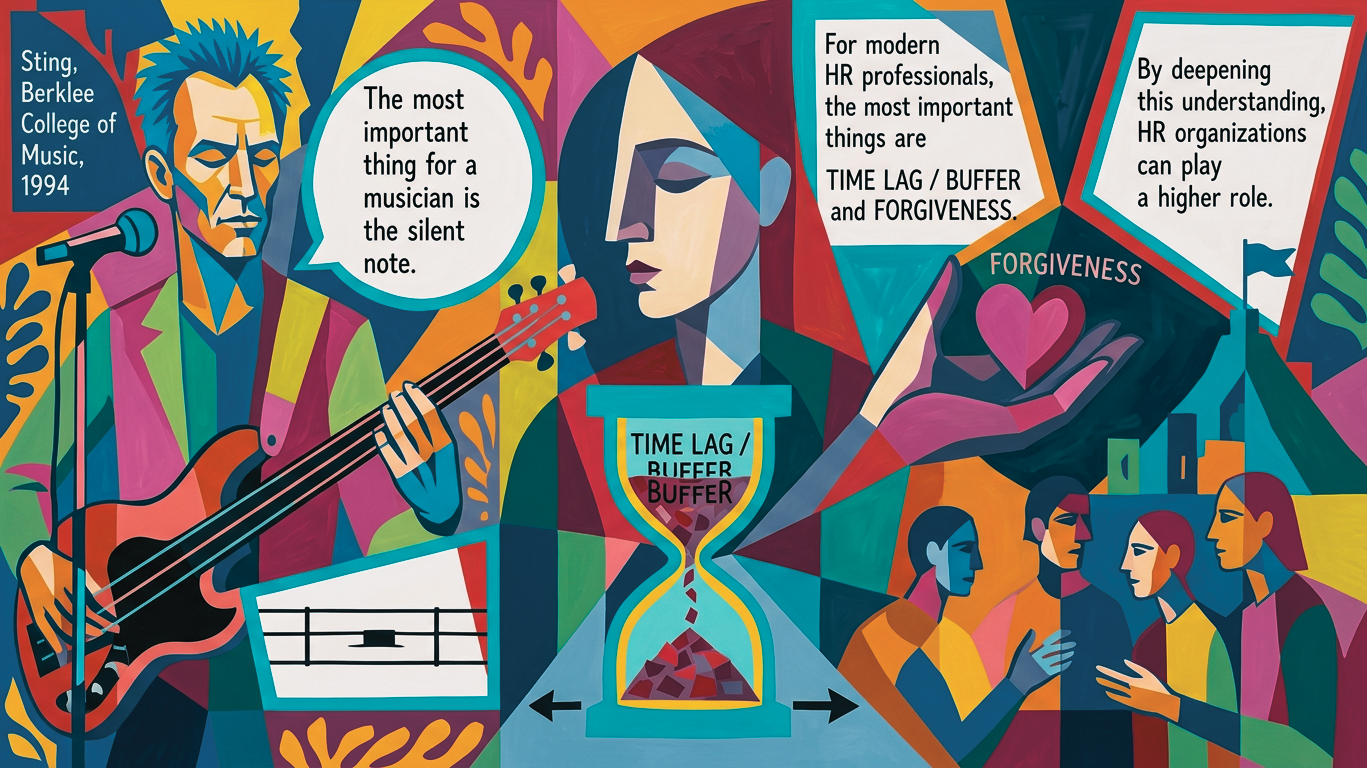
In his 1994 commencement speech at Berklee College of Music, Sting shared a simple but profound lesson with young musicians.
When he was younger, he tried to fill every moment with sound.
With experience, however, he realized that music is shaped not only by the notes we play, but also by the notes we do not play.
One gift given equally to every musician is the Silent Note.
It is not the sound itself, but how silence is used, that creates music.
Some graduates would perform in sold-out concert halls.
Others might make a living playing in small bars.
Some might simply continue making music for themselves.
Yet every musician receives the same Silent Note.
I believe this idea extends far beyond music.
Every profession is given something fundamental from the moment we choose that profession—something we cannot avoid or escape.
This Insight begins with that hypothesis.
What about HR?
What is common to every HR professional and every HR organization, regardless of industry, company, or country?
We believe the answer can be described in terms of two concepts.
The first is Time Lag.
The time between hiring and becoming productive.
The time between development and performance.
The time between organizational change and organizational adoption.
If people changed as quickly as data could be updated, HR would be a very different profession.
But reality is different.
People do not change like data.
The second concept is Forgiveness.
Here, Forgiveness does not mean kindness or sympathy.
It is the organization’s judgment not to define a person by a single result.
It is a deliberate judgment latitude.
However, this judgment cannot depend on personal preference.
It must be derived from the organizational Context and shared cultural norms.
Every HR professional therefore faces the same questions.
How long should we wait?
How much additional opportunity should we provide?
When does learning become accountability?
These questions cannot be avoided.
Ignoring them does not eliminate them.
It simply transfers the judgment to individual managers or organizational habits.
The quality of HR is therefore determined by how well Time Lag and Forgiveness are understood and managed.
Operations provides an interesting comparison.
In HR Operations, Time Lag is managed through Buffer.
Processing capacity.
Approval windows.
Redundancy.
Exception handling.
Operational buffers are not a waste.
They are intentional designs that protect quality.
Talent Management uses Buffer differently.
Recruitment.
Development.
Succession.
Internal mobility.
Here, Buffer becomes an investment.
Its purpose is to transform Time Lag into an Investment Horizon.
Poor HR sees Time Lag as delay.
Professional HR sees Time Lag as investment.
The same period of time can become either organizational risk or a future organizational capability.
Until this point, we have discussed what every HR professional inevitably faces.
But global business asks a different question.
Can HR contribute to business execution?
In other words,
Can HR practice Strategic HR?
We previously proposed that Strategic HR is less about strategy itself and more about Strategic Operations.
This discussion extends that idea.
If Strategic HR means
- understanding Time Lag,
- designing appropriate Buffers,
- making judgments through Context and Cultural Norms,
- and taking Accountability for those judgments,
then Strategic HR may not be a special discipline after all.
Perhaps it is simply the professional responsibility that has always existed within HR—made explicit from the perspective of business execution.
Recruiting.
Learning.
HRBP.
Talent Management.
HR Operations.
None of these functions can operate strategically if they optimize only their own Time Lag.
Strategic HR requires a common language across the entire HR function.
Time Lag.
Buffer.
Forgiveness.
Accountability.
Different situations will naturally require different decisions.
Consistency does not mean making identical decisions.
It means explaining different decisions through the same organizational principles.
That is Accountability.
The advancement of DX and AI makes this way of thinking even more important.
Data will become faster.
Predictions will become more accurate.
Investment horizons will become more visible.
Buffer design will become increasingly sophisticated.
But DX-AI will never determine organizational Context.
Nor will it define Cultural Norms.
It cannot decide which Time Lag should be eliminated,
which should become investment,
where Buffers should exist,
or when Forgiveness should be applied.
Those remain organizational judgments.
DX-AI will not replace those judgments.
It will make them more informed, more consistent, and more explainable.
Sting’s Silent Note was never about silence itself.
It was about what every musician receives equally as part of being a professional.
For HR professionals, Time Lag and Forgiveness are much the same.
They are not limitations.
They are responsibilities.
Understanding them.
Designing a buffer around them.
Making better judgments.
And accepting Accountability for those judgments.
Perhaps that is what truly separates good HR from great HR. (Originally posted on LinkedIn on 2026-07-13)
About Errand Consulting
Errand Consulting explores organizational transformation
through the ERR& Philosophy.
Learn more → www.hrfd3.com
ERR& Insight Vol.21
良いHRと悪いHRを分けるものは何か
世界的なミュージシャンであるStingは、1994年のバークリー音楽大学の卒業式で、若い音楽家たちに「音楽と沈黙」について語りました。
若い頃の彼は、演奏できるすべての時間を音で埋めようとしていたこともあったといいます。
しかし、経験を重ねる中で、それが必ずしも音楽を豊かにするわけではないことに気付きます。
音楽家に平等に与えられているものの一つは、Silent Note――休符です。
どのような音を奏でるかだけではなく、沈黙をどのように使うか。
それが音楽を変えます。
卒業後、満員の会場で演奏する人もいるでしょう。
バーや小さなクラブで演奏しながら、生計を立てる人もいるでしょう。
あるいは、一人で音楽を続ける人もいるかもしれません。
それでも、音楽と沈黙は、すべての音楽家に与えられています。
この話を聞いて、「それは音楽家の話であり、自分には関係がない」と考える人もいるでしょう。
しかし、そうではないと考える人もいるはずです。
今回のInsightは、
すべてのプロフェッショナルには、その職業に就いた時点で平等に与えられ、逃れることのできないものがある。
という仮説から始まります。
では、人事という仕事についてはどうでしょうか。
人事に携わる個人にも、人事部門という組織にも共通して与えられ、避けることのできないものは何でしょうか。
私たちは、その答えを二つの言葉で整理しました。
一つは、Time Lagです。
人事という仕事が、基本的に「待ち」の要素を持つ受動的な仕事であることは、この仕事に携わる人であれば理解しているはずです。
採用してから、戦力になるまでの時間。
育成してから、成果として現れるまでの時間。
組織を変更してから、新しい体制が定着するまでの時間。
手元の端末でデータを書き換えるように、人や組織も即座に変えることができるのであれば、人事はもっと能動的で、戦略的な仕事になっていたかもしれません。
しかし、現実はそうではありません。
人は、データのように瞬時には変わりません。
もう一つは、Forgivenessです。
ここでいうForgivenessは、「甘さ」でも「情緒」でもありません。
人事プロフェッショナルが個々の人に対応し、判断を行う際に生じる差異、すなわち判断のゆらぎです。
もし、このゆらぎがまったく存在せず、工場で不良品を選別する機械のように、一定の基準だけで人を処理できるのであれば、人事はもっと無味乾燥な仕事であったに違いありません。
しかし、人は一度の結果だけで確定できる存在ではありません。
私たちがいうForgivenessとは、
人を一度の結果だけで判断しないために、組織が持つ判断のゆらぎ
です。
ただし、それは担当者個人の気分や好意によって決まるものではありません。
組織が置かれたContextと、組織内で共有されているCultural Normsから導かれるものです。
したがって、人事は常に判断を求められます。
どれだけ待つのか。
どこまで再挑戦を認めるのか。
どの失敗を学習の過程と考え、どの失敗を看過できないものと考えるのか。
この責任から、人事は逃れることができません。
判断を避けたとしても、その結果はなくなりません。
現場の上司、個々の担当者、あるいは過去から続く暗黙の慣行へ、判断が移されるだけです。
したがって、Time LagとForgivenessに日々どのように向き合い、組織としてどのようにマネジメントするか。
そこに、人事という仕事の本質的な巧拙が表れるのではないでしょうか。
まず、オペレーションから見てみましょう。
人事オペレーションに存在するTime Lagは、Bufferによって吸収されます。
締め日。
処理能力の余力。
冗長性。
例外処理。
確認や承認のための期間。
優れたオペレーションは、Time Lagが存在しないことを前提にするのではありません。
Time Lagが必ず生じることを前提として設計されています。
その基本となる考え方が、適切なBufferを持つことです。
『The Goal』で知られるエリヤフ・ゴールドラット博士の制約理論、TOCをはじめ、オペレーションを改善するためのさまざまな方法論が、Bufferの考え方を取り入れています。
人事オペレーションも、日々の業務に存在する制約や処理能力を把握し、適切なBufferを設計することで、生産性と安定性を高めています。
Bufferが適切に設計されていれば、業務が一度完了した後に、最初からやり直すような実質的な手戻りを抑えることができます。
それによって、データの不整合、承認のやり直し、関係者間の混乱を防ぐことができます。
オペレーションにおけるBufferは、単なる余裕ではありません。
Time Lagや業務の変動によって、プロセス全体の品質が損なわれないようにするための設計です。
それでは、タレントマネジメントではどうでしょうか。
タレントマネジメントが扱うBufferは、単なる業務上の余力ではありません。
それは、人への投資であると考えることができます。
採用。
育成。
サクセッション。
配置転換。
これらの施策では、現在の人材の状態と、将来期待する状態との間に、必ずTime Lagが生じます。
採用した人材が戦力になるまでには時間がかかります。
育成への投資が、実際のパフォーマンスとして現れるまでにも時間がかかります。
後継者候補が重要なポジションを担えるようになるまでにも、一定の時間が必要です。
タレントマネジメントにおけるBufferとは、こうした時間を単なる遅れとして受け止めることではありません。
現在の状態と将来の期待値との間にあるTime Lagを、Investment Horizon――投資期間へと転換するための仕組みです。
良くないHRは、Time Lagを、問題が解決されていない期間として捉えます。
そのため、欠員が生じてから採用を始め、能力不足が顕在化してから育成を行い、後継者が必要になってから候補者を探します。
結果として、常に後手に回ります。
一方、優れたHRは、Time Lagが存在することを前提に、将来から逆算して投資を始めます。
将来必要となる能力を予測し、まだ問題が顕在化していない段階から採用し、育成し、配置し、後継者を準備します。
同じTime Lagであっても、一方にとっては遅れであり、もう一方にとっては投資期間です。
この違いが、タレントマネジメントの品質を大きく左右します。
ここまでは、人事にとって避けることのできないもの、逃れることのできないものをどのように取り扱うかによって、人事という仕事の巧拙が表れるということについて論じてきました。
では、グローバルビジネスではどうでしょうか。
グローバル企業が人事に期待しているのは、人事制度を運用することだけではありません。
事業目標の達成に、人事としてどれだけ貢献できるか。
つまり、Strategic HRを実践できるかということです。
人事の巧拙は、個々の担当者の知識や技術だけで決まるものではありません。
Time Lag、Buffer、Forgivenessについての考え方を、人事機能のサイロを越えて共有し、ビジネス上の意思決定へ統合できるか。
そして、その判断と結果について、組織としてAccountabilityを果たせるか。
それが、グローバルビジネスが人事部門に求めるStrategic HRの実践ではないでしょうか。
私たちは以前のERR& Insightで、
Strategic HRは戦略そのものではなく、Strategic Operationではないか。
という仮説を提示しました。
今回の議論は、そのStrategic Operationをどのように組織として設計し、実践するかという問いにつながります。
採用、育成、タレントマネジメント、HRBP、HR Operationsが、それぞれ異なるTime Lagだけを見ていては、Strategic HRは一つのオペレーションとして機能しません。
必要なのは、すべての人事機能が、
Time Lagをどのように捉えるのか。
どこに、どの程度のBufferを設けるのか。
ForgivenessをどのようなContextとCultural Normsから導くのか。
という共通の考え方を持つことです。
仮にStrategic HRを、
Time Lagを理解し、 必要なBufferを設計し、 ForgivenessをContextとCultural Normsに基づいて判断し、 その結果にAccountabilityを持つこと
と捉えるなら、Strategic HRは特別な仕事ではないのかもしれません。
それは、もともと人事という仕事に備わっていた責任を、ビジネスラインの視点から言語化したものです。
そして、その責任を明確にすることで、個人の経験や勘に委ねられていた人事の諸活動を、組織能力として共有し、実践しようとするものです。
採用、育成、HRBP、タレントマネジメント、HR Operations。
それぞれが異なるTime Lagだけを見ていては、Strategic HRは機能しません。
必要なのは、人事組織全体が共通言語を持って仕事に取り組むことです。
私たちが提唱するTime Lag、Buffer、Forgivenessは、そのための一つの指針になり得ます。
もちろん、すべてのケースで同じ判断を下すという意味ではありません。
異なる人、異なる職務、異なる事業環境に対しては、異なる判断が必要になります。
重要なのは、それぞれ異なる判断を行ったとしても、その判断を同じ組織原則によって説明できることです。
それがAccountabilityです。
人事部門が身構えがちなDX–AIの進展は、この考え方をさらに重要なものにします。
データは、より早く集まり、分析され、予測されるようになります。
Bufferの設計も、Investment Horizonの可視化も、これまで以上に高度になるでしょう。
しかし、DX–AIがContextを決めるわけではありません。
Cultural Normsを決めるわけでもありません。
どのTime Lagを、解消すべき遅れと考えるのか。
どのTime Lagを、将来への投資期間として残すのか。
どこに、どの程度のBufferを設計するのか。
どの判断にForgivenessを適用するのか。
その答えは、組織が決めるものです。
DX–AIは、その判断を置き換えるものではありません。
その判断を、より先見的に、より一貫性を持って、より説明可能にするための強力なアプローチです。
Stingが若い音楽家たちに伝えたSilent Noteは、単に音を出さない空白ではありませんでした。
それは、音楽家というプロフェッショナルに平等に与えられた、創造の余白でした。
人事にとってのTime LagとForgivenessも同じです。
それは、避けるべき制約ではありません。
人事というプロフェッショナルに平等に与えられた責任です。
その責任を理解し、Bufferを設計し、判断し、その結果にAccountabilityを持つ。
私は、その姿勢こそが、良いHRとそうでないHRを分けるものだと考えています。 (Originally posted on LinkedIn on 2026-07-13)
About Errand Consulting
Errand Consulting explores organizational transformation
through the ERR& Philosophy.
Learn more → www.jp.hrfd3.com


コメント