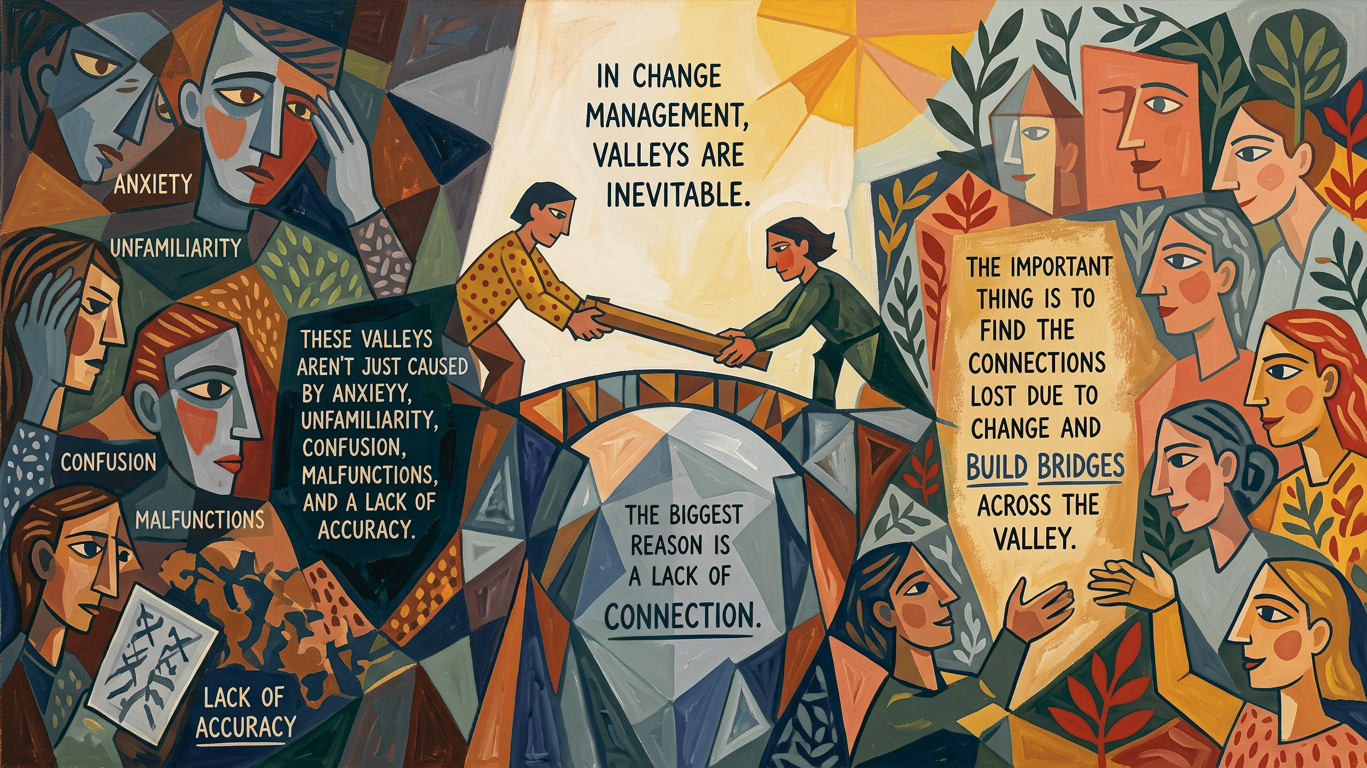
As we launch a new series, ERR& Missing Link, we would like to begin with one hypothesis.
Consultants are often involved as companions in transformation initiatives that affect the entire organization. Through such work, one thing becomes clear.
When HR reform or organizational transformation fails, the problem is not always that the initiative itself is weak.
More often, something is missing.
If we were to describe it in one phrase, it would be a lost “link.”
By “Missing Link,” we do not mean an additional initiative intended to compensate for what is missing. We mean the connection required for an initiative to actually work inside the organization.
A link between operations, decisions, accountability, systems, contracts, culture, and the tacit knowledge held by people on the ground.
Only when these links are in place can reform or transformation actually begin.
If these missing links are not found and addressed quickly, the distortion grows as the transformation progresses.
ERR& Missing Link will explore these missing connections that often become obstacles to reform and transformation.
The first theme is change management.
When HR departments are asked to support change management, many people immediately think of employee communication, communication plans, FAQs, training, town halls, and messages for managers.
Of course, these are important.
But in large-scale organizational transformation, change management is not limited to these activities.
The reason change management fails is not always the quality of the communication or the design of each initiative. In many cases, the real issue is that the links required for those initiatives to function as organizational change are missing.
These links may be operational. They may involve decision-making, accountability, systems, contracts, culture, or the tacit knowledge embedded in the workplace.
For HR departments, change management is often seen as a difficult and troublesome assignment. This is because the role assigned to HR is often associated with communication, organizational role changes, policy revisions, employee explanations, and related support activities, rather than with the design of transformation itself.
But large-scale transformation does not move through communication alone.
Change is often explained through the idea of a “valley of change.”
There will be temporary confusion. There will be a temporary decline in productivity. People will temporarily struggle to adapt. But over time, the organization will adjust to the new state.
This way of thinking has some value in small-scale operational improvements or projects that can be tested and adjusted step by step.
But in large-scale transformations such as M&A, divestitures, carve-outs, PMI, HRIS integration, or payroll migration, it can be dangerous to apply this assumption too easily.
Why?
Because in large-scale transformation, changes do not occur one after another in a clean sequence. They occur simultaneously.
Employment contracts change. Reporting lines change. Approval routes change. Payroll, attendance, and expense processes change. IT accounts and access rights change. Accounting treatment and cost allocation change. Customer and vendor interfaces change. Operational circuits embedded in the old organization are disconnected and reconnected to the new organization.
These cannot be managed through “communication” alone.
A business divestiture provides a useful example.
From the outside, it may look as if the seller has little left to do once the sale price is agreed, and the transaction documents are signed. After that, it may appear that the buyer simply proceeds with integration.
In practice, however, it is not that simple.
A divested business contains countless operational circuits that do not appear clearly in contracts or organization charts.
Who actually approves what? Who knows how exceptions are handled? Which system access rights are indispensable for daily operations? Which customer or vendor interactions depend on the tacit knowledge of specific employees? Which processes still rely on the seller’s finance, IT, legal, or HR infrastructure?
The reason a buyer may want the seller’s executives or key personnel to remain for a certain period is often explained in textbooks as a way to ensure a smooth management transition.
That explanation is not wrong.
But in practice, there is more to it.
What is really needed is to identify, disconnect, and reconnect the contracts, operations, approvals, systems, authorities, and human circuits embedded in the old organization.
And this work cannot proceed smoothly without the cooperation of the seller-side people on the ground.
Here lies the Missing Link in change management.
Change management is not simply a communication activity designed to help people accept change.
At least, it is not only that.
True change management is the work of managing which connections must be cut, which must be preserved, and which must be newly created so that the organization can actually operate in its new state.
Consultants are often involved in these situations. But consultants cannot directly cut these circuits or handle the operational consequences after disconnection.
What consultants can do is identify where the circuits are, clarify who needs to act by when, and encourage coordination among the relevant functions.
But the actual work of disconnecting, reconnecting, and stabilizing those circuits must be done by people inside the organization.
So what should HR do in this context?
Let us consider what HR can do within the framework of Strategic HR.
HR does not replace the work of Legal. HR does not replace the work of Finance. HR does not replace the work of IT.
But HR can see something important.
HR can ask what it means for transferred employees to be ready to work from Day 1 in the new organization.
Agreement on employment terms is not enough. Completion of employee briefings is not enough. A well-designed communication plan is not enough.
Can transferred employees actually continue their work in the new company? Can they access the systems they need? Can they obtain approvals? Will payroll and expenses be processed properly? Can they continue to respond to customers and vendors? Whom do they report to? Who makes decisions? Who holds accountability?
Only when these connections are in place is the transfer practically complete.
In this sense, the role of HR in change management is not merely People Communication.
It is the design of Operational Readiness.
Or, more specifically, it is the work of creating the conditions that allow transferred employees to become productive in the new organization.
HR is not simply looking at the movement of people.
What HR must safeguard is the state in which transferred employees, as human capital, do not lose value in the new organization and can continue to function.
In other words, HR’s role in this situation is to ensure that human capital continues to create value.
This does not mean that HR substitutes for Legal, Finance, or IT.
Legal looks at contracts. Finance looks at the flow of money. IT looks at systems and access.
But HR can assess whether these elements are connected to the working conditions of transferred employees.
Can this person work from Day 1? Are the authorities, approvals, systems, contracts, payroll, expenses, and customer interfaces required for this person to create value properly connected? What must not be broken if this person is to become productive in the new organization? What must be cut, what must be preserved, and what must be reconnected?
Answering these questions is one of HR’s important roles in change management.
Of course, this does not mean that HR should lead every large-scale transformation. Legal, Finance, IT, and business functions each have their own expertise and accountability.
However, from the perspective of enabling people to operate in the new organization, HR may be the function that identifies the Missing Links and connects the relevant functions.
What Strategic HR is asked to do is not necessarily to create corporate strategy itself.
But when business leaders or the organization ask the question, HR must be able to answer from a people and organization perspective:
What is not connected? Where will the organization stop if a link breaks? Which functions and which people on the ground must be connected?
The role of HR in change management is not only to help people accept temporary disruption on the assumption that they are passing through a valley of change.
What matters more is not allowing the valley of change to become an Allowance Period.
A period in which confusion is tolerated. A period in which operational disruption is accepted. A period in which people assume that things can simply be stabilized later.
In large-scale transformation, that assumption is dangerous.
What HR must look at are the links that must not be broken during change.
And when certain links must be cut, HR must understand the sequence in which they should be cut, whose cooperation is needed, and how they will be reconnected.
In large-scale transformation, the questions HR must ask are simple.
Can this person work from Day 1? Can this person continue to create value as human capital? Are the authorities, approvals, systems, contracts, payroll, expenses, and customer interfaces required for that value creation properly connected? Which circuits must be cut? Which circuits must be preserved? Whose cooperation is necessary to disconnect them? Who will be accountable for stable operations after reconnection?
Change Management is not just communication.
It is not merely the work of telling people about change. It is the work of creating the conditions in which people can work in the new organization.
Finding and reconnecting the Missing Link is one of the roles Strategic HR is asked to play in change management.
In change management, what HR must safeguard is not the administrative movement or reassignment of people.
It is the state in which human capital continues to create value in the new organization.(Originally posted on LinkedIn on 2026-07-07)
About Errand Consulting
Errand Consulting explores organizational transformation
through the ERR& Philosophy.
Learn more → www.hrfd3.com
ERR& Missing Link #1
ストラテジックHRに求められるもの
チェンジマネジメントにおける人事の役割:Beyond Communication
今回、ERR& Missing Link という新しいシリーズを立ち上げるにあたり、私たちには一つの仮説がある。
コンサルタントは、会社全体に影響を及ぼす変革や改革に、伴走者として関わることがある。 その中で気づくのは、人事改革や組織変革が機能しないとき、必ずしも施策そのものが弱いわけではないということである。
むしろ多くの場合、そこには何かが欠けている。
それを一言で表すなら、失われた「つながり」である。
ここでいう Missing Link とは、欠けたものを補うための追加施策そのものではない。 施策が組織の中で機能するために必要な接続条件のことである。
業務、意思決定、責任、システム、契約、文化、あるいは現場の暗黙知とのつながり。 これらがつながって初めて、改革や変革は実際に動き出す。
このつながりの欠損を速やかに発見し、対応していかなければ、改革が進むにつれてひずみは大きくなる。
ERR& Missing Link では、改革や変革の妨げとなる、こうした「つながり」の欠損をテーマにしていきたい。
第一回のテーマは、チェンジマネジメントである。
企業の中で人事部門が担当するチェンジマネジメントというと、多くの場合、従業員への説明、コミュニケーションプラン、FAQ、研修、タウンホール、マネージャー向けメッセージなどが想起される。
もちろん、それらは重要である。
しかし、大型の組織変革におけるチェンジマネジメントは、本来それだけではない。
チェンジマネジメントがうまくいかない理由は、施策そのものの巧拙だけにあるとは限らない。 むしろ、個々の施策を組織変化として機能させるために必要な「つながり」が欠けている場合がある。
この「つながり」は、業務上の接続であることもあれば、意思決定、責任、システム、契約、文化、あるいは現場の暗黙知との接続であることもある。
人事部門にとって、チェンジマネジメントはしばしば面倒で厄介な仕事として見られる。 なぜなら、人事が担う領域は、変革そのものの設計というよりも、変革に伴うコミュニケーション、組織上の役割変更、制度改定、説明対応などに寄りがちだからである。
しかし、それだけでは大型変革は動かない。
しばしば変革は「変革の谷」を前提に語られる。
一時的に混乱する。 一時的に生産性が落ちる。 一時的に現場が戸惑う。 しかし、時間が経てば新しい状態に適応していく。
この考え方は、小規模な業務改善や、段階的に試行錯誤できるプロジェクトでは一定の意味を持つ。
しかし、M&A、事業売却、カーブアウト、PMI、HRIS統合、Payroll移管のような大型変革では、この考え方をそのまま持ち込むと危険である。
なぜなら、大型変革では、変化は順番に起きるのではなく、同時に起きるからである。
雇用契約が変わる。 所属が変わる。 承認ルートが変わる。 給与・勤怠・経費処理が変わる。 ITアカウントやアクセス権限が変わる。 会計処理や費用負担が変わる。 顧客や取引先との接点が変わる。 旧組織に埋め込まれていた業務回路が切断され、新しい組織側につなぎ直される。
これらは、単なる「コミュニケーション」では処理できない。
事業売却を例に考えると分かりやすい。
外から見ると、売り手側は、売却金額が確定し、契約が締結されれば、あとは買い手側が統合を進めるだけのように見える。
しかし実務では、そう簡単ではない。
売却された事業には、契約書や組織図には表れない無数の業務回路が残っている。
誰が実際に承認しているのか。 どの担当者が例外処理を知っているのか。 どのシステム権限がなければ業務が止まるのか。 どの取引先とのやり取りが、特定の現場担当者の暗黙知に依存しているのか。 どの業務が旧会社側の経理、IT、法務、人事の仕組みに残っているのか。
買い手側が売り手側の経営者やキーパーソンを一定期間とどめたい理由は、教科書的には「マネジメント・トランジションを円滑に行うため」と説明される。
それは間違いではない。
しかし実務上は、それだけではない。
本当に必要なのは、旧組織に埋め込まれた契約、業務、承認、システム、権限、人の回路を個別に確認し、切断し、必要なものを新しい組織側につなぎ直すことである。
そして、この作業は、売り手側の現場担当者の協力なしには円滑に進まない。
ここに、チェンジマネジメントの Missing Link がある。
チェンジマネジメントは、人々に変化を受け入れさせるためのコミュニケーション活動ではない。 少なくとも、それだけではない。
本来のチェンジマネジメントは、組織が新しい状態で実際に稼働するために、どの接続を切り、どの接続を残し、どの接続を新しく作るのかを管理する仕事である。
このような場面で、コンサルタントがプロジェクトに関わることは少なくない。 しかし、実際にはコンサルタントが自ら回路を切断したり、切断後の後処理を担ったりすることはできない。
コンサルタントができるのは、どこに切断すべき回路があるのかを指摘し、いつまでに誰が対応すべきかを明確にし、関係部門の連携を促すことである。
しかし、回路そのものを実際に切断し、再接続し、業務として安定させるのは、組織内部の人間である。
では、この中で人事は何を担うべきなのか。
ストラテジックHRという枠組みの中で、人事部門ができうることを考えてみたい。
人事は、法務の専門業務を代替するわけではない。 経理の専門業務を代替するわけでもない。 ITの専門業務を代替するわけでもない。
しかし、人事には見えるものがある。
それは、転籍する社員が新しい組織で Day 1 から働ける状態とは何か、という問いである。
雇用条件が合意されているだけでは不十分である。 説明会が終わっているだけでも不十分である。 コミュニケーションプランが整っているだけでも不十分である。
転籍した社員が、新しい会社で実際に業務を続けられるか。 必要なシステムにアクセスできるか。 承認を受けられるか。 給与や経費が処理されるか。 顧客や取引先に対応できるか。 誰に報告し、誰が判断し、誰が責任を持つのか。
ここまでつながって初めて、転籍は実務上完了する。
この意味で、人事がチェンジマネジメントで担うべき役割は、単なる People Communication ではない。
それは、Operational Readiness の設計である。 あるいは、転籍する社員が新しい組織で戦力化するための接続条件を整えることである。
人事が見ているのは、単なる人の移動ではない。
人事が担保すべきものは、転籍する社員という人的資本が、新しい組織の中で価値を失わず、引き続き機能する状態である。
つまり、人事がこの場面で担うべき役割は、人的資本の価値発揮を担保することである。
これは、法務、経理、ITの役割を代替するという意味ではない。
法務は契約を見る。 経理はお金の流れを見る。 ITはシステムとアクセスを見る。
しかし人事は、それらが転籍する社員の稼働条件としてつながっているかを見ることができる。
その人は Day 1 から働けるのか。 その人が価値を発揮するために必要な権限、承認、システム、契約、給与、経費、顧客接点はつながっているのか。 その人が新しい組織の中で戦力になるために、何が切れてはいけないのか。 何を切り、何を残し、何をつなぎ直さなければならないのか。
この問いに答えることが、チェンジマネジメントにおける人事の重要な役割である。
もちろん、すべての大型変革において人事が全体をリードすべきだという意味ではない。 法務、経理、IT、事業部門には、それぞれ固有の専門性と責任がある。
しかし、人が新しい組織で稼働できる状態をつくるという観点では、人事が Missing Link を発見し、関係部門をつなぐ役割を担うことがある。
ストラテジックHRに求められるものは、必ずしも経営戦略そのものを作ることではない。
しかし、経営や現場から問われたときに、人と組織の観点から、何がつながっておらず、どこが切れると組織が止まり、どの機能とどの現場を接続しなければならないのかを答える必要がある。
チェンジマネジメントにおける人事の役割は、変革の谷を前提に、人々が一時的な混乱を受け入れるように支援することだけではない。
むしろ重要なのは、変革の谷を Allowance Period にしないことである。
混乱しても仕方がない期間。 業務が多少止まっても許される期間。 あとで安定すればよい期間。
大型変革において、そのような前提は危険である。
人事が見るべきものは、変革に伴って切れてはいけない接続である。 そして、切らなければならない接続を、どの順番で、誰の協力を得て、どのように再接続するかである。
大型変革において、人事が問うべきことは単純である。
この人は Day 1 から働けるのか。 人的資本として、価値を発揮し続けられる状態にあるのか。 そのために必要な権限、承認、システム、契約、給与、経費、顧客接点はつながっているのか。 切るべき回路は何か。 残すべき回路は何か。 誰の協力がなければ、その接続は切れないのか。 誰が再接続後の安定稼働に責任を持つのか。
Change Management is not just communication.
それは、人々に変化を伝える仕事ではなく、人が新しい組織で働ける状態をつくる仕事である。
そして、その Missing Link を見つけ、つなぎ直すことこそ、チェンジマネジメントにおいてストラテジックHRに求められる役割である。
チェンジマネジメントにおいて、人事が担保すべきものは、手続きとしての人の異動や再配置ではない。 人的資本が、新しい組織の中で価値を発揮し続けられる状態である。(Originally posted on LinkedIn on 2026-07-07)
About Errand Consulting
Errand Consulting explores organizational transformation
through the ERR& Philosophy.
Learn more → www.jp.hrfd3.com
Comments
Comments settings

LikeCommentShare
Add a comment…
Open Emoji Keyboard
No comments, yet.
Be the first to comment.Start the conversation


コメント