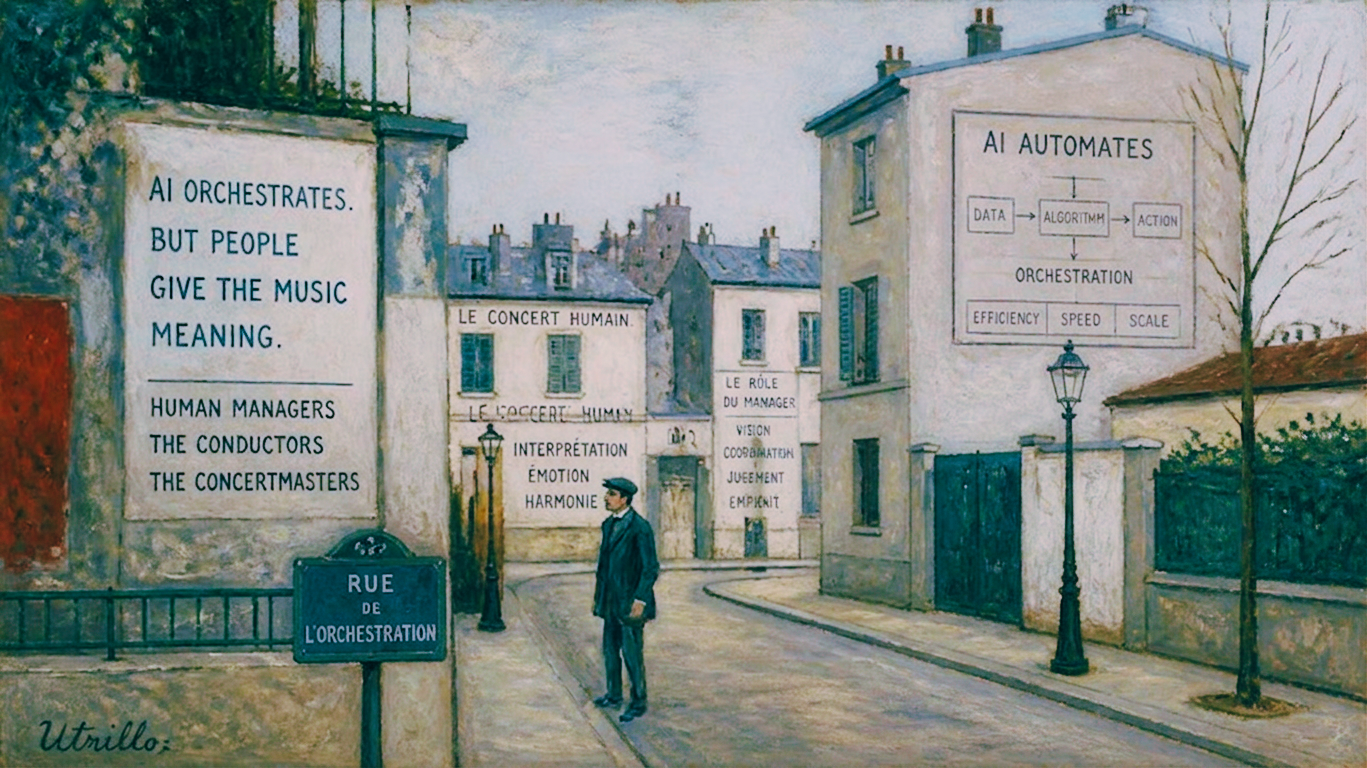
Part 2 — Who Chooses the Concertmaster?
In our previous Insight, we explored AI Orchestration.
We argued that orchestrating AI Agents and Workflows is not the same as orchestrating the enterprise itself through AI.
Our conclusion was:
For management to realize Management Orchestration through AI, organizations will need to redesign not only their Technology Architecture, but also their Management Architecture.
We ended with one question:
Who should become the concertmaster?
Even if every Player in the Orchestra is highly capable, the Orchestra will not perform well if the person who should become the Concertmaster never becomes the Concertmaster.
We believe many people would agree with this.
So, in the age of AI, what kind of person should become the Concertmaster?
Who should choose that person?
Or will AI eventually make that choice?
Before we consider those questions, we have another question to address.
Will DX-AI require managers themselves to become more capable than before?
Or will it require a different kind of Management Capability?
Will AI Make Management Easier?
Since its emergence, IT Technology has continuously improved the efficiency of Management.
To use some familiar examples:
EDI accelerated Transactions between companies.
ERP integrated Processes and Data across enterprises.
BI made Performance more visible.
And now AI is moving one step further.
It can collect information.
Compare alternatives.
Make predictions.
Generate Options.
Recommend Resource Allocation.
And even suggest the next Action as a strategic alternative.
More importantly, these capabilities may become available not only to a limited number of specialists, but to a much broader range of people.
From this perspective, AI may appear to make Management itself easier.
There is no doubt that expectations are extremely high.
But will it really?
For some companies, perhaps it will.
Yet history suggests that improvements in information-processing capability do not automatically create the Management Capability required to increase enterprise value.
EDI and ERP were major technological advances.
But the number of companies that successfully converted those Technologies into sustained competitive advantage and higher enterprise value was not necessarily the same as the number that implemented them.
One reason is that Technology itself eventually becomes a de facto standard across an industry.
A company may be forced out of the market if it fails to adopt it.
But adopting it does not automatically create competitive advantage.
The same may happen with AI.
AI Adoption may become a requirement for staying in the game, but not necessarily a source of competitive advantage.
AI can improve Management Efficiency.
But that alone does not improve Management Quality.
In fact, as the Speed, Reach, and Impact of decision-making increase, the quality of Management may spread through the organization faster and more widely than before.
Good management scales faster.
But at the same time,
Bad management scales faster too.
Do Managers Need to Keep Searching for the Perfect Answer?
Now let us turn to managers themselves — the people who exercise Management Capability.
Managers in the age of AI do not necessarily need to find an answer better than AI for every decision.
Many Business decisions can only be judged as right or wrong after the outcome becomes visible.
Product Pricing.
Marketing.
Resource Allocation.
New Customer Segments.
New Processes.
In decisions like these, continuing to search for the perfect answer may be less valuable than selecting a sufficiently reasonable second-best proposed by AI, executing it, implementing it in the organization, and seeing the result quickly.
Organizations may capture first-mover advantage while improving their risk resilience by shortening the PDCA Cycle.
If AI eventually becomes so advanced that even first-mover advantage disappears, the situation may change.
But at least for the foreseeable future,
Accuracy of the first decision
may sometimes matter less than
Speed and quality of correction.
If AI can provide a certain level of Decision Accuracy, Management may be able to create sufficient Performance by shortening the PDCA Cycle and correcting mistakes quickly.
In other words, Management Capability in the AI era may be measured not only by the ability to be right from the beginning, but also by:
how quickly management can correct itself when it is wrong.
But not every Decision is reversible.
Consider:
CEO Succession.
Major M&A.
The sale of a Core Business.
Large-scale workforce reductions.
Critical Safety or Compliance decisions.
Some decisions are extremely difficult to reverse once they have been executed.
In such situations, the Management Style of:
“Take the Second Best now and correct it later”
does not work.
So the capability required of managers in the AI era may not be the ability to produce the perfect answer every time.
It may instead be the ability to distinguish:
Which Decisions are good enough to run with a second-best?
and
Which Decisions require management to stop and exercise deeper Judgment?
What Separates a Great Performance from an Accurate One?
Let us return to the Orchestra.
A Conductor does not produce every sound.
There is a Score.
There are Players.
Each Professional performs their own instrument.
And there are parts of the performance that must follow the Score accurately.
Timing must align.
Tempo must be maintained.
The overall Balance must not collapse.
Consistency, Accuracy, and Reproducibility matter.
If AI were eventually capable of completely reproducing an orchestral performance, it might produce an extremely precise performance that follows the Score with remarkable fidelity.
But when a human Orchestra performs a piece of music, interpretation enters the performance.
Where should the Conductor create space?
Where should the music become stronger?
Where should the Soloist be allowed to express more?
The same Score can sound very different depending on the Conductor’s interpretation and discretion.
And when that interpretation is expressed by the Players and reaches the Audience, the result may become something more than simply an accurate performance.
It may become a great performance.
We believe the same may be true of Management.
In the enterprise, the Conductor is Management.
Managers may use AI extensively, but ultimately they must still interpret the Business Context themselves and decide how the enterprise should be led.
AI’s Consistency, Accuracy, and high Reproducibility may work extremely well in areas such as:
Financial Control.
Compliance.
Safety.
Governance.
Mature Core Processes.
But other areas are different.
New Businesses.
Transformation.
Crisis.
Turnaround.
M&A.
The Target may be clear, but the Path toward it may not be.
In these situations, Professionals need discretion, and decisions must be made while circumstances continue to change.
The role of the Conductor is therefore not to know every answer.
It is to decide:
How far should we follow the Score?
Where should we give people discretion?
Where should we experiment quickly, and where should we stop?
Perhaps this is the real Management Capability required in the age of AI.
Not the ability to produce more answers, but the ability to decide:
where to use AI, where to give people discretion, and where management itself must take responsibility for the judgment.
Who Decides What the Right Management Answer Is?
The Conductor has another responsibility.
Reproducing the Score accurately does not necessarily make a Concert successful.
An accurate performance is not always a great performance.
A strong Conductor seeks their own interpretation of the piece while also understanding how the Audience will experience that performance.
We believe the same may apply to Management.
As AI shortens decision-making time and provides a certain level of Accuracy, the difference in Management Quality may increasingly emerge beyond analytical decision-making itself.
Will customers accept the decision?
Can employees execute it?
Will investors support it?
Will suppliers cooperate?
Will regulators and society regard it as legitimate?
Even if AI produces the Analytically Best Option, it will not become Business Performance if Stakeholders do not understand it, accept it, and act on it.
Management Decisions therefore require not only:
Analytical Correctness
but also:
Stakeholder Legitimacy.
The role of Management is not simply to treat the Answer generated by AI as the correct one.
Management must bring the Decision to a point where Stakeholders can understand it, accept it, and participate in its execution.
In other words:
Management must turn an analytically correct Decision into an organizationally executable Decision.
This does not mean accommodating every Stakeholder.
Managers must still exercise their own Judgment.
But if that Judgment cannot be translated into something that the organization and its Stakeholders can execute, it will not create enterprise value.
The ultimate First Best may not always be necessary.
Selecting a reasonable Second Best at the right Time, executing it with Stakeholder support, and correcting it quickly when necessary is an important Management Capability.
Who Is the Concertmaster?
Now we return to the question we left in Part 1.
Who should become the concertmaster?
In this discussion, the Concertmaster is not necessarily the most outstanding Professional in the organization.
We define the Concertmaster as:
the Leader who connects Management Intent with Professional Execution.
The Concertmaster understands what Management is trying to accomplish.
Understands the Business Context.
Understands the language of different Functions and Professionals.
Uses discretion when necessary and sends Signals back to Management when something is wrong.
And connects different Players into one Performance.
In other words:
Management Intent → Concertmaster → Professional Execution
This role was not created by AI.
Strong organizations have always had Leaders who performed this function.
So what changes?
As AI Orchestration shortens the Decision Cycle and increases Execution Speed, Leaders’ judgment can spread through the organization faster and more broadly.
The benefit of having the right Leader becomes greater.
But so does the consequence of putting the wrong Leader in place.
AI Orchestration does not reduce the importance of leadership. It amplifies it.
The more sophisticated AI Orchestration becomes, the more important the Management Decision of who should become the Concertmaster may become.
Does Leadership Development Really Need to Change?
This brings us to a somewhat ironic conclusion.
The age of AI may not require us to invent an entirely new form of Leadership.
Instead, management should take more seriously what it has always been responsible for.
Who should be given the difficult Assignment?
Who can make decisions under ambiguity?
Who can recover after failure?
Who can move people across Functions?
Who earns the trust of Professionals?
And who should be given the next level of responsibility?
Looking at Leadership Development cases that have long been studied at Harvard Business School and other leading Business Schools, future Leaders were not developed or selected through Training Programs alone.
They were given Stretch Assignments.
They gained experience across different Businesses and Functions.
Management looked at results.
Management looked at failure.
Management looked at Recovery.
Senior Management observed people directly.
And then decided the next Assignment.
Leadership Development wasn’t just an HR Program. It was part of the Management Process.
What the AI era may require is not the invention of a new Leadership Development model.
It may require bringing back to the center of Management one of its longstanding responsibilities:
seeing people, giving them difficult work, and choosing the next Leader based on what they actually do.
AI can increase the Speed of Management.
It can provide a certain level of Accuracy.
It can expand the Reach of Execution.
But Management still has to decide:
Who becomes the Concertmaster?
How closely should the organization follow the Score?
Where should Professionals be given discretion?
And where should the Performance ultimately go?
Technology may evolve.
That does not necessarily mean the fundamentals of Management become new.
In fact, as AI increases the Speed and Leverage of Management, those fundamentals may become even more important.
The more powerful the orchestration becomes, the more important leadership becomes.
AI may allow the Orchestra to perform faster and more accurately.
But it is still the Conductor who decides what piece to perform, how it should be interpreted, and who should become the Concertmaster.
Technology may change the orchestra. It does not eliminate the need for the conductor.
That is why, in the age of AI Orchestration, Leadership Development may need to be reconsidered once again as a responsibility of Management itself. (Originally posted on LinkedIn on 2026-08-31)
About Errand Consulting
Errand Consulting explores organizational transformation
through the ERR& Philosophy.
Learn more → www.hrfd3.com
- Part 2 — Who Chooses the Concertmaster?
- Will AI Make Management Easier?
- Do Managers Need to Keep Searching for the Perfect Answer?
- What Separates a Great Performance from an Accurate One?
- Who Decides What the Right Management Answer Is?
- Who Is the Concertmaster?
- Does Leadership Development Really Need to Change?
- ERR& Insight Vol.23
ERR& Insight Vol.23
AI Orchestrationは組織をどう変えるのか?
Part 2 — Who Chooses the Concertmaster?
前回、私たちはAI Orchestrationについて考えました。
そして、AI AgentやWorkflowをOrchestrateできることと、AIによって企業そのものをOrchestrateできることは同じではないと主張しました。
前回のInsightでの私たちの結論は、
経営者がAIによってManagement Orchestrationを実現するためには、Technologyだけではなく、Management Architectureそのものに手を加える必要がある。
というものです。
そして最後に、一つの問いを残しました。
Who should become the concertmaster?
どれだけ優秀なPlayerが揃っていても、Concertmasterになるべき人がConcertmasterにならなければ、Orchestraは上手く鳴らない。
このことについては、多くの方に同意していただけるのではないかと思います。
では、AI時代のManagementにおいて、どのような人材がそのConcertmasterに就くのでしょうか。
そして、それを誰が選ぶのか。
あるいは、AIが選ぶようになるのでしょうか。
私たちは、この問いについて考える前に、もう一つ考えておく必要があると思っています。
それは、
DX-AIは、経営者そのものに、これまで以上に高い能力を求めるのでしょうか。
あるいは、これまでとは異なる能力を求められているのでしょうか。
ということです。
AIはManagementを簡単にするのか
IT Technologyは、その登場以来、長い間Managementの効率を高めてきました。
分かりやすい例を挙げれば、
EDIによって企業間のトランザクションが速くなった。
ERPによって企業全体のProcessやDataが統合された。
BIによってPerformanceが可視化された。
そしてAIは、さらにその先へ進もうとしています。
情報を集める。
比較する。
予測する。
Optionをつくる。
Resource Allocationを提案する。
そして、次に取るべきActionまで、戦略の代替案として示す。
しかも、それを限られた専門家だけではなく、より多くの人が利用できるようになる。
これだけを見ると、AIによってManagementそのものが簡単になるようにも見えます。
また、その期待値が非常に大きいことも事実です。
しかし、本当にそうでしょうか。
もちろん、ある企業にとってはそうかもしれません。
一方、これまでを振り返ってみると、IT Technologyによって情報処理能力が高まったからといって、それを使って企業価値を高めるManagement Capabilityが自動的に生まれたわけではありません。
確かにEDIもERPも、Technologyとしては大きな進化でした。
しかし、それらをManagement Capabilityへ転換し、持続的な競争優位や企業価値の向上につなげられた企業が、Technologyを導入した企業と同じだけ存在したわけではありません。
その理由の一つは、Technologyの実装そのものが、やがて業界全体のDe Facto Standardになっていくことです。
実装しなければ市場からの退出を迫られるかもしれない。
しかし、実装したからといって、自動的に競争優位を得られるわけでもない。
AIでも同じことが起きる可能性があります。
AI Adoption may become a requirement for staying in the game, but not necessarily a source of competitive advantage.
AIはManagementのEfficiencyを高める。
しかし、それだけでManagementのQualityが高まるわけではない。
むしろ、意思決定のSpeed、Reach、Impactが大きくなることで、Managementの良し悪しが、これまで以上に早く、そして大きく組織に伝わるようになる。
Good management scales faster.
しかし同時に、
Bad management scales faster too.
ということです。
正解を探し続ける必要はあるのか
こんどはManagement Capabilityの主体である経営者について考えてみましょう。
AI時代の経営者が、すべての意思決定についてAI以上の正解を見つけなければならないわけではありません。
ビジネスにおける多くの意思決定は、後になって初めて正しかったかどうかが分かるものです。
新商品のPricing。
Marketing。
Resource Allocation。
新しいCustomer Segment。
新しいProcess。
AI時代のこうした判断では、究極の正解を探し続けるよりも、AIが提示した十分に合理的なSecond Bestを選び、実行し、現場に実装し、結果を早く確認した方がよい場合があります。
先行者利益を享受しながら、PDCA Cycleを短くすることでリスク耐性を高める。
AIが究極に進化し、先行者利益さえ享受できなくなる時代が来れば別ですが、少なくとも当面は、
Accuracy of the first decision
より、
Speed and quality of correction
の方が重要になる場面が増えるのではないでしょうか。
AIによって一定水準のDecision Accuracyが得られるのであれば、ManagementはPDCA Cycleを短くし、間違いを早く修正することで十分なPerformanceをつくれるかもしれません。
つまり、AI時代のManagement Capabilityは、最初から正解する能力だけではなく、
間違ったときに、どれだけ早く修正できるか
という能力によっても測られるようになるのかもしれません。
しかし、すべてのDecisionがそうとは限りません。
たとえば、
CEO Succession。
大型M&A。
Core Businessの売却。
大規模な人員削減。
重大なSafetyやComplianceの判断。
一度実行すれば、簡単には元に戻せないDecisionがあります。
こうした場面では、
「まずSecond Bestで走り、後から修正する」
というManagement Styleは通用しません。
つまりAI時代の経営者に必要なのは、毎回究極の正解を出す能力ではなく、
どのDecisionはSecond Bestで走ってよいのか。
そして、
どのDecisionでは立ち止まり、より深いJudgmentが必要なのか。
この二つを見分ける能力なのかもしれません。
名演奏と正確な演奏の差を生み出すものは?
ここで再び話をOrchestraに戻してみます。
オーケストラでは、指揮者はすべての音を自分で出すわけではありません。
Scoreがあります。
演奏者がいます。
それぞれのProfessionalが、それぞれの楽器を演奏します。
そして、Score通りに正確に進めるべき部分があります。
Timingを合わせる。
Tempoを守る。
全体のBalanceを崩さない。
ここではConsistency、Accuracy、そして再現性が重要になります。
仮にAIによってオーケストラの演奏を完全に再現できるようになれば、Scoreに極めて忠実で、精度の高い演奏をつくることはできるでしょう。
しかし、人間からなるOrchestraが楽曲を演奏するときには、そこに解釈が加わります。
どこで間を取るのか。
どこを強くするのか。
どこでSoloistの表現を引き出すのか。
同じScoreでも、指揮者の裁量と解釈によって演奏は変わります。
そして、その解釈がPlayerによって表現され、Audienceに届いたとき、単に正確な演奏ではなく「名演奏」と呼ばれるものになるのではないでしょうか。
私たちは、企業経営にも同じことが言えると考えています。
企業活動において指揮者は経営者です。
経営者はAIを活用しながらも、最後は自らBusiness Contextを解釈し、どのように企業を導くのかを判断しなければなりません。
AIのConsistency、Accuracy、そして高い再現性は、
Financial Control。
Compliance。
Safety。
Governance。
成熟したCore Process。
といった領域と非常に相性がよいでしょう。
しかし一方で、
新規事業。
Transformation。
Crisis。
Turnaround。
M&A。
こうした領域では、Targetはあっても、そこへ至るPathが明確ではありません。
ここではProfessionalに裁量を与え、状況を見ながら判断しなければなりません。
つまり、経営者であるConductorに求められるのは、すべての答えを知っていることではなく、
どこまでScore通りに進めるのか。
どこから裁量を与えるのか。
どこでは早く試し、どこでは立ち止まるのか。
そのManagement Modeを切り替えることなのではないでしょうか。
AI時代に経営者へ求められるのは、より多くの正解を出す能力ではなく、
どこでAIを使い、どこで人に裁量を与え、どこで自ら判断を引き受けるのかを決める能力
なのかもしれません。
経営の正解は誰が決めるのか
そして、オーケストラにおいて指揮者には、もう一つの仕事があります。Scoreを
どれだけを正確に再現しても、それだけでConcertが成功するとは限りません。
正確な演奏であっても、必ずしも名演奏になるわけではありません。
優れた指揮者は、その楽曲における自分なりの正解を求めながら、同時にAudienceがその演奏をどう受け取るのかを考えています。
私たちは企業経営でも、同じことが言えると考えています。
AIによって意思決定の時間が短縮され、一定のAccuracyが確保されるようになれば、Managementの差は、その先に現れる可能性があります。
顧客はその判断を受け入れるのか。
従業員は実行できるのか。
投資家はその判断を支持するのか。
Supplierは協力するのか。
Regulatorや社会から正当性を得られるのか。
AIがAnalytically BestなOptionを提示したとしても、それがStakeholderに理解されず、受け入れられず、組織が動かなければBusiness Performanceにはなりません。
つまりManagement Decisionには、
Analytical Correctness
だけではなく、
Stakeholder Legitimacy
も必要になります。
経営者にとって重要なのは、AIが示したAnswerをそのまま正解とすることではありません。
そのDecisionを、Stakeholderが理解し、受け入れ、実行に参加できる状態まで導く。
言い換えれば、
Analytically correctなDecisionを、Organizationally executableなDecisionへ変える。
これもManagementの仕事です。
もちろん、これはStakeholderへの迎合を意味するわけではありません。
経営者は自らの判断を持たなければならない。
しかし、その判断を組織とStakeholderが実行可能なものに変換しなければ、企業価値にはつながりません。
究極のFirst Bestではなくても、十分に合理的なSecond Bestを適切なTimingで選び、Stakeholderの支持を得ながら実行し、必要なら早く修正する。
それもまた、一つのManagement Capabilityなのだと思います。
Concertmasterとは誰なのか
そこで、Part 1で残した問いに戻ります。
Who should become the concertmaster?
今回の議論におけるConcertmasterは、単に最も優秀なProfessionalではありません。
私たちは、
経営者のIntentとProfessional Executionの間をつなぐLeader
をConcertmasterと考えています。
経営者が何を実現しようとしているのかを理解する。
Business Contextを理解する。
異なるFunctionやProfessionalの言葉を理解する。
必要な場面では自ら裁量を使い、異常があれば経営者へSignalを返す。
そして、異なるPlayerを一つのPerformanceにつなげていく。
つまり、
Management Intent → Concertmaster → Professional Execution
をつなぐLeaderです。
この役割自体は、AIによって新たに生まれたものではありません。
優れた企業には、以前からこのようなリーダーが存在していました。
では、何が変わるのでしょうか。
AI OrchestrationによってDecision Cycleが短くなり、Execution Speedが上がれば、Leaderの判断もこれまで以上に早く、組織全体に広く伝わります。
正しいLeaderを置いたときの効果は大きくなる。
しかし同時に、間違ったLeaderを置くことで、影響も大きくなる。
AI Orchestration does not reduce the importance of leadership. It amplifies it.
だからこそ、AI Orchestrationが高度になるほど、誰をConcertmasterにするのかというManagement Decisionの重要性も高まるのではないでしょうか。
Leadership Developmentは本当に変わるのか
ここまで考えると、少し皮肉な結論に達します。
AI時代だからといって、まったく新しいLeadershipを発明する必要があるわけではないのかもしれません。
むしろ、これまでManagementが行ってきたことを、もう一度本気でやる必要がある。
誰に難しい仕事を任せるのか。
誰が曖昧な状況で判断できるのか。
誰が失敗した後に立て直せるのか。
誰がFunctionを越えて人を動かせるのか。
誰がProfessionalから信頼されるのか。
そして、誰に次の大きな責任を任せられるのか。
Harvard Business Schoolをはじめ、著名なBusiness SchoolのCase Studyで取り上げられてきたLeadership Developmentの事例を見ると、次のLeaderをTraining Programだけで育成・選抜してきたわけではありません。
Stretch Assignmentを与える。
異なるBusinessやFunctionを経験させる。
結果を見る。
失敗を見る。
Recoveryを見る。
Senior Management自身が人を見る。
そして次のAssignmentを決める。
Leadership Developmentそのものが、HR ProgramではなくManagement Processの一部だった。
AI時代に必要なのは、新しいLeadership Developmentを発明することよりも、かつてManagementの重要な責任だった、
人を見て、難しい仕事を任せ、その結果から次のリーダーを選ぶ
というProcessを、もう一度経営の中心に戻すことなのかもしれません。
AIは、ManagementのSpeedを上げることができます。
一定のAccuracyを提供することもできます。
Executionの範囲を広げることもできます。
しかし、
誰をConcertmasterにするのか。
どこまでScore通りに進めるのか。
どこでProfessionalに裁量を与えるのか。
そして、そのPerformanceをどこへ向かわせるのか。
それを決めることは、依然としてManagementの仕事です。
Technologyが進化したからといって、Managementの本質まで変わるわけではないのかもしれません。
むしろ、AIによってManagementのSpeedとLeverageが高まるほど、これまで当たり前だと考えられてきたManagementの基本が、より重要になる。
The more powerful the orchestration becomes, the more important leadership becomes.
AIはOrchestraをより速く、より正確に演奏させることができるかもしれません。
しかし、どの楽曲を、どのように演奏し、誰をConcertmasterにするのかを決めるのは、今も指揮者です。
Technology may change the orchestra. It does not eliminate the need for the conductor.
だからこそAI Orchestrationの時代には、Leadership Developmentそのものを、もう一度Managementの仕事として考える必要があるのではないでしょうか。(Originally posted on LinkedIn on 2026-08-31)
About Errand Consulting
Errand Consulting explores organizational transformation
through the ERR& Philosophy.
Learn more → www.jp.hrfd3.com


コメント