Corporate management is a living organism. There are good times and bad times. When business performance deteriorates, companies activate their “budget adjustment function” and begin cutting items that appear non-essential. And in HR, the first target is always the training budget.
1. Why the Cut Seems Rational
In accounting, training expenses are classified as variable costs. When revenue targets are missed, they are grouped with advertising or sales expenses as “costs that can be cut immediately.”
Because reducing them does not visibly worsen short-term financial results, cutting the training budget often appears rational as part of the managerial adjustments.
Moreover, the ROI of training is further difficult to measure. Unlike revenue or profit, learning outcomes cannot be converted into KPIs compared with other expense items. To institutional investors, training appears to be an ambiguous expense and therefore becomes an easy target for reduction.
2. But the Real Problem Is Not the Cost
The real issue is that HR organizations often lack a model to measure or explain the effect of training.
As a result, many companies repeat the same cycle: adopting trendy programs during good times, and pausing all training activities during downturns. Over time, this reinforces the perception that “training has no visible effect.”
3. Our Proposal: Human-Centric Learning Curve Model
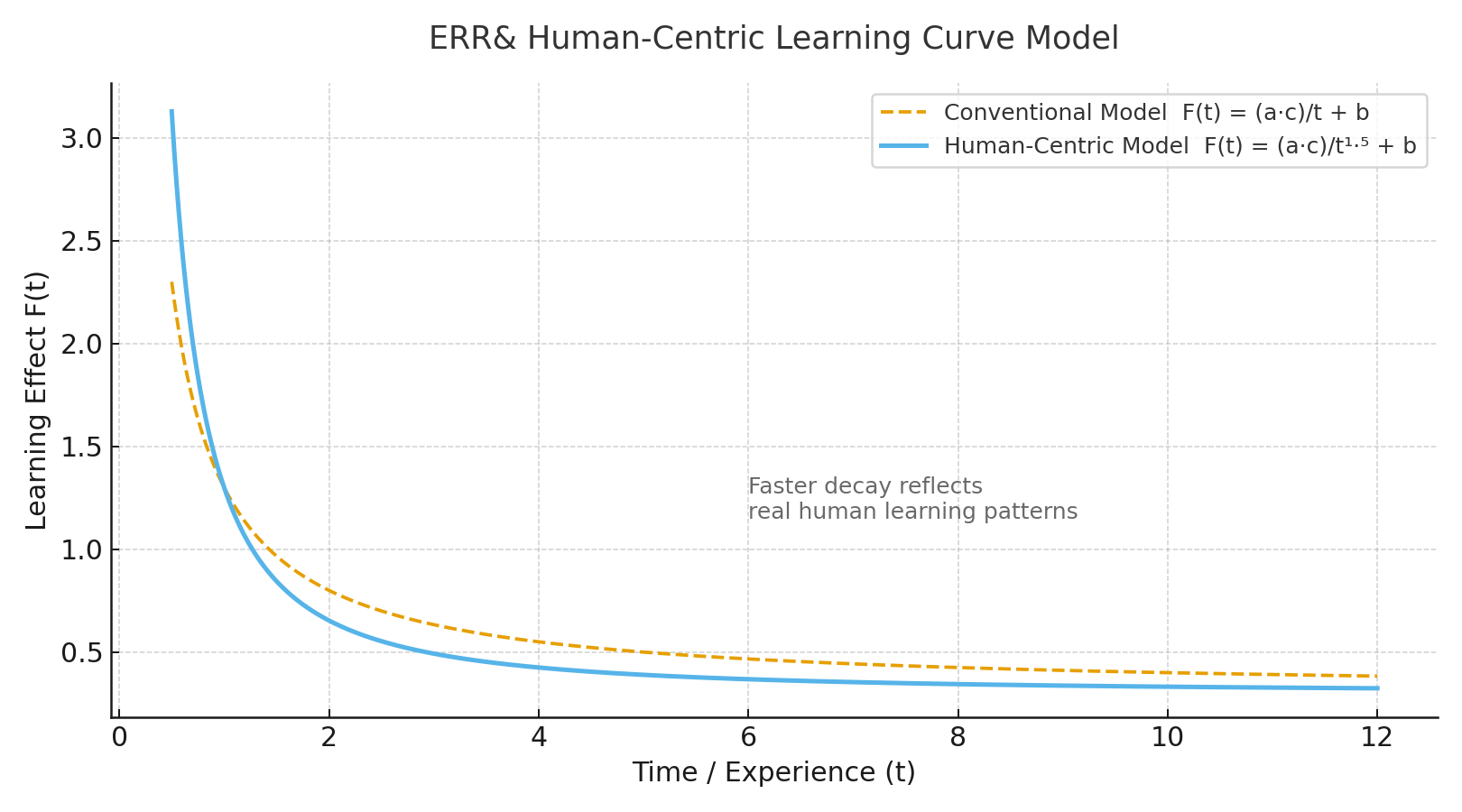
To visualize learning effectiveness, we propose the following human-centric model:

Where:
- F(t) = learning effect
- t = time or experience
- a = individual readiness/engagement
- c = organizational learning agility (the environment that enables learning)
- b = individual baseline capability, prior experience, or goodwill
Compared with the conventional 1/t model, this t⁻¹·⁵ model reflects a much faster decline in learning momentum, consistent with real human behavior such as loss of focus, habituation, and saturation.
In other words, learning fades faster than organizations assume. And the impact of any training program depends heavily on what the individual already knows and has experienced (b), which we keep constant here to simplify the model.
4. Executives Intuitively Understand This Rapid Decay
Executives and CFOs know—through experience, not data itself— that learning effects fade quickly.
As the term (a × c) / t¹·⁵ rapidly shrinks over time, training outcomes disappear unless b (goodwill or accumulated capability) grows.
This is why training budgets are the first to be cut: leaders intuitively understand the structural decay of training effectiveness.
5. What the Model Tells Us
The effectiveness of training is not determined primarily by the program itself. It is determined by:
- a: individual readiness
- c: organizational learning agility
- b: accumulated individual capability
No matter how excellent the training program is, if these conditions are weak, learning effects will fade.
HR’s role, therefore, is not to easily add more good programs. It is to redesign the learning soil— the environment that supports a, c, and b.
Budget cuts may be unavoidable. But the one thing that must never be cut is the mechanism that increases b — the individual’s baseline capability and goodwill.
6. Next in the Series
In the next ERR& Tips, we will extend this model by introducing b(t) as a time-dependent function and explore how to sustain and reinforce learning effects over time.
(Originally posted on LiknkedIn on 2025-10-12)
About Errand Consulting
Errand Consulting explores organizational transformation
through the ERR& Philosophy.
Learn more → www.hrfd3.com
なぜ教育研修費は削減のスケープゴートになるのか
企業経営は生き物である。良い時もあれば、悪い時もある。 業績が悪化したとき、企業は「予算調整機能」を使って“不要に見える”費用を削減する。 そして人事部門では、最初に削られるのが教育研修費である。
1. 経営合理性としての削減
会計上、教育研修費は「変動費」に分類される。 収益未達の局面では、営業費や広告費と同列に**“すぐ削れるコスト”**として扱われる。 短期的には削っても外部から業績悪化として認識されにくいため、 財務調整の手段として合理的に見えてしまう。
さらに教育研修はROI(投資対効果)の測定が難しい。 売上や利益のようにKPI化しにくいため、 機関投資家の目には「曖昧な支出」として映る。 したがって、財務的観点からは削減が“理にかなっている”ように見える。
2. しかし問題は「費用」ではない
真の問題は、人事部門が教育研修の効果を測る明確なモデルを持たないことである。 多くの企業では、好況時には流行の研修を導入し、 不況になると一斉に中止する。 これを繰り返すうちに、「教育は効果が見えないもの」として扱われてしまっている。
3. 私たちの提案:Human-Centric Learning Curve Model
教育研修の効果を測定するために、 私たちは次のような“人間中心の学習モデル”を考案した。

ここで:
- F(t):学習効果(Learning Effect)
- t:時間または経験(Time / Experience)
- a:個人のレディネス(Engagement / Learning Readiness)
- c:組織のラーニングアジリティ(Organizational Learning Agility)=学ばせる環境係数
- b:基礎能力・該当領域の経験値・Goodwill(個人の基礎値)
この式では、従来の「1/t」型モデルよりも減衰速度が速い。 これは現実の人間の学習特性──集中の低下、習慣化、飽和──を反映している。 つまり、学びの勢いは急速に失われる。
また教育プログラムの効果は、結局のところ教育を受ける個人の持っている知識や経験に最も影響を受ける。 ここではモデルをシンプルにするため、bを固定値として扱う。
4. 経営者はこの“急減衰”を感覚的に理解している
CEOやCFOは財務データだけでなく、 「教育効果は時間とともに急速に薄れていく」という現象を経験的に知っている。 この式のように、主要項 (a × c) / t¹·⁵ は時間経過とともに急速に小さくなり、 b(Goodwill)が育たなければ、学びは組織に残らない。
だからこそ、教育費は真っ先に削られる。 彼らは「教育が効かなくなる構造」を感覚的に理解しているのである。
5. モデルが示唆すること
教育研修の効果を決めるのは研修プログラムそのものではなく、 a(個人のレディネス)、c(組織のアジリティ)、そして b(個人の蓄積) である。 どんなに優れた研修であっても、 これらの条件が整っていなければ、学習効果は半減する。
したがって人事部門が取り組むべきは、 「プログラムを増やすこと」ではなく、 学びの土壌=a・c・bを支える環境の再設計である。
教育研修費の削減は避けられない場合もある。 しかしそのときに本当に削ってはいけないのは、 b=個人の基礎値(Goodwill)を増やしていく仕組みなのだ。
6. 次回予告
次回は、このモデルを発展させて b(t) を時間の関数として扱い、 「研修効果を持続的に定着させるためには何が必要か」を考えていく。
About Errand Consulting
Errand Consulting explores organizational transformation
through the ERR& Philosophy.
Learn more → www.hrfd3.com


コメント