
In every organization, learning budgets carry a quiet irony. They symbolize a commitment to people—yet when the economy shifts, they are the first to vanish. This pattern is not new, but the reason behind it is often misunderstood.
A simple model helps us see the truth more clearly:
F(t) = (a × c) / t^1.5 + b
Here, learning effectiveness is shaped by:
- a:the readiness of the individual
- c:the learning agility of the environment
- b:the foundation each person brings
- and the inevitable decline captured by 1/t^1.5
The model reveals what many executives quietly sense: training produces a short-lived spike, followed by a rapid fade. This intuition—accumulated through years of organizational experience—makes cutting training budgets seem rational. After all, the organization does not collapse the next day.
But perhaps the true issue is not training itself. Perhaps what is missing is the architecture that sustains learning after the session ends.
Beyond Training: The Case for b(t)
To explore this, we replaced the constant b with b(t)—the actual learning accumulated after training.
F(t) = (a × c) / t^1.5 + b(t)
Because learning does not transform people on the day of delivery. The real transformation happens later, in the quiet spaces where individuals:
- try something new,
- fail safely,
- succeed unexpectedly,
- repeat intentionally, and
- eventually turn knowledge into habit.
This is b(t)—the compounding effect of lived practice. Ironically, it is also the part organizations have historically been unable to support. HR is not a school. Follow-up, coaching, reinforcement—these were luxuries, not realities.
Thus, learning decayed. And CFOs, observing this cycle for years, made a logical judgment: training is expendable.
AI: A Quiet, Structural Shift
But the landscape has changed.
AI has turned E-learning from a digital shelf of videos into a personal learning ecosystem— a companion that understands how humans grow.
AI can now:
- detect weak points in real time
- adjust review timing
- personalize content based on role and trajectory
- answer questions without delay
- integrate learning into daily work rhythms
It does not replace human effort. It amplifies it—quietly, persistently, respectfully.
In ERR& terms, AI enables organizations to Engage individuals continuously, respect their differences, and Relate learning to each person’s actual journey.
AI makes b(t) real.
A Second Transformation: Rethinking the Annual Review
AI does more than support learners. It reshapes the structure around them.
As micro-coaching becomes embedded in work and progress is tracked automatically, the annual review shifts from a backward-looking ritual to a forward-looking catalyst.
What emerges is d(t)—an organizational boost that reignites learning:
d(t):the annual reset that gives direction, clarity, and momentum
This shift reframes performance conversations:
- from “How did you perform?”
- to “Where are you growing next?”
From judgment to readiness. From evaluation to acceleration.
In this sense, d(t) is the moment a stalled learner moves from 0 to 1.
When combined with AI-supported E-learning, learning is no longer voluntary; it becomes a guided journey that aligns individual aspiration with organizational intent.
The Integrated Model—Learning as Architecture
Bringing these pieces together, learning effectiveness takes its full shape:
F(t) = (a × c × {1 + d(t)}) / t^1.5
+ b0 × (1 − e^(−k·t)) + d(t)
This model reflects the essence of human growth:
- readiness,
- environment,
- practice,
- encouragement,
- and the passing of time.
It also reveals a simple truth: training was never the whole story—and never should have been.
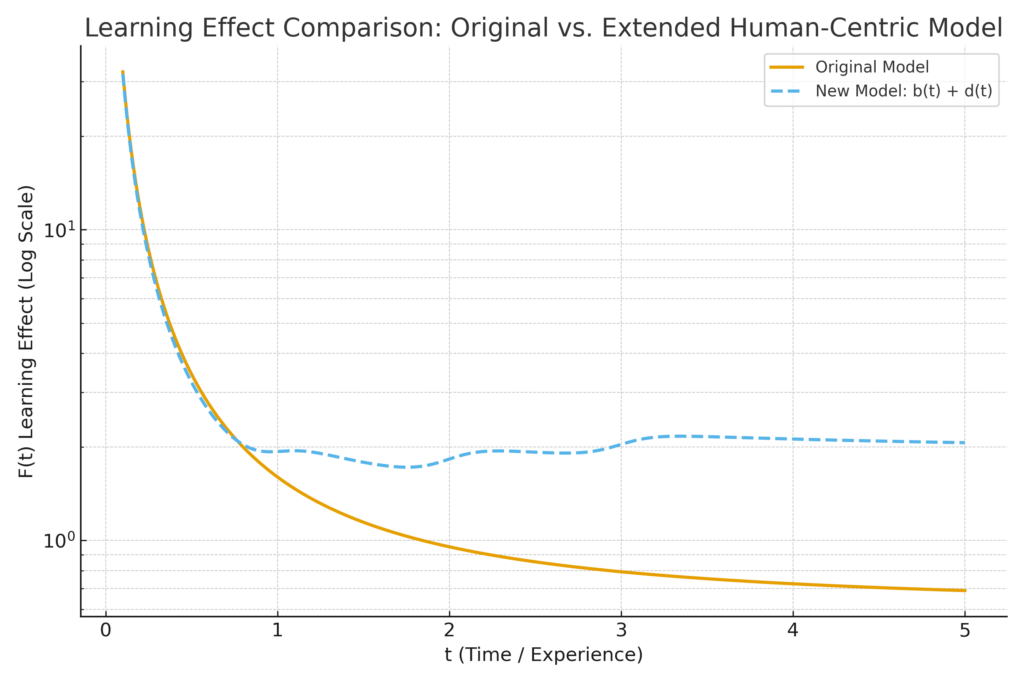
What the Curve Shows Us
When we plot the model, the contrast is striking.
- The traditional curve drops sharply—learning evaporates.
- The integrated curve softens, stabilizes, and even lifts over time.

It tells us:
Learning effectiveness is not a matter of budget. It is a matter of design.
And design is leadership.
L&D as the Architect of Human-Centric Transformation
The implications are profound.
L&D must move beyond managing programs. Its future role lies in designing the conditions where learning becomes inevitable:
- cultivating b(t) through systems of continuous reinforcement
- shaping d(t) through human-centric evaluation
- elevating c by embedding learning into the fabric of work
- activating a through meaningful engagement
- and using AI to support humans, not replace them
In short:
L&D is no longer the training department. It is the architect of organizational capability.
Hopefully, this is a Human-Centric Transformation.
Note: The model introduced in this article is not a mathematical predictor of learning performance. It is a conceptual framework designed to illuminate the drivers of learning and guide strategic decision-making in HR and L&D.(Originally posted on LinkedIn on 2025-10-15)
About Errand Consulting
Errand Consulting explores organizational transformation
through the ERR& Philosophy.
Learn more → www.hrfd3.com
なぜ企業はまず研修予算を削るのか── そしてAI時代のL&Dは何者であるべきか**
企業における研修予算には、静かな逆説がある。 「人への投資」を象徴するはずのそれが、景気が悪くなると真っ先に削られてしまう。 多くの企業で繰り返されてきた光景だ。
前回紹介したシンプルなモデルは、この現象の背景を鮮明にする。
F(t) = (a × c) / t^1.5 + b
ここで学習効果を決めるのは、
- a:個人のレディネス(学ぶ構え)
- c:環境のラーニングアジリティ
- 1/t^1.5:時間とともに学びが薄れる特性
- b:個人がもつ基礎力
という構造だ。
このモデルが示すのは、避けがたい現実である。 研修直後には急激に学習効果が高まるが、その後は驚くほどのスピードで減衰していく。 CEO や CFO は、この“急減衰”を経験則として知っている。 だから研修予算が最初に切られる。 翌日から組織が崩れるわけではない、と。
しかし問題は研修そのものではない。 本質は、研修「後」の学びを支える設計が存在しないことにある。
◆ 研修では人は変わらない。変わるのは「その後」である
そこで b を b(t) に書き換えた。
F(t) = (a × c) / t^1.5 + b(t)
人が変わるのは研修の瞬間ではない。 学びを持ち帰り、実践し、失敗し、また試し、小さく成功し、習慣になったときだ。
これが b(t) ――学びの複利である。 しかし企業の L&D は、これを支える仕組みを持てなかった。 人事は学校ではない。 フォローも、復習管理も、個別コーチングも、現実的には不可能だった。
だから研修効果は薄れ、研修予算は“簡単に削れる費用”とみなされてきた。
◆ AIが b(t) に“命”を吹き込む
状況は変わった。 AIの登場によって、E-learning は“動画置き場”ではなく、 個人に寄り添う学習エコシステムへと変わりつつある。
AI は以下を可能にする。
- 研修中の弱点を分析する
- 個人の職務や学習パターンに合わせる
- 最適な復習タイミングを提示する
- 不明点をその場で解決する
- キャリアに沿った学びを提案する
AIは人を代替しない。 人を静かに支え、学びの動力を絶やさない存在になる。
ERR&で言えば、AIは Engage(関わり)、Respect(違いを尊重し)、Relate(つなぐ)という 学びの土台を静かに支えてくれる。
AIは、b(t) を「現実のもの」にした。
◆ もう一つの変化:年次評価という d(t)
AI が変えるのは L&D だけではない。 年次評価もまた、新しい意味を持ち始めている。
進捗は週次で自動記録され、マイクロコーチングが日常化する。 この環境では、年次評価はもはや“過去を振り返る儀式”ではない。
それは、
- 次の成長テーマを設定し、
- 学びの方向性を定め、
- 必要な支援を明らかにし、
- 個人をもう一段前へ押し出す
“学習の起動装置”となる。 これをモデルに組み込んだのが d(t) である。
d(t):学びに方向と火を与える外的ブースト
年次評価は、b(t)=0 の人を 1 に引き上げるための最初の一歩でもある。
◆ すべてを統合した学習効果のモデル
AI、E-learning、年次評価―。 これらは最終的に以下のモデルで統合される。
F(t) = (a × c × {1 + d(t)}) / t^1.5
+ b0 × (1 − e^(−k·t)) + d(t)
これは人がどのように学び、 組織がどのように学ばせるかという 学びの本質がそのまま形になったモデルだ。
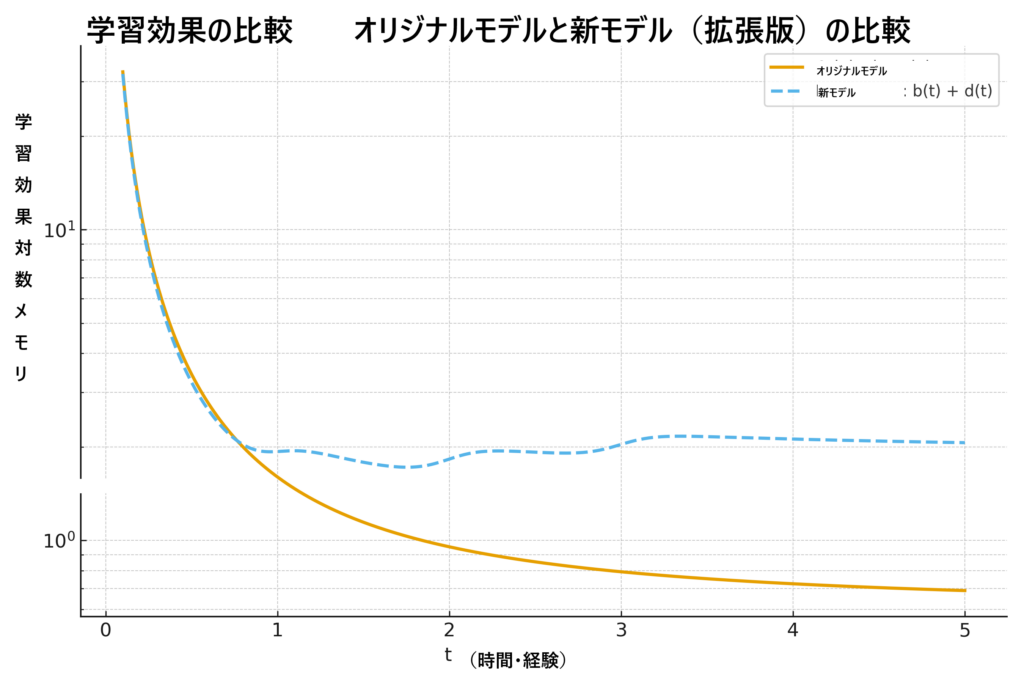
◆ グラフはひとつの真実を示す
従来モデルでは、学習曲線は急落する。 しかし b(t) と d(t) を取り入れると、曲線は穏やかになり、安定し、 時にわずかに上向きさえする。

メッセージは明確だ。
学習効果は、デザインすれば維持できる。
◆ L&Dは“研修屋”ではなく、組織の未来をつくる設計士へ
L&D に求められる役割は劇的に変わった。
- b(t) をどう立ち上げるか
- d(t) をどう再設計するか
- c をどう高めるか
- AI と E-learning をどう組み合わせるか
L&D の仕事は、研修運営ではない。 組織の学習力そのものを設計することである。 つまり、組織の未来を創る“建築士”だ。
これこそが我々の考える Human-Centric Transformationだ。
(注)本稿で扱った数式は、学習効果を厳密に測定することを目的としたものではありません。人事・L&D が学びの構造を捉え、戦略的に介入すべき領域を明らかにするための概念モデルです。
About Errand Consulting
Errand Consulting explores organizational transformation
through the ERR& Philosophy.
Learn more → www.hrfd3.com

コメント