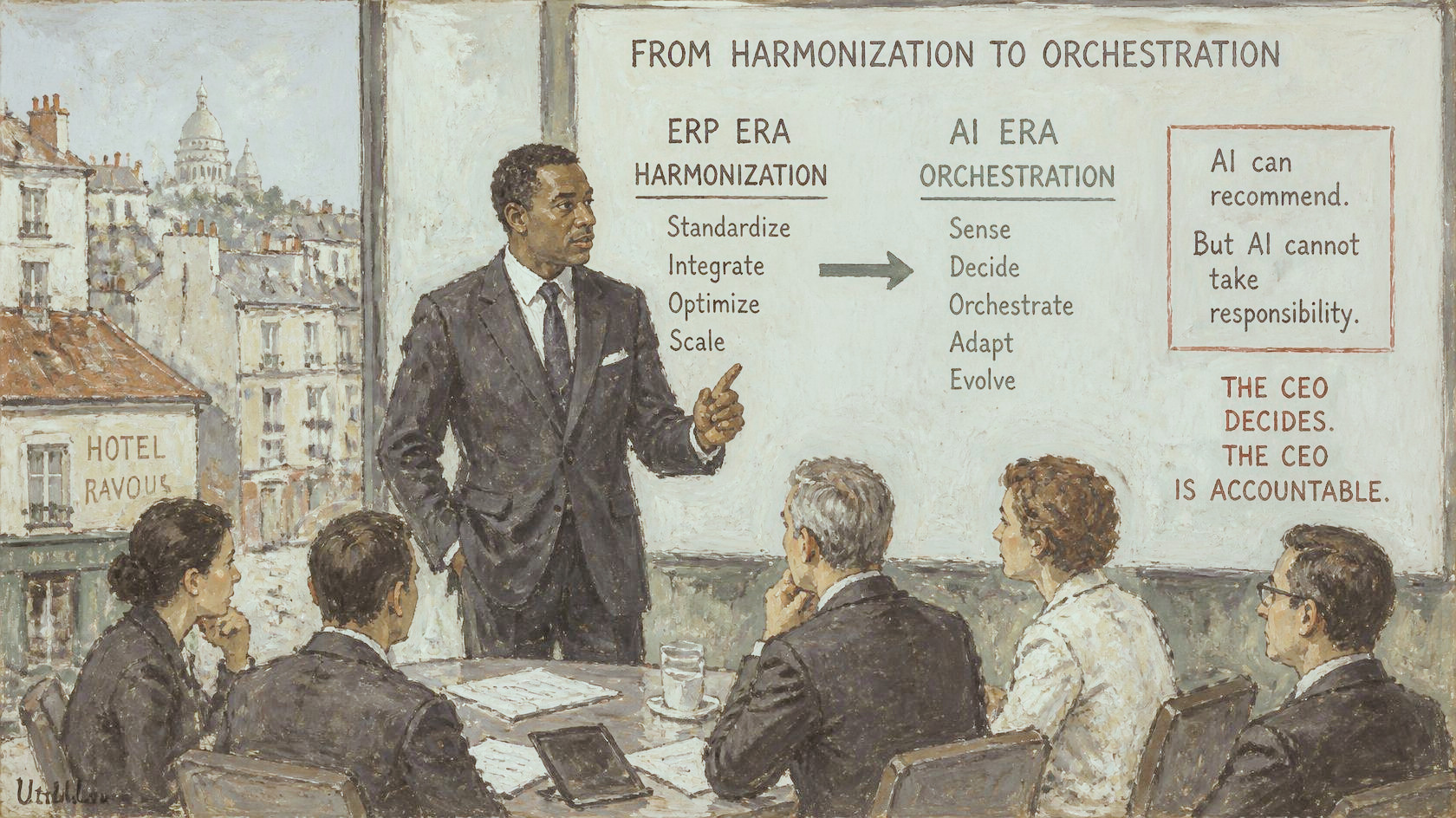
- Part 1 — From Harmonization to Orchestration
- ERP and Harmonization
- Orchestration Does Not Move in Exactly the Same Direction
- AI Orchestration and Management Orchestration Are Not the Same
- Where Does Orchestration Create the Most Value?
- Harmonized Core and Orchestrated Edge
- Can Orchestration Eliminate Organizational Fragmentation Caused by Local Optimization?
- Is a Fully Orchestrated Organization Really Stronger?
- Will the Orchestra Really Play?
- ERR& Insight Vol.23 AI Orchestrationは組織をどう変えるのか?
- Part 1 — HarmonizationからOrchestrationへ
- ERPとHarmonization
- Orchestrationは同じ方向には進まない
- AI OrchestrationとManagement Orchestrationは同じではない
- Orchestrationが最も力を発揮するのはどこか
- Harmonized CoreとOrchestrated Edge
- Orchestrationは組織の断片化をなくすのか
- 完全にOrchestratedされた組織は本当に強いのか
- Orchestraは本当に鳴るのか
Part 1 — From Harmonization to Orchestration
As AI implementation accelerates, the term “Orchestration” is increasingly used by major consulting firms and global companies as a new concept in discussions of Organization Development and Operating Models.
In the early 2000s, when ERP implementation was expected to fundamentally reshape global organizations, another term was frequently used in management discussions:
Harmonization.
Today, with the rise of AI, orchestration is emerging as the next Management Principle.
We see this as an important shift.
Through Orchestration, organizations may increasingly be able to:
Combine multiple AI Agents.
Identify operational bottlenecks.
Allocate information and capabilities to the right place.
Reconfigure workflows as circumstances change.
With the evolution of Agentic AI, we expect more global organizations to adopt such mechanisms.
But being able to orchestrate AI Agents and workflows is not the same as enabling management to orchestrate the company itself.
Enterprise-wide Management Orchestration cannot be achieved simply by implementing the necessary AI Platform.
It may also require changes to the Management Architecture itself.
And this is where Orchestration begins to differ from the Harmonization that accompanied the ERP era.
ERP and Harmonization
During the 2000s, Harmonization became a widely used concept among global companies.
Alongside ERP and Global HRIS implementation, organizations aligned their processes, Data, Policies, and systems, which had previously differed across countries and businesses.
The objective was not necessarily to standardize everything.
Necessary Local Differences could remain, while the enterprise as a whole achieved greater consistency.
At the time, Harmonization was one of the important Management Principles for maximizing the Return from large Technology Investments in ERP.
The logic was relatively clear.
More variation made Systems more complex.
Aligned Processes created Scale Benefits.
Aligned database Entry definitions enabled organizations to view the enterprise through common perspectives.
In that sense, Harmonization was also a Transformation designed to maximize one of ERP’s fundamental characteristics:
Creating value by reducing Variation.
Orchestration Does Not Move in Exactly the Same Direction
The value of AI Orchestration, however, is not limited to reducing Variation.
AI may allow organizations to standardize Processes that could not previously be standardized.
It may also make previously incomparable structures more comparable.
In other words, AI can strengthen Harmonization itself.
But its potential goes beyond that.
Different AI Agents.
People with different areas of expertise.
Different Local Markets.
Different Systems.
Different Capabilities.
Rather than forcing them into a single common form, Orchestration can combine them in different ways when needed.
It can then continue selecting the most reasonable Option available at a given moment in pursuit of the Business Goal.
In simple terms:
Harmonization aligns differences.
It raises productivity through Efficiency.
By contrast,
Orchestration uses differences.
It raises Business Value through Optimization.
This is an important distinction.
ERP improved Efficiency and Control within a common Architecture.
AI Orchestration seeks to improve Adaptability by dynamically combining different Capabilities.
AI+Orchestration, therefore, may not simply sit on the same continuum as ERP+Harmonization.
And the people most affected by this change may ultimately be senior management.
The information generated by AI will not be limited to historical Performance presented under common Definitions, as was often the case with ERP.
AI may increasingly provide possible Options and suggest what Action could be taken next based on changing circumstances.
AI Orchestration and Management Orchestration Are Not the Same
The Orchestration offered by AI vendors generally connects Agents, Systems, and Workflows, decomposes Tasks, assigns processing, and changes the next Action depending on the result.
This is, in effect, the Optimization of Execution.
Management, however, must make decisions one level above this.
What should the Target be?
What are the Constraints?
Who has the authority to make which decisions?
Where should different Capabilities be allocated?
How should Performance be evaluated?
Who ultimately retains Accountability?
In this article, we use the term Management Orchestration to describe a management mechanism that dynamically combines not only AI but also people, capital, and organizational Capabilities in pursuit of Business Goals.
To make that possible, organizations need a Management Architecture that connects AI with management decisions.
Management Architecture, in this context, connects Objective, Decision Rights, Capability Allocation, Performance, and Accountability under a common set of management principles.
In other words:
AI Orchestration is a Technology Architecture issue. Management Orchestration is also a Management Architecture issue.
Treating the two as if they were the same requires caution.
Where Does Orchestration Create the Most Value?
Should global companies therefore pursue Orchestration across the entire enterprise?
We do not necessarily think so.
AI Orchestration may be particularly powerful in areas where:
The target is relatively clear, but the Path toward it remains uncertain.
Consider a new business.
There may be a Revenue or EBITDA Target.
But many questions remain.
Which Customer Segment should be pursued?
Which products should be scaled?
Which Markets should be entered?
Which Capabilities should remain internal, and which should come from external sources?
As new information emerges, the best Option may change.
In these situations, looking only at the current state is not enough.
Why are we where we are today?
Which hypotheses have already been tested?
What failed?
Which decisions created the Options that remain available?
By tracing that Narrative and continuously selecting the Next Best Option toward the Target, Agentic AI may create significant value.
But what about an established Cash Cow Business?
The situation may be very different.
Customers are known.
The Demand Structure is relatively stable.
Processes are established.
Margin Structures are visible.
KPIs are functioning.
If AI continuously searches for alternative Options and repeatedly reallocates Resources in such an environment, the result may become Noise.
A Process considered correct yesterday may be changed due to a short-term Signal, only to be changed back several months later.
Optimization may begin to undermine Operational Stability.
In other words:
When both the Target and the Path are already known, enhancing a Harmonized Architecture with AI may sometimes be more rational than pursuing Orchestration.
This remains a hypothesis.
But we believe the possibility that excessive Optimization may create Noise in otherwise stable businesses should not be ignored.
Harmonized Core and Orchestrated Edge
If so, the most realistic path for established global companies may not be:
A full Transformation from Harmonization to Orchestration.
A more practical approach may be to distinguish between:
Harmonized Core
and
Orchestrated Edge.
Financial Definitions.
Data Governance.
Compliance.
Basic Decision Rights.
Enterprise Risk.
Areas that should remain common across the organization can remain part of the Harmonized Core.
This can help prevent the organization itself from becoming fragmented through excessive Optimization, while avoiding unnecessary Transformation in areas that do not require Orchestration.
Meanwhile, Orchestration can be applied selectively to areas with high Path Uncertainty and meaningful potential for Incremental Value.
New businesses.
R&D.
Transformation.
Specific Customer Journeys.
This may be more realistic from both a Technology Investment and a Management Risk perspective.
The question should not be whether Orchestration itself is desirable.
The more important question is:
Where does orchestration create enough incremental value to justify the investment?
And that Investment is not limited to the AI Platform.
Data Architecture.
System Integration.
Capability Visibility.
Decision Rights.
Performance Measurement.
Governance.
Human Capability.
Organizations must also consider the cost of changing the Management Architecture itself.
Can Orchestration Eliminate Organizational Fragmentation Caused by Local Optimization?
Another attractive promise of Orchestration is that it may reduce organizational fragmentation.
As organizations grow, Businesses, Functions, and Countries tend to develop their own objectives.
Sales pursues Revenue.
Finance protects Cash.
Operations pursues Efficiency.
HR looks at Headcount and Capability.
If Orchestration can connect these toward a common enterprise Target, it may reduce function bias and people bias and move the company closer to Enterprise Optimization.
But there is an opposite risk.
If Objectives, Data, and Decision Rights remain fragmented while Orchestration becomes more sophisticated, each Function may become better and faster at optimizing itself.
In other words:
Fragmentation may not disappear. The execution speed of fragmentation may increase.
Sales may be rational.
Finance may be rational.
HR may be rational.
Operations may be rational.
Yet the enterprise as a whole may still be suboptimal.
Individual optimization does not necessarily produce enterprise optimization.
We might call this:
Orchestrated Fragmentation.
The same may be true of People Bias.
People who have already been given important Assignments accumulate more Experience.
Those with more Experience are more likely to receive the next important Assignment.
AI may then increasingly recognize the same individuals as High Potential.
At the same time, people who have handled highly confidential Crisis situations, M&A, Turnarounds, or significant management decisions may not have those Experiences fully recorded in HRIS or on their CV.
The result may be that:
Visible Experience creates more Visible Experience, while Invisible Experience remains undervalued.
AI does not necessarily eliminate people’s bias.
It may instead embed that Bias more deeply into the Management Architecture.
Is a Fully Orchestrated Organization Really Stronger?
As Orchestration becomes more sophisticated, organizations may become more efficient.
Excess Capacity can be reduced.
Duplicate Capabilities can be eliminated.
Decisions can be accelerated.
Resources can be moved toward the apparently optimal location.
But another issue emerges.
Some of what appears inefficient inside an organization also functions as a Buffer against Risk.
Excess Capability.
Local Variation.
Time Lag in decision-making.
Multiple Suppliers.
Different Forecasts.
Human exceptions.
If all of these are optimized away, normal operating Performance may improve.
But if one Forecast is wrong and every Function immediately moves in the same direction, the entire enterprise may be wrong at the same time.
Reducing Local Failure may increase the risk of:
Coordinated Failure
or even Systemic Failure.
A fully orchestrated company may also become a fully Correlated company.
That is why we believe the Management Architecture required for AI Orchestration may also need a Resilience Architecture.
Human Override.
Buffer.
Redundancy.
Circuit Breakers.
And mechanisms that deliberately preserve judgments different from those generated by AI.
Maximizing Orchestration and maximizing enterprise value are not necessarily the same thing.
Management should keep this firmly in mind.
Will the Orchestra Really Play?
Human Organizations face an even more fundamental issue.
For an orchestra to function, someone must know who can play which instrument.
Who plays the violin?
Who should be the principal?
Who should become the Concertmaster?
How capable is each player?
Does everyone understand the same Score?
In companies, these conditions are not always satisfied.
Competencies may be recorded.
Performance may be recorded.
Position History may be available.
But not every Experience that creates human value becomes Data.
Consider:
Crisis Management.
Highly confidential M&A.
Turnarounds.
Major management decisions.
Informal Coordination that saved the organization.
Trust earned from other Professionals.
Some of the most important Experiences may also be the most confidential.
In other words:
Some of the most valuable experiences may also be the least visible.
And if that Experience cannot be seen, AI may not be able to orchestrate the right person into the right Role.
Even if every Player is excellent, the Orchestra may not play if the person who should become the Concertmaster never does.
AI can optimize the Organization.
But one question remains:
Who should become the concertmaster?
Technology alone cannot answer that question.
To realize Management Orchestration, organizations may need to change not only their Technology and Management Architecture, but also the way they identify and develop the Leaders who will operate within it.
In the next installment, we will focus on who should become the Concertmaster — and how Leadership Development may need to change in the age of AI.(Originally posted on LinkedIn on 2026-08-22)
About Errand Consulting
Errand Consulting explores organizational transformation
through the ERR& Philosophy.
Learn more → www.hrfd3.com
ERR& Insight Vol.23 AI Orchestrationは組織をどう変えるのか?
Part 1 — HarmonizationからOrchestrationへ
AIの実装が進む中、Orchestrationという言葉を目にする機会が増えてきました。
主要なコンサルティングファームやGlobal企業では、AI AgentやWorkflowをどのようにつなぎ、動かしていくのかというTechnologyの議論だけでなく、Organization DevelopmentやOperating Modelを考える上でも、Orchestrationという言葉が使われ始めています。
この動きを見ていると、私たちは2000年代前半を思い出すでしょう。
当時、ERPの導入によってグローバル企業の経営や組織が大きく変わると考えられていました。
そこで盛んに使われた言葉が、Harmonizationです。
そして今、AIの実装が進む中で、その次のManagement PrincipleとしてOrchestrationが語られ始めている。
私たちは、現在そのような変化が起きつつあるのではないかと考えています。
Agentic AIが進化すれば、企業の中では複数のAI Agentを組み合わせ、業務のボトルネックを発見し、必要な情報やCapabilityを適切な場所へ振り分け、状況の変化に応じてWorkflowそのものを組み替えることが可能になります。
こうした仕組みを取り入れるGlobal企業は、今後実に増えていくでしょう。
しかし、ここで一つ疑問が生まれます。
AI AgentやWorkflowをOrchestrateできることと、経営者が企業そのものをOrchestrateできることは、本当に同じなのでしょうか。
私たちは、企業全体のManagement Orchestrationを実現するためには、必要なAI Platformを導入するだけでは足りないと考えています。
Management Architectureそのものに手を加える必要がある。
そしてここに、かつてのHarmonizationとは少し異なる問題が見えてきます。
ERPとHarmonization
2000年代のGlobal企業では、ERPやGlobal HRISの導入とともに、各国・各事業で異なっていたProcess、Data、Policy、Systemを可能な範囲で共通化することが求められました。
ただし、すべてをStandardizeする目的ではありません。
各国の法制度やビジネスの違いなど、必要なLocal Differencesを残しながら、企業全体として整合性を持たせる。
それがHarmonizationでした。
当時、多くの企業はERPに非常に大きなTechnology Investmentを行っていました。
そのReturnを最大化するためには、各国で全く異なるProcessやData Structureを維持したままでは効率が悪い。
違いが多ければSystemは複雑になり、Maintenance Costも高くなる。
Processを揃えればScale Benefitが得られる。
データベースのEntry項目を揃えれば、企業全体を同じ視点で可視化できる。
つまりHarmonizationとは、ERPが持つ
Variationを減らすことで価値を高める
という特性を最大限に活用するためのTransformationでもあったのです。
Orchestrationは同じ方向には進まない
AIにも、Harmonizationをさらに進める力があります。
これまで共通化できなかったProcessをAIによって共通化する。
異なるData Structureを読み取り、それまで比較できなかったものを比較可能にする。
その意味では、AIはHarmonizationをさらに高度化するTechnologyでもあります。
しかし、AI Orchestrationの可能性はそこだけにはありません。
異なるAI Agent。
異なる専門性を持つ人。
異なるLocal Market。
異なるSystem。
異なるCapability。
これらを一つの形に揃えるのではなく、必要なときに必要なものを組み合わせる。
そしてBusiness Goalに向けて、その時点で最も合理的なOptionを選択し続ける。
ここにOrchestrationのもう一つの価値があります。
言い換えれば、
Harmonizationとは、異なるものを整合させること。
Efficiencyによって生産性を高める。
一方、
Orchestrationは違いを利用する。
OptimizationによってBusiness Valueを高める。
似ているように見えて、この二つはかなり異なります。
ERPは、共通化さアーキテクチャreの中でEfficiencyとControlを高めました。
AI Orchestrationは、異なるCapabilityを動的に組み合わせることでAdaptabilityを高めようとしています。
したがって、
ERP+Harmonizationの延長線上に、そのままAI+Orchestrationがあるわけではない。
私たちはそう考えています。
そして、この変化によって最も大きな影響を受けるのは、実は経営者なのかもしれません。
ERPが経営者に提供したのは、基本的には共通のDefinitionによって可視化された過去のPerformanceや現在のPerformanceでした。
ところがAIは、そこからさらに一歩進みます。
何が起きたのか。
なぜ起きたのか。
何が起こり得るのか。
そして、次にどのOptionを選ぶべきか。
AIがそこまでManagement Decisionに近づいてくれば、変わるべきものはSystemだけではありません。
経営そのものです。
AI OrchestrationとManagement Orchestrationは同じではない
AIベンダーが提供するOrchestrationは、多くの場合、Agent、System、Workflowをつなぎ、Taskを分解し、必要な処理を割り当て、その結果によって次のActionを変える仕組みです。
これは、いわばExecutionのOptimizationです。
しかし、企業経営ではその一段上に別の問いがあります。
何をターゲットとするのか。
何をConstraintとするのか。
誰がどこまで意思決定できるのか。
どのCapabilityをどこへ配置するのか。
何をもってPerformanceとするのか。
そして、最終的に誰がAccountabilityを負うのか。
本稿では、AIだけでなく、人、資本、組織CapabilityをBusiness Goalに向けて動的に組み合わせる経営の仕組みを、Management Orchestrationと呼びたいと思います。
Management Orchestrationを成立させるには、AIとManagement Decisionを接続するManagement Architectureが必要です。
Objective。
Decision Rights。
Capability Allocation。
Performance。
Accountability。
こうしたものを、一つの経営原則の下でつなぎ直さなければなりません。
つまり、
AI OrchestrationはTechnology Architectureの問題です。 Management OrchestrationはManagement Architectureの問題でもあります。
この二つを同じものとして扱うことには、少し注意が必要です。
Orchestrationが最も力を発揮するのはどこか
では、Global企業は企業全体をOrchestrationへ移行すべきなのでしょうか。
私たちは、必ずしもそうではないと考えています。
AI Orchestrationが特に力を発揮するのは、
Targetは比較的明確だが、そこへ至るPathが不確実な領域
ではないでしょうか。
たとえば新規事業です。
一定のRevenueやEBITDAというTargetはある。
しかし、どのCustomer Segmentを狙えばよいのかは分からない。
どの商品を伸ばすべきか。
どのMarketへ入るべきか。
どこまで内製し、どこからExternal Capabilityを取り込むべきか。
途中で得られる情報によって、最適なOptionは変わります。
このようなビジネスでは、現在地点だけを見ても十分ではありません。
なぜ今ここにいるのか。
どの仮説を試したのか。
何が失敗したのか。
その失敗から何を学んだのか。
どの判断によって、今の選択肢が残っているのか。
そのNarrativeをTraceしながら、Targetに向けてNext Best Optionを選び続ける。
ここにはAgentic AIの大きな可能性があります。
では、既存のCash Cow Businessではどうでしょうか。
顧客は分かっている。
Demand Structureもある程度安定している。
Processも確立している。
Margin Structureも見える。
KPIも機能している。
このようなBusinessに対してまで、AIが常に別のOptionを探索し、Resource Allocationを組み替え続けていたらどうなるでしょう。
昨日まで正しかったProcessを短期的なSignalによって変更し、数か月後にはまた元に戻す。
Optimizationを追求した結果、Operational Stabilityを失うことも考えられます。
つまり、
TargetもPathも分かっている仕事では、Orchestrationするより、HarmonizationされたArchitectureをAIによって高度化した方が合理的な場合がある。
もちろん、これは現時点では仮説です。
しかし、安定したBusinessに過剰なOptimizationを持ち込むことで、かえってNoiseを生み出す可能性は無視できないと考えています。
Harmonized CoreとOrchestrated Edge
そう考えると、既存のGlobal企業が目指すべきものは、
HarmonizationからOrchestrationへの全面的なTransformation
ではないのかもしれません。
むしろ、
Harmonized Core
と
Orchestrated Edge
を分ける。
Financial Definition。
Data Governance。
Compliance。
基本的なDecision Rights。
Enterprise Risk。
企業全体で共通して守らなければならないものは、Harmonized Coreとして残す。
そうすることで、Optimizationの追求によって組織そのものが断片化することを防ぎ、Orchestrationの必要のない領域までTransformationの対象にしてしまうことも避けられます。
その一方で、新規事業、研究開発、Transformation、特定のCustomer Journeyなど、Path Uncertaintyが高く、動的なOption SelectionによってIncremental Valueが期待できる領域ではOrchestrationを使う。
既存のGlobal企業にとっては、この方がTechnology InvestmentとしてもManagement Riskとしても現実的ではないでしょうか。
重要なのは、Orchestrationそのものを目的にしないことです。
問うべきなのは、
Where does orchestration create enough incremental value to justify the investment?
です。
しかも、ここでいうInvestmentはAI Platformへの投資だけではありません。
Data Architecture。
System Integration。
Capability Visibility。
Decision Rights。
Performance Measurement。
Governance。
Human Capability。
そしてManagement Architectureそのものを変えるためのCost。
OrchestrationのReturnを考えるのであれば、これらも含めて考える必要があります。
Orchestrationは組織の断片化をなくすのか
Orchestrationには、もう一つ魅力的な期待があります。
組織の断片化を減らすことです。
企業が大きくなるほど、Business、Function、Countryはそれぞれ独自の目的を持つようになります。
SalesはRevenueを追う。
FinanceはCashを守る。
OperationsはEfficiencyを追う。
HRはHeadcountやCapabilityを見る。
もしOrchestrationによって、これらを企業全体のTargetに接続することができれば、Function BiasやPeople Biasを抑え、Enterprise Optimizationに近づくことができるかもしれません。
しかし、ここにも逆の可能性があります。
ObjectiveもDataもDecision RightsもFragmentされたまま、Orchestrationだけを高度化したらどうなるでしょう。
それぞれのFunctionは、これまで以上に速く、そして正確に、自分自身を最適化できるようになるでしょう。
Salesは合理的です。
Financeも合理的です。
HRも合理的です。
Operationsも合理的です。
ところが、企業全体としては最適ではない。
つまり、
Fragmentationがなくなるのではなく、Fragmentationの実行速度だけが上がる。
Individual optimization does not necessarily produce enterprise optimization.
私たちは、このような状態を
Orchestrated Fragmentation
と呼ぶことができるのではないかと考えています。
People Biasについても同じことが言えます。
過去に重要なAssignmentを与えられた人は、経験を積みます。
Experienceを積んだ人には、さらに重要なAssignmentが与えられます。
その履歴をAIが見れば、その人はますますHigh Potentialと判断されるでしょう。
一方で、Crisis Management、極秘のM&A、Turnaround、重大な経営判断などを経験した人は、そのExperienceがHRISやCVに十分反映されていないことがあります。
すると、
Visible Experienceが、さらにVisible Experienceを生む。
その一方で、
Invisible Experienceは、さらに見えなくなる。
AIによってPeople Biasがなくなるとは限りません。
むしろ、そのBiasがManagement Architectureに組み込まれていく可能性があります。
完全にOrchestratedされた組織は本当に強いのか
Orchestrationが高度になるほど、組織は効率的になります。
余剰Capacityを減らす。
重複したCapabilityを減らす。
判断を速くする。
Resourceを最適な場所へ移す。
しかし、企業の中で一見非効率に見えるものの中には、Riskに対するBufferとして存在するものもあります。
余剰Capability。
Local Variation。
判断のTime Lag。
複数のSupplier。
異なるForecast。
人による例外判断。
これらをすべてOptimizationの対象にしたらどうなるでしょう。
通常時のPerformanceは高まるかもしれません。
しかし、一つのForecastが間違ったとき、すべてのFunctionが同じ方向へ瞬時に動けば、企業全体が同時に間違えることになります。
Local Failureを減らす代わりに、
Coordinated Failure
あるいはSystemic Failureを生み出す。
完全にOrchestratedされた企業は、完全にCorrelatedされた企業でもあり得ます。
だからこそ、AI Orchestrationを支えるManagement Architectureには、Resilience Architectureも必要になります。
Human Override。
Buffer。
Redundancy。
Circuit Breaker。
そして、AIとは異なる判断を意図的に残す仕組み。
Optimizationできるからといって、すべてをOptimizationする必要はありません。
Orchestrationを最大化することと、企業価値を最大化することは必ずしも同じではない。
この点は、これからAI Orchestrationを考える上で忘れてはいけない点だと思います。
Orchestraは本当に鳴るのか
そしてHuman Organizationには、さらに根本的な問題があります。
オーケストラが成立するためには、誰がどの楽器を演奏できるのかが分かっていなければなりません。
誰がViolinを弾くのか。
誰が首席なのか。
そして、誰がConcertmasterになるべきなのか。
各Playerの能力が分からなければ、Orchestraを組むことはできません。
企業でも同じです。
Competencyは記録できるかもしれません。
パフォーマンスを記録できます。
Position Historyも残ります。
しかし、人の価値を形成するExperienceのすべてがDataになるとは限りません。
Crisis Management。
極秘のM&A。
Turnaround。
重大な経営判断。
組織を救った非公式なCoordination。
他のProfessionalから得ている信頼。
こうしたExperienceは、重要であるほどConfidentialであることがあります。
つまり、
Some of the most valuable experiences may also be the least visible.
企業にとって最も価値のあるExperienceの一部は、同時に最も見えにくいExperienceでもあるのです。
もしそのExperienceが見えなければ、AIは正しい人を正しいRoleへOrchestrateすることができません。
すべてのPlayerが優秀だったとしても、Concertmasterになるべき人がConcertmasterにならなければ、Orchestraは鳴らない。
AIはOrganizationを最適化できるかもしれません。
しかし最後に、
Who should become the concertmaster?
という問いが残ります。
そして、この問いにはTechnologyだけでは答えられません。
Management Orchestrationを本当に実現しようとすれば、TechnologyやManagement Architectureだけではなく、それを担うLeaderをどのように見つけ、育て、選ぶのかという問題に直面することになります。
次回は、誰がConcertmasterになるべきなのか。
そしてAI時代にLeadership Developmentはどう変わるのか。
この点について考えてみたいと思います。(Originally posted on LinkedIn on 2026-08-22)
About Errand Consulting
Errand Consulting explores organizational transformation
through the ERR& Philosophy.
Learn more → www.jp.hrfd3.com


コメント