From Talent Lists to a Management Process That Builds Organizational Capability
The term “talent management” is used in many different ways depending on the company.
In many organizations, talent management is often understood as a process or a mechanism for achieving optimal placement.
It is also often discussed as the objective of various HR initiatives and best practices.
Assessment.
9 Box.
High-potential talent.
Succession planning.
Leadership training.
Deployment and assignments.
Talent review.
All of these may be part of talent management.
However, these complex and sometimes ceremonial processes involve many different stakeholders.
Business leaders.
People managers.
HR Centers of Expertise.
HR Planning.
Corporate Planning.
IT.
And HRBPs.
Among them, HRBPs are often expected to play an important role in connecting the organization and talent on the ground.
It is also true that when talent management is not working well, HRBPs are often the ones whose responsibility is questioned.
But this raises an important question.
Can talent management work if it is left to HRBPs?
HRBPs are certainly on the front line of seeing the connection between people and the organization.
Who is playing which role?
Which positions carry succession risk?
Which talent needs the next developmental experience?
If this person is moved, where will a gap open in the organization?
HRBPs see these questions within the context of the business and the workplace.
But if talent management is left only to HRBPs, another problem may emerge.
Each business may develop its own approach to talent.
Talent evaluation criteria may become inconsistent.
Deployment and development may be pulled toward short-term staffing needs.
People may be viewed through the lens of current organizational convenience rather than future organizational capability.
If that happens, talent management cannot become a Strategic HR enterprise-wide agenda.
Within each organization, talent development should fundamentally be the responsibility of all leaders.
Business leaders and people managers are accountable for developing people.
HR itself is not the primary actor that develops people.
What HR should do is design the mechanisms, lenses, information, and processes that enable leaders to fulfill their responsibility for talent development.
In that sense, HR may be said to play a PMO role in talent management.
However, this PMO is not simply an administrative office.
Scheduling talent meetings.
Collecting 9 Box inputs.
Updating succession lists.
Managing training participants.
If that is all HR does, talent management becomes administrative coordination.
What HR should examine is whether talent judgments are connected to the organization chart, job descriptions, the Human Balance Sheet, rosters, heat maps, and future business priorities.
To create this connection, talent management cannot be left entirely to the discretion of HRBPs.
HR needs a clear structure as a function.
The HRD or CHRO is responsible for positioning talent management not simply as an HR initiative, but as a management process that builds future organizational capability.
HR Planning is responsible for designing the overall process.
How should Talent Review, Succession Review, 9 Box, Readiness, rosters, and heat maps be connected?
In which governance forums should decisions be made?
Who should decide what?
What information should be escalated to management, and what information should be returned to the field?
These are design responsibilities.
Recruiting plays the role of looking at people at the entry point.
Its responsibility is not only to meet hiring targets but also to consider which candidates can contribute to future organizational capability and into which positions, job families, or talent pools they should enter.
L&D does not simply provide training programs.
It designs the experiences, learning opportunities, and leadership development needed for leaders to fulfill their accountability for people development.
Performance Management and Compensation need to ensure that evaluation, promotion, and rewards do not contradict the behaviors and future role expectations the company wants to encourage.
HRIS and HR Operations support the data foundation for continuously seeing people and the organization by accurately recording People Events such as hiring, mobility, performance evaluations, promotions, learning, and exits.
And HRBPs are on the front line of confirming whether these mechanisms truly function in the field.
They verify, within the business context, whether talent judgments are connected to the organization chart, job descriptions, the Human Balance Sheet, rosters, heat maps, and future business priorities.
In other words, HR, as a function, needs to design, visualize, support, and validate talent management.
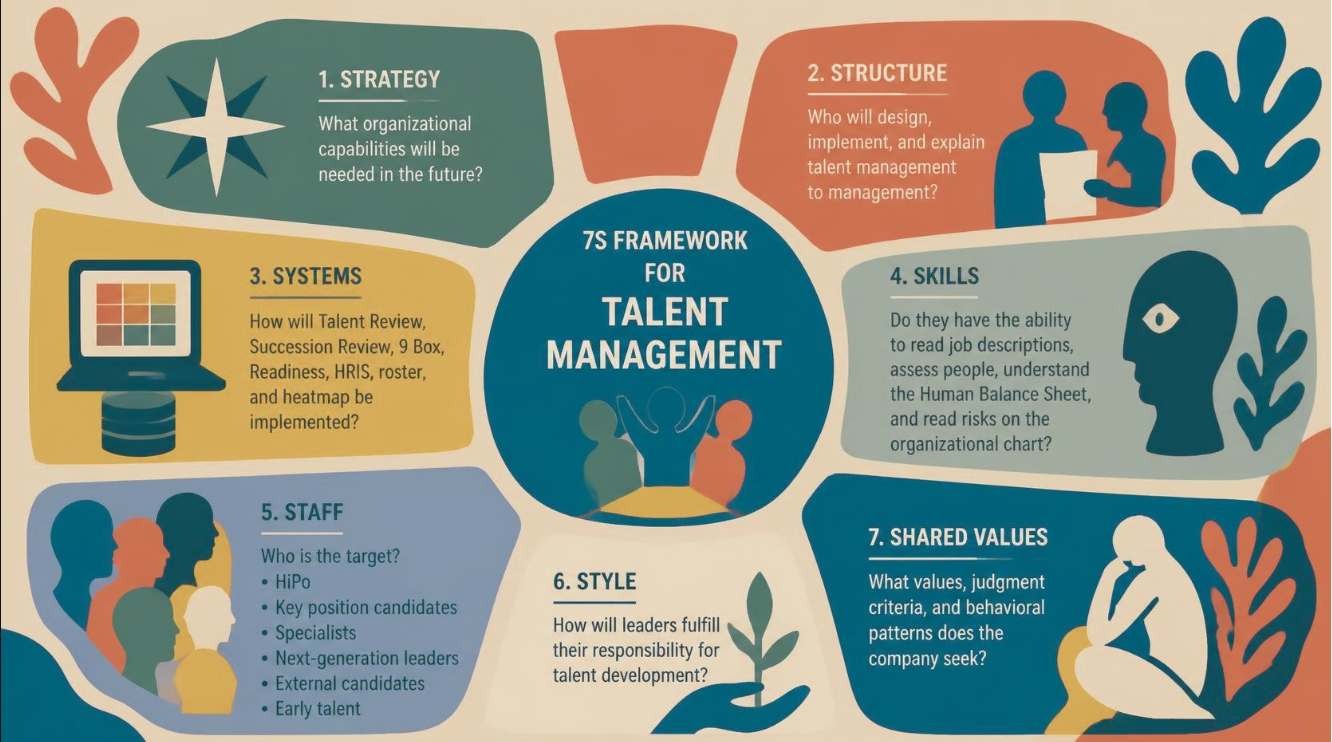
This may become easier to understand through McKinsey’s 7S framework.
Why 7S?
Because talent management is not a single HR initiative.
It only functions when strategy, structure, systems, skills, staff, leadership style, and shared values are aligned.
Strategy.
What organizational capability will be required in the future?
Structure.
Who designs talent management, who executes it, and who explains it to management?
Systems.
How should Talent Review, Succession Review, 9 Box, Readiness, HRIS, rosters, and heat maps be operated?
Skills.
Do we have the capability to read job descriptions, assess people, understand the Human Balance Sheet, and identify risks on the organization chart?
Staff.
Who should be included?
High-potential talent, key position candidates, expert talent, next-generation leaders, external candidates, and early talent.
Style.
How do leaders fulfill their responsibility for talent development?
Shared Values.
What values, judgment criteria, and behaviors does the company expect?
Only when these elements are in place can talent management move beyond talent-list management and become a management process that builds organizational capability.
For example, Japanese companies have long hired new graduates and developed their way of thinking and behaving through placement, rotation, managers, and workplace experience.
In terms of the 7S framework, Japanese HR departments may have had a certain philosophy and enterprise-wide methodology around Staff, Style, and Shared Values.
But conversely, much of the rest was often left to the field.
Who gains which experience?
Who develops under which manager?
Who is sent into which difficult assignment?
Who moves to the next role, and when?
These decisions were strongly influenced by field judgment, managers’ assessments, and HR’s tacit knowledge.
On the other hand, Western-style talent management may have seemed attractive to Japanese HR departments because it appeared to offer a more systematic approach to managing these issues.
Assess people.
Develop capability through training.
Provide experience through deployment and assignments.
Confirm readiness.
Connect talent to succession.
These mechanisms have long been discussed as common practices in global companies.
However, simply introducing these mechanisms is not enough.
Talent management is not only a mechanism for looking at people.
We also need to see how a person’s experience, capabilities, trust, and behavior relate to their role on the organization chart.
Toward which key position is that person being developed?
In which roster can that person be converted into future organizational capability?
Without this view, talent management remains only a talent list.
What is needed is to connect the information HRBPs see in the field with HR’s Strategy, Structure, Systems, Skills, Staff, Style, and Shared Values.
To confirm that connection, we ultimately need to review each organization chart.
In Vol. 1 of this series, we discussed why it is important for HRBPs to view the organization from a broader perspective beyond job descriptions.
People do not develop on a list.
People develop future organizational capability through roles, placements, experiences, managers, and rosters within the organization.
To repeat, talent management is not a system in which HR itself develops people.
It is a management process that converts leaders’ responsibility for talent development into organizational capability.
And HR must be the PMO that designs, visualizes, and enables that process to function between management and the field.
In organizations where talent management does not work well, each HR function may focus on fulfilling the responsibilities assigned to its own area, while the overall purpose of talent management is not sufficiently shared.
As a result, the responsibility for problems that appear in the field may concentrate on HRBPs, who stand at the front line.
This is our view.
Whether talent management works depends not only on the capability of HRBPs, but also on the structure through which the entire HR function supports leaders’ responsibility for developing people.
Before leaving talent management to HRBPs, we may need to ask:
What should HR design?
What should HR visualize?
Who should play which role?
Using the 7S framework, it may be worth revisiting the roles of each HR function in talent management. (Originally posted on LinkedIn on 2026-08-15)
About Errand Consulting
Errand Consulting explores organizational transformation
through the ERR& Philosophy.
Learn more → www.hrfd3.com
ERR& Tips Vol.5
タレントマネジメントは、HRBPに任せれば機能するのか?
人材リストから、組織能力をつくる経営プロセスへ
タレントマネジメントという言葉は、企業によってさまざまな意味で使われています。
多くの企業では、最適配置の実現という結果を生み出す過程、あるいはそのための装置として、タレントマネジメントという言葉を用いていることが多いのではないでしょうか。
また、タレントマネジメントは、HRの施策やベストプラクティスの目的として語られることも少なくありません。
アセスメント。
9 Box。
ハイポテンシャル人材。
サクセッションプラン。
リーダーシップ研修。
配置とアサインメント。
タレントレビュー。
これらは、いずれもタレントマネジメントの一部かもしれません。
しかし、これらの複雑で、ときに儀式的にも見えるプロセスには、実に多くの人たちが関わっています。
組織長。
ピープルマネージャー。
人事部門の各COE。
人事企画。
経営企画。
IT。
そしてHRBP。
なかでもHRBPは、組織とタレントを現場で結びつける役割として重視されているのではないでしょうか。
また、タレントマネジメントがうまく機能していない組織では、HRBPの責任が問われることも少なくありません。
しかし、ここで立ち止まって考えてみたいと思います。
タレントマネジメントは、HRBPに任せれば機能するのでしょうか。
HRBPは、確かに現場で人と組織の接続を見る最前線にいます。
誰がどの役割を担っているのか。
どのポジションに後継リスクがあるのか。
どの人材に次の経験が必要なのか。
誰を動かすと、どの組織に穴が開くのか。
HRBPは、こうした問いを現場文脈の中で見ています。
しかし、タレントマネジメントをHRBPだけに任せてしまうと、別の問題が起こります。
現場ごとに見方が変わる。
人材の評価基準が揃わない。
配置と育成が短期の人員充足に引き寄せられる。
将来の組織能力ではなく、現在の組織都合で人が見られる。
これでは、タレントマネジメントは全社的に推進されるべきStrategic HRにはなりません。
個別の組織において、人材育成と人材開発は、本来、すべてのリーダーの責任です。
組織長やピープルマネージャーは、人材育成の実行責任者です。
人事が人を育てる主体になるのではありません。
人事が担うべきなのは、リーダーが人材育成責任を果たせるように、仕組み、人の見方、情報、プロセスを設計することです。
その意味では、人事はタレントマネジメントにおけるPMO機能を担うということになるのではないでしょうか。
ただし、ここでいうPMOは、単なる事務局ではありません。
人材会議を設定すること。
9 Boxを回収すること。
後継者リストを更新すること。
研修対象者を管理すること。
それだけであれば、タレントマネジメントは運営事務になってしまいます。
人事部門として見るべきなのは、人材の見立てが、組織図、JD、Human Balance Sheet、ロースター、ヒートマップ、将来の事業課題と接続されているかです。
そして、この接続をつくるためには、すべてをHRBPの裁量に任せるのではなく、人事部門として明確なストラクチャーが必要になります。
HRDまたはCHROは、タレントマネジメントを単なる人事施策ではなく、将来の組織能力をつくる経営プロセスとして位置づける責任を持ちます。
人事企画やHR Planningは、そのプロセス全体の設計を担います。
Talent Review、Succession Review、9 Box、Readiness、ロースター、ヒートマップをどのように接続するのか。
どの会議体で、誰が、何を判断するのか。
どの情報を経営に上げ、どの情報を現場に返すのか。
そこを設計する役割です。
Recruitingは、入口で人を見る役割を担います。
単に採用数を満たすだけではなく、将来の組織能力に接続できる候補者を、どのポジション、どの職種、どの人材プールに入れるのかを考える必要があります。
L&Dは、研修を提供するだけではありません。
リーダーが人材育成責任を果たすために必要な経験、学習機会、リーダーシップ開発を設計する役割を担います。
Performance ManagementやCompensationは、評価、昇格、報酬が、会社として求める行動様式や将来の役割期待と矛盾していないかを見る必要があります。
HRISやHR Operationsは、入社、異動、評価、昇格、研修、退職といったPeople Eventを正しく記録し、人材と組織を継続的に見るためのデータ基盤を支えます。
そしてHRBPは、これらの仕組みが現場で本当に機能しているかを確認する最前線にいます。
人材の見立てが、組織図、JD、Human Balance Sheet、ロースター、ヒートマップ、将来の事業課題と接続されているかを、現場文脈の中で検証する役割です。
つまり、人事は一つの部門として、タレントマネジメントを設計し、可視化し、実行を支援し、現場で検証する必要があります。
このことは、McKinseyの7Sで考えると、より分かりやすいかもしれません。
なぜ7Sで見るのかといえば、タレントマネジメントは単一の人事施策ではなく、戦略、組織、制度、スキル、人材、リーダーの行動様式、共有価値観が揃って初めて機能するものだからです。
Strategy。
将来どの組織能力が必要なのか。
Structure。
誰がタレントマネジメントを設計し、誰が実行し、誰が経営に説明するのか。
Systems。
Talent Review、Succession Review、9 Box、Readiness、HRIS、ロースター、ヒートマップをどう回すのか。
Skills。
JDを読み、人を見立て、Human Balance Sheetを理解し、組織図上のリスクを読む力があるのか。
Staff。
誰を対象にするのか。
HiPo、キーポジション候補、専門人材、次世代リーダー、外部候補、early talent。
Style。
リーダーは、人材育成責任をどのように果たすのか。
Shared Values。
会社として、どのような価値観、判断基準、行動様式を求めるのか。
これらが揃って初めて、タレントマネジメントは人材リスト管理ではなく、組織能力をつくる経営プロセスになります。
たとえば、日本企業は長い間、新卒を採用し、配属、異動、上司、現場経験を通じて、会社の考え方や行動様式を育ててきました。
7Sでいえば、Staff、Style、Shared Valuesについて、日本企業の人事部門は一定の方針と、全社に展開するための方法論を持っていたと言えるかもしれません。
しかし、逆に言えば、それ以外の部分は基本的に現場に委ねられていたとも言えます。
誰がどの経験を積むのか。
誰がどの上司の下で育つのか。
誰がどの修羅場に送られるのか。
誰がどのタイミングで次の役割に移るのか。
そこには、現場の判断、上司の見立て、人事の暗黙知が大きく影響していました。
一方、欧米型のタレントマネジメントは、それをより体系的に行う仕組みとして、日本企業の人事部門には魅力的に映ったのではないでしょうか。
アセスメントで人を見る。
トレーニングで能力を伸ばす。
配置とアサインメントで経験を与える。
Readinessを確認する。
サクセッションにつなげる。
こうした仕組みは、グローバル企業では一般的なプラクティスとして広く語られてきました。
しかし、これらの仕組みを導入しただけでは十分ではありません。
タレントマネジメントは、本来的には人を見る仕組みであるだけでは足りないからです。
その人の経験、能力、信頼、行動様式が、どの組織図上の役割に接続されるのか。
どのキーポジションに向かって育っているのか。
どのロースターに入ることで、将来の組織能力に変わるのか。
ここまで見なければ、タレントマネジメントは単なる人材リストに留まります。
必要なのは、HRBPが現場で見た人と組織の情報を、人事部門としてのStrategy、Structure、Systems、Skills、Staff、Style、Shared Valuesに接続することです。
そして、その接続を確認するためには、最後は個々の組織図を見ることになります。
私たちはこのシリーズのVol.1で、HRBPがJDをベースに組織を俯瞰的に見ることの重要性について述べました。
人は、リスト上で育つのではありません。
人は、組織の中の役割、配置、経験、上司、ロースターを通じて、将来の組織能力に変わります。
繰り返しになりますが、タレントマネジメントは、人事が人を育てる仕組みそのものではありません。
リーダーの人材育成責任を、組織能力に変換するための経営プロセスです。
そして人事は、そのプロセスを設計し、可視化し、経営と現場の間で機能させるPMOでなければならないのではないでしょうか。
タレントマネジメントがうまく機能していない組織では、人事部門の各担当者が、それぞれの機能に割り当てられた責務を果たすことに集中する一方で、全体として何を実現しようとしているのかが十分に共有されていないことがあります。
その結果、現場で見える問題の責任が、最前線にいるHRBPに集中してしまう。
これが、私たちの見立てです。
タレントマネジメントが機能するかどうかは、HRBPの力量だけではなく、人事部門全体がどのような構造でリーダーの育成責任を支えているかにかかっています。
タレントマネジメントをHRBPに任せる前に、人事部門として何を設計し、何を可視化し、誰がどの役割を担うのか。
今回ご紹介した7Sのフレームワークを使って、タレントマネジメントにおける人事部門の各機能の役割を、もう一度見直してみてはいかがでしょうか。(Originally posted on LinkedIn on 2026-08-15)
About Errand Consulting
Errand Consulting explores organizational transformation
through the ERR& Philosophy.
Learn more → www.jp.hrfd3.com

コメント