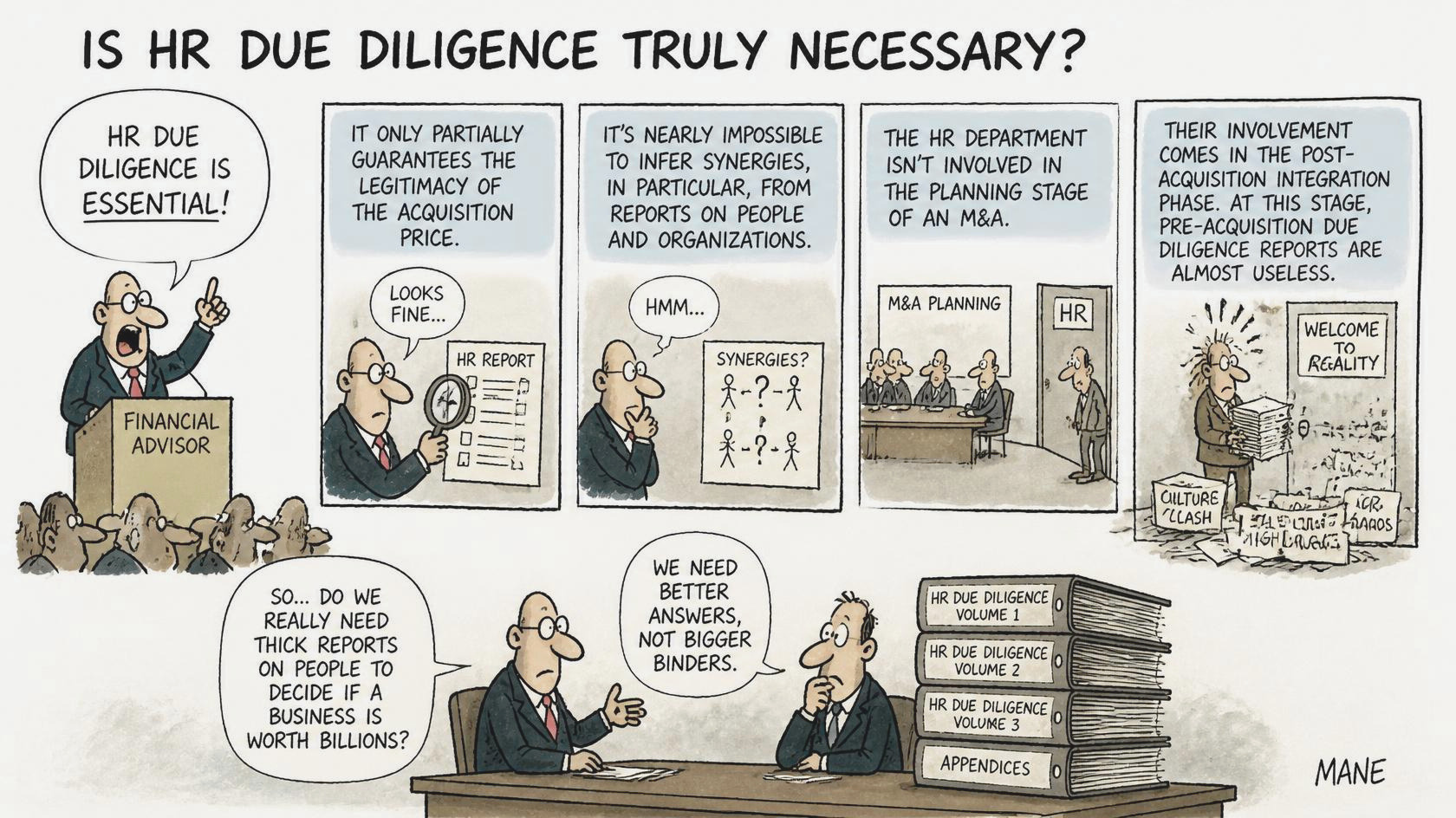
From Justifying the Premium to Testing the Conditions for Synergy Realization
When considering an M&A transaction, HR due diligence may be conducted alongside financial and legal due diligence.
Workforce composition.
Compensation programs.
Retirement benefits.
Labor issues.
Organizational structure.
Key people.
Corporate culture.
The scope differs from one transaction to another and can sometimes become extremely broad.
Today, HR due diligence is recognized as one of the major areas of investigation in M&A. Twenty years ago, however, it was not conducted as routinely as it is today.
One reason for its expansion is the growing recognition that people and organizational issues can significantly affect the success or failure of an M&A transaction.
M&A success rates have long been considered relatively low.
The definition and measurement of “success” vary across studies. However, even though the scope of due diligence has expanded and analytical methods have become more sophisticated, transactions that fail to realize their expected value have not disappeared.
This does not mean that HR due diligence has been ineffective.
It does, however, suggest that conducting HR due diligence does not directly guarantee the financial success of an M&A transaction.
This raises a fundamental question.
What decision is HR due diligence actually intended to support?
Is it intended to validate the purchase price?
To identify labor and employment risks?
To confirm business continuity on Day 1?
Or to design the organizational integration and synergies expected after the acquisition?
This is the question we explore in this ERR& Labo.
How often is HR involved from the initial planning stage of an M&A transaction and invited to discuss what should be examined through HR due diligence?
In many cases, HR may instead receive the due diligence report only after the acquisition has been completed and be told:
“Please use this information to determine how we should proceed with PMI.”
This ERR& Labo is intended for HR professionals who find themselves in that position.
Our purpose is to separate the different objectives contained within the single term “HR due diligence” and reconsider what role it should actually play.
We believe HR due diligence is difficult to understand because several different objectives are grouped under one label.
The objectives of HR due diligence can broadly be divided into four categories.
- To confirm whether people-related costs are properly reflected in the financial statements and whether any off-balance-sheet liabilities or additional expenses exist.
- To confirm whether the current organization is operating lawfully and whether there are any compliance concerns.
- To determine whether any people- or organization-related factors could create a critical risk to business continuity after Day 1.
- To examine the synergies expected after the acquisition from a people and organizational perspective.
The first three primarily support the acquisition decision, the contractual terms, and business continuity on Day 1.
The fourth attempts to validate the premium included in the purchase price from a people- and organizational-perspective.
One reason HR due diligence has become more complicated and its scope has expanded may be that it is now increasingly expected to perform this fourth role.
However, this raises another question.
Can HR Due Diligence Prove the Acquisition Premium?
When a company pays more than the standalone value of a target, the difference is often explained by the word “synergy.”
Technology.
Customer access.
An experienced management team.
Specialized talent.
Organizational capabilities.
Corporate culture.
Corporate planning teams and financial advisors explain to management that these factors will create additional value post-acquisition.
However, the greater the gap between the target’s standalone value and the purchase price, the more evidence is needed to support the assumed synergy.
HR due diligence may then be expected to answer questions such as:
Are the target company’s people highly capable?
Does the organization possess strong capabilities?
Are there people and organizational synergies between the buyer and the target?
Can the two corporate cultures be integrated?
However, the numbers typically handled by HR functions and HR consultants are primarily cost-related.
Personnel expenses.
Compensation levels.
Employee benefits.
Turnover rates.
Recruitment costs.
Retention costs.
HR can forecast future workforce costs.
However, HR does not have a standardized method for converting the future cash flows created by people and organizations into present value.
The professionals who most routinely calculate present value in the HR field are probably the actuaries who calculate retirement benefit obligations.
But actuaries are not valuing people.
They are calculating the present value of the future obligations owed to employees.
HR consultants can calculate the cost of retaining certain employees.
They cannot independently prove how much future profit those employees will generate or the present value of that profit.
In other words:
HR due diligence is not designed to prove the value of an acquisition premium.
Nevertheless, when additional HR due diligence is commissioned to justify a premium that cannot otherwise be explained, qualitative reports begin to accumulate.
The company has excellent people.
It has a strong organizational culture.
Its management team is highly experienced.
Its capabilities complement those of the buyer.
Each observation may be correct.
However, if the information changes neither the purchase price nor the contractual terms nor the Day 1 plan, its incremental contribution to the decision is limited.
To use an analogy from multivariate analysis, the number of explanatory variables may increase, but each additional variable may provide little statistically significant explanatory value for the purchase price.
The volume of reporting increases.
The accuracy of the acquisition decision does not necessarily improve.
We therefore believe that HR due diligence should be divided into pre-deal and post-deal activities.
Pre-deal HR due diligence protects the transaction and Day 1.
Post-deal HR due diligence identifies the people and organizational conditions required to realize synergy.
The two have different objectives, access to different information, and require different deliverables.
Three Areas for Pre-deal HR Due Diligence
What, then, should HR due diligence examine before an acquisition?
We believe it can largely be limited to three areas.
1. Financial Impact
The first question is whether any people- or organization-related matter will affect the purchase price, future P&L, or required funding.
Unpaid wages.
Retirement benefit obligations.
Change-of-control payments.
Retention costs.
Restructuring and termination costs.
The structure of employee and external workforce costs.
TSA costs.
Standalone costs after the TSA ends.
A Transition Services Agreement, or TSA, is an agreement under which the seller continues to provide certain services that cannot be separated by Day 1, such as payroll, accounting, or IT.
This is different from the cost of hiring a PMI consulting firm.
A PMI consultant may primarily support issue management and schedule management.
Under a TSA, however, the seller provides the systems, data, operational infrastructure, and services that it actually owns and operates.
These services cannot easily be replaced by a consultant.
The purpose here is not to determine whether the target company’s HR programs are good or bad.
The financial question is:
How much more will the buyer need to pay because of the people and organizational structure of the transaction?
2. Compliance Impact
The second area concerns matters that could affect the lawful completion of the transaction or create liabilities post-acquisition.
Employment law.
Social insurance.
Unpaid compensation.
Labor relations.
Employment contracts.
Employee data and privacy.
Employee transfers and the succession of employment relationships.
Issues identified through this review may need to be reflected in the purchase price, representations and warranties, indemnities, or closing conditions.
The purpose is not to evaluate the quality of the HR system.
It is to complete the transaction lawfully and avoid unexpected liabilities after the acquisition.
3. Business Continuity Impact
The third area is whether the people, processes, systems, and contracts required to keep the business operating on Day 1 will remain available.
Will the necessary employees transfer?
Will the management team and key people remain?
Are critical activities being performed by contractors or employees of the seller rather than by the target company?
Can payroll, time management, and HRIS operations continue from Day 1?
How dependent is the target on the seller’s HR, IT, and finance functions?
In one case, an overseas engineering company was acquired partly because of the high quality of its engineers.
After the acquisition, it became clear that many of those engineers were not employees of the target company.
They were external contractors.
The role of HR due diligence is not to determine whether those engineers are excellent.
The relevant question is:
Who owns or controls the workforce supporting the acquisition value, under what contractual arrangements, and will that workforce remain available after the acquisition?
HR Due Diligence Should Test the Assumptions Behind the Premium
Under this model, the role of pre-deal HR due diligence becomes clearer.
HR due diligence does not prove the amount of synergy assumed by the corporate planning team.
It tests whether the assumptions supporting that synergy are valid.
For example:
The engineers expected to create the synergy are excluded from the transaction.
Critical capabilities depend on external contractors.
The continuing involvement of the management team has not been contractually secured.
The business plan does not include the additional cost required to retain key talent.
Early integration would change the people-cost structure and invalidate the original P&L assumptions.
If such facts are identified, the buyer can revise the purchase price, contractual terms, TSA, or Day 1 plan.
Pre-deal HR due diligence should therefore be positioned as:
A process for testing the assumptions supporting the premium—not a process for proving the premium itself.
HR PMI Begins with the Design of the TSA
When HR is included in the Deal Team, it should become substantively involved during the sign-to-close period, beginning with the design of the TSA scope.
In a business transfer, the first step is to obtain the required employee consents and determine who will be the legal employer from Day 1.
Functions that cannot be transferred or replaced by Day 1 are then included in the TSA.
Payroll.
Time and attendance.
HRIS.
Employee benefits.
Employee data.
The system interfaces with finance and IT.
Temporary HR support from the seller.
The purpose at this stage is not to integrate HR programs.
It is:
To prevent people and operations from stopping on Day 1 and to build a bridge until the buyer can operate independently.
The first responsibility of HR PMI is therefore not to redesign the organization chart or compensation system.
It is to design the HR Transition Architecture.
The Reality of People and Organizations May Only Become Visible After Closing
When, then, should the buyer determine how to integrate the organization and realize the expected synergy?
We believe that the main investigation should begin after Day 1.
Seller-side executives may be subject to confidentiality obligations toward the seller.
They may not be permitted to provide the buyer with information beyond what was formally disclosed during the due diligence process.
Even if the buyer carefully reviews the due diligence reports and transaction documents, it may still be unable to see the operational dependencies that only emerge when the seller begins to separate the business.
Who informally supports a critical operation?
Which data is generated through systems owned by other parts of the seller’s organization?
Which external relationship would interrupt the business if it were disconnected?
Does the formal organization chart reflect the actual decision-making structure?
Some of these matters can only be understood after the buyer gains access to the target’s actual operations.
People and organizational information also becomes outdated more quickly than financial or contractual information.
Key employees may begin considering other opportunities after the transaction is announced.
Management’s willingness to remain involved may change.
Contractors and business partners may request new contractual terms.
A pre-deal HR due diligence report therefore has limitations as a direct basis for organizational integration on Day 100.
Post-deal Organizational DD
The period from Day 1 to Day 100 does not necessarily need to be a period of rapid organizational and HR program integration.
It can instead be treated as a period in which the buyer examines the actual people and organizational structure of the acquired business.
We may call this Post-deal Organizational DD or Post-close Organizational Verification.
The questions include:
Who is actually running the business?
Which teams support the customer relationships, technology, products, and operational quality?
Does the capability belong to an individual, or is it created by a team?
What dependencies exist among employees, contractors, and seller-side support functions?
What functions, people, and costs will be required after the TSA ends?
Can the synergy assumed before the acquisition actually be realized within the existing organizational structure?
Which parts should be integrated to create value?
Which parts would destroy existing capabilities if they were changed too quickly?
The purpose of this investigation is not to rate the quality of the target company’s organization.
It is:
To discover what must be preserved, what must be connected, and what must be changed to realize the expected synergy.
Separating the Present Value of Synergy
The target company’s standalone value can be estimated under certain assumptions based on its existing customers, products, revenue, and cost structure.
Synergy value is different.
It depends on multiple conditions with a relatively high degree of uncertainty.
The necessary people must remain.
The organizations must be connected appropriately.
Customers must accept the buyer’s new proposals.
Integration costs must remain within the expected range.
The synergy must be realized within the planned period.
HR has an inherent limitation in directly calculating the cash flows arising from these conditions.
From a financial perspective, it may also be inappropriate to apply exactly the same assumptions or discount rate to the target’s standalone business and to the expected synergy.
The realization probability, timing, sustainability, and required investment for the synergy could be evaluated separately.
Alternatively, a discount rate reflecting the additional risk associated with the synergy cash flow could be applied.
The important point is to make the synergy visible as a separate hypothesis from the target’s standalone value.
HR does not calculate the monetary amount of the synergy itself.
HR confirms the facts and conditions required for that calculation.
Through Post-deal Organizational DD, HR can update factors such as:
The probability that the people required to realize the synergy will remain.
The time required to establish the necessary organizational connections.
The cost of retention, recruitment, and redeployment.
The probability that the existing capabilities can be preserved.
These factors update the assumptions and coefficients supporting the value attributed to synergy.
The 2nd Action After Day 100
Day 100 is not necessarily the date on which HR integration should be completed.
The reality identified between Day 1 and Day 100 should be used to determine the 2nd Action after Day 100.
Should the organization be fully integrated?
Should only selected functions be integrated?
Should the acquired company continue to operate on a standalone basis?
Should the organization and reporting lines be changed?
Should the management team and key positions be reconsidered?
When should compensation, grading, and performance management be connected?
How should the TSA be exited?
How should the future HR Operating Model be designed?
The overall sequence is therefore:
By Day 1, establish business continuity.
Until Day 100, understand the reality of the people and the organization.
After Day 100, select the 2nd Action required to realize the synergy.
What Is Required to Include HR in the Deal Team?
When HR is included in a Deal Team, it must be clear what HR is expected to decide—and what it is not.
Before the deal, HR examines financial impact, compliance, and business continuity.
HR does not justify the acquisition premium.
During the sign-to-close period, HR designs Day 1 HR Continuity, including the TSA.
After Day 1, the buyer conducts its own Post-deal Organizational DD.
After Day 100, corporate planning, business leadership, finance, and HR decide the 2nd Action based on the updated synergy hypothesis.
Before commissioning additional HR due diligence, the financial advisor and corporate planning team should be able to answer at least one question:
What will change as a result of this investigation—the purchase price, contractual terms, Day 1 business continuity, the TSA, or the probability of realizing the synergy?
If none of these will change, the additional HR due diligence report will have little incremental explanatory value for the decision.
From Explaining the Premium to Implementing the Value
HR due diligence becomes complicated not only because people and organizations are complicated.
It also becomes complicated because justifying the purchase price and realizing value after the acquisition are mixed together within a single due diligence process.
Pre-deal HR due diligence protects the transaction.
The TSA protects Day 1.
Post-deal Organizational DD identifies the conditions required to realize the synergy.
The 2nd Action after Day 100 converts those conditions into organizational action.
HR due diligence should not be a report designed to explain the acquisition premium.
It should be the starting point for converting the value expected from an acquisition into a program that can actually be implemented through people and organizations.
By redefining its role in this way, the purpose of including HR in the Deal Team may also become much clearer.(Originally posted on LinkedIn on 2026-08-11)
About Errand Consulting
Errand Consulting explores organizational transformation
through the ERR& Philosophy.
Learn more → www.hrfd3.com
- From Justifying the Premium to Testing the Conditions for Synergy Realization
- Can HR Due Diligence Prove the Acquisition Premium?
- Three Areas for Pre-deal HR Due Diligence
- 1. Financial Impact
- 2. Compliance Impact
- 3. Business Continuity Impact
- HR Due Diligence Should Test the Assumptions Behind the Premium
- HR PMI Begins with the Design of the TSA
- The Reality of People and Organizations May Only Become Visible After Closing
- Post-deal Organizational DD
- Separating the Present Value of Synergy
- The 2nd Action After Day 100
- What Is Required to Include HR in the Deal Team?
- From Explaining the Premium to Implementing the Value
- ERR& Labo
ERR& Labo
人事デューデリジェンスは本当に必要か?
プレミアムの正当化から、シナジー実現条件の検証へ
M&Aを検討する際、財務デューデリジェンス、法務デューデリジェンスと並んで、人事デューデリジェンスが実施されることがあります。
人員構成。
報酬制度。
退職給付。
労務問題。
組織体制。
キーパーソン。
企業文化。
調査対象は案件によって異なり、その範囲はときに非常に広くなります。
現在では、人事DDはM&Aにおける主要な調査領域の一つとして認識されています。しかし、今から20年ほど前には、現在ほど一般的に実施されていたわけではありません。
その背景には、人や組織の問題がM&Aの成否を左右するという認識が広がってきたことがあります。
M&Aの成功率は長年低いといわれてきました。
調査によって「成功」の定義や数値は異なりますが、DDの対象が広がり、分析手法が高度化した現在でも、期待された価値を実現できない案件がなくなったわけではありません。
これは、人事DDが役に立っていないことを示すものではありません。
一方で、人事DDを実施することが、M&Aの財務的成功を直接担保するものではないということもできるのではないでしょうか。
それでは、
人事デューデリジェンスは、そもそも何を判断するために行われているのでしょうか。
買収価格を検証するためでしょうか。
労務リスクを発見するためでしょうか。
Day 1の事業継続を確認するためでしょうか。
それとも、買収後の組織統合やシナジーを設計するためでしょうか。
今回のLaboでは、この問いを考えます。
そもそも、人事部門がM&Aの企画段階から参画し、人事DDで何を調査すべきかという議論に加わるケースは、それほど多くないのではないでしょうか。
むしろ買収完了後に初めてDDレポートを渡され、
「この情報をもとに、PMIをどのように進めるか検討してほしい」
と求められることの方が多いかもしれません。
今回のLaboは、そのような人事部門の方々に向けて、「人事DD」という一つの言葉に含まれる異なる目的を分解し、その役割を理解し直すことを目的としています。
私たちは、異なる目的が一つの「人事DD」という言葉の中に混在していることが、人事DDを分かりにくくしているのではないかと考えています。
人事DDの目的は、主に次の四つに整理できます。
① 人に関するコストが財務諸表へ適切に反映されているか、簿外債務や追加費用が存在しないかを確認する。
② 現在の組織が適法に運営されているか、コンプライアンス上の問題や懸念事項がないかを確認する。
③ 人や組織に、Day 1以降の事業継続を妨げる致命的なリスクがないかを確認する。
④ 買収後に期待されるシナジーを、人と組織の側面から検証する。
①から③は、主として買収判断、契約条件、Day 1の事業継続に関係する調査です。
一方、④は、買収価格に含まれるプレミアムの妥当性を、人と組織の側面から検証しようとするものです。
昨今、人事DDが複雑化し、調査範囲が拡大している背景には、この④の役割まで人事DDに期待されるようになったことがあるのではないでしょうか。
しかし、ここで私たちが疑問に感じることがあります。
人事DDにプレミアムを証明できるのか
企業が対象会社の単独価値を上回る価格を支払うとき、その差額はしばしば「シナジー」という言葉で説明されます。
技術力。
顧客基盤。
優秀な経営陣。
専門人材。
組織能力。
企業文化。
企画部門やFA(Financial Advisor)は、これらが買収後に追加的な価値を生み出すとして、経営陣に買収価格を説明します。
しかし、対象会社の単独価値と買収価格の差が大きくなるほど、そのシナジーを裏づける説明も多く必要になります。
そこで、人事DDにも次のような役割が期待されます。
対象会社の人材は優秀か。
組織能力は高いか。
買い手との間に人材・組織シナジーはあるか。
企業文化は統合可能か。
しかし、人事部門や人事コンサルタントが通常扱っている数値は、人件費、報酬水準、福利厚生費、離職率、採用費、リテンション費用など、基本的にはコスト側の数値です。
将来の人件費を予測することはできても、その人と組織が将来生み出すキャッシュフローを現在価値に変換する標準的な方法を持っているわけではありません。
人事領域で将来キャッシュフローを現在価値として定常的に扱っている代表的な専門家は、退職給付債務を計算するアクチュアリーでしょう。
しかし、アクチュアリーが評価しているのも、人材の価値ではありません。
従業員に対して将来発生する債務の現在価値です。
人事コンサルタントは、人材を維持するためにいくら必要かを計算できます。
しかし、その人材が将来いくらの利益を生み、その現在価値がいくらになるかを単独で証明することはできません。
つまり、
人事DDは、買収プレミアムの価値を証明することには向いていない。
それにもかかわらず、説明できないプレミアムを正当化するために人事DDが追加されれば、定性的なレポートが積み上がっていきます。
優れた人材がいる。
強い組織文化がある。
経営陣の経験が豊富である。
買い手との補完性がある。
それぞれの記述は間違っていないかもしれません。
しかし、その情報によって買収価格、契約条件、Day 1計画のいずれも変わらないのであれば、意思決定に対する追加的な説明力は限定的です。
多変量解析にたとえるなら、説明変数は増えているものの、それぞれの変数が買収価格を説明するうえで、有意な追加価値を持っていない状態です。
レポートの量は増えても、買収判断の精度は上がりません。
そこで私たちは、人事DDをPre-dealとPost-dealに分けて考える必要があるのではないかと考えています。
Pre-dealの人事DDは、取引とDay 1を守る。
Post-dealの人事DDは、シナジーを実現するための人と組織の条件を明らかにする。
両者は、目的も、取得できる情報も、求められる成果物も異なります。
Pre-dealの人事DDで確認すべき三つのこと
では、買収前の人事DDでは何を確認すべきなのでしょうか。
私たちは、大きく三つに限定できるのではないかと考えています。
1.財務上の影響
人と組織に関する事項が、買収価格、将来PL、必要資金に影響するかを確認します。
未払い賃金。
退職給付債務。
Change of Controlによる支払い。
リテンション費用。
再編・退職費用。
人件費・外注費の構造。
TSA費用。
TSA終了後のStand-alone Cost。
ここでいうTSAとは、Day 1までに切り離せない給与、会計、ITなどの機能を、売り手が一定期間継続して提供するためのTransition Services Agreementを意味します。
これは、買い手が起用するPMIコンサルタントの費用とは異なります。
PMIコンサルタントが主として課題管理やスケジュール管理を支援するのに対し、TSAでは、売り手が保有するシステム、データ、業務基盤そのものが提供されます。
したがって、コンサルタントが簡単に代替できるサービスではありません。
ここで確認するのは、人事制度の良し悪しではありません。
人と組織に関連して、追加的にいくら支払う必要があるのか。
という財務上の問いです。
2.コンプライアンス上の影響
労働法令、社会保険、未払い、労使関係、雇用契約、個人情報、従業員の転籍・承継など、取引成立や買収後の責任に影響する事項を確認します。
発見された問題は、買収価格、表明保証、補償、クロージング条件などに反映されることがあります。
これは、人事制度を評価するためではありません。
取引を適法に成立させ、買収後に想定外の責任を負わないための確認です。
3.事業継続上の影響
Day 1に事業を止めないために必要な人、業務、システム、契約が確保されているかを確認します。
必要な従業員は転籍するのか。
経営者やキーパーソンは残るのか。
重要な業務を外注者や売り手側の社員が担っていないか。
給与、勤怠、HRISはDay 1から運営できるのか。
売り手側の人事、IT、経理機能にどの程度依存しているのか。
以前、ある会社がとある海外エンジニアリング会社を買収したところ、優秀だと考えられていたエンジニアの多くが、実際には対象会社の社員ではなく、外注者だったというケースがありました。
人事DDが確認すべきなのは、そのエンジニアが優秀かどうかではありません。
買収価値を支える労働力が誰に属し、どの契約の下にあり、買収後も利用可能なのか。
ということです。
人事DDはプレミアムを証明するのではなく、前提を検証する
この整理に立てば、Pre-dealにおける人事DDの役割は明確になります。
人事DDは、企画部門が設定したシナジー金額を証明するものではありません。
確認すべきなのは、そのシナジー仮説を支える前提が成立しているかです。
たとえば、
シナジーを担う技術者が売却対象外になっている。
主要な能力が外注先に依存している。
経営者の継続関与が契約上確保されていない。
人材維持に必要な追加コストが事業計画に含まれていない。
組織を早期に統合すると人件費構造が変わり、当初の想定PLが成立しない。
このような事実が確認されれば、買収価格、契約条件、TSA、Day 1計画を修正できます。
つまり、Pre-dealの人事DDは、
プレミアムの価値を証明するものではなく、プレミアムを支える前提を検証するもの
と位置づける方が合理的です。
人事PMIはTSAの設計から始まる
少なくとも事業譲渡やカーブアウトにおいて、人事がDeal Teamに入るのであれば、Sign-to-Closeの期間に、TSAのスコープ設計から本格的に関与することが重要です。
事業譲渡であれば、まず対象従業員の転籍同意を取得し、Day 1から誰が雇用主となるかを確定します。
そのうえで、Day 1までに切り替えられない機能をTSAへ切り出します。
Payroll。
勤怠。
HRIS。
福利厚生。
従業員データ。
経理・ITとのシステム連携。
売り手側の人事による暫定的な支援。
ここでの目的は、人事制度を統合することではありません。
人と業務をDay 1で止めず、買い手が自ら運営できる状態までの橋をつくることです。
したがって、人事PMIの最初の仕事は、組織図や報酬制度を変更することではありません。
HR Transition Architectureを設計することになります。
人と組織の実態は、買収後でなければ見えない
では、どのように組織を統合し、シナジーを実現するかは、いつ検討すべきなのでしょうか。
私たちは、その中心はDay 1以降に置くべきではないかと考えています。
売り手側の経営者には、売主との守秘義務があります。
DDで正式に開示された情報以外を、任意に買い手へ提供できない場合もあります。
また、買い手がDD資料や契約書を詳細に確認しても、売り手側で実際に事業を切断する過程で初めて判明する業務依存までは見えません。
誰が非公式に業務を支えているのか。
どのデータが、別部門のどのシステムから作られているのか。
どの外注先との関係が切れると、事業が止まるのか。
組織図上の責任者と、実際の意思決定者は一致しているのか。
これらは、買い手が対象会社の実際の運営へ入ってからでなければ確認できないことがあります。
さらに、人と組織に関する情報は、財務や契約の情報よりも早く陳腐化します。
買収公表後にキーパーソンが転職を検討することもあります。
経営者の関与姿勢が変わることもあります。
外注者や取引先が、契約条件の変更を求めることもあります。
したがって、Pre-dealの人事DDレポートを、そのままDay 100の組織統合設計に使うことには限界があります。
Post-deal Organizational DD
Day 1からDay 100までは、必ずしも組織や人事制度を一気に統合する期間ではありません。
むしろ買い手自身が、人と組織の実態を確認する期間と考えることができます。
本稿では、これをPost-deal Organizational DDと呼びます。
ここで確認するのは、たとえば次の事項です。
誰が実際に事業を動かしているのか。
どのチームが顧客、技術、製品、業務品質を支えているのか。
その能力は個人に属するのか、チームに属するのか。
社員、外注者、売り手側支援者の依存関係はどうなっているのか。
TSA終了後に必要となる機能、人員、コストはいくらか。
買収前に想定したシナジーは、実際の組織構造の中で実現可能なのか。
どの部分を統合すれば価値が生まれ、どの部分を変更すると既存能力を壊してしまうのか。
この調査の目的は、対象会社の組織を評価することではありません。
シナジーを実現するために、何を維持し、何を接続し、何を変える必要があるかを発見することです。
シナジーの現在価値を分けて考える
対象会社の単独価値は、既存顧客、既存商品、現在の収益やコスト構造などをもとに、一定の前提の下で評価できます。
一方、シナジー価値は、
必要な人材が残ること。
組織を適切に接続できること。
顧客が新しい提案を受け入れること。
統合コストが想定内に収まること。
実現までの時間が計画どおりであること。
といった、不確実性の高い複数の条件に依存します。
したがって、人事部門が、シナジーによって生まれるキャッシュフローを直接金額として算定することには、本質的な限界があります。
また、財務的にシナジーの現在価値を計算する場合にも、対象会社の単独事業と同じ係数や割引率を機械的に適用するべきではないかもしれません。
シナジーの実現確率、実現時期、維持可能性、必要投資を分けて評価する。
あるいは、シナジーキャッシュフローに、より高いリスクを反映した割引率を適用する。
重要なのは、シナジーを単独価値とは別の仮説として可視化することです。
人事部門が算定するのは、シナジーの金額そのものではありません。
人事部門の役割は、その計算に必要となる事実と条件を確認することです。
Post-deal Organizational DDを通じて、
実現に必要な人材が残る可能性。
必要な組織接続に要する時間。
リテンション、採用、再配置に必要なコスト。
既存能力を維持できる可能性。
など、シナジー価値を成立させる前提や係数を更新します。
Day 100後の2nd Action
Day 100は、人事統合の完了日ではありません。
Day 1からDay 100までに確認した実態をもとに、Day 100後の2nd Actionを決定します。
全面統合するのか。
部分統合にとどめるのか。
Stand-aloneを維持するのか。
組織やレポーティングラインを変更するのか。
経営陣やキーポジションを見直すのか。
報酬、等級、評価制度をいつ接続するのか。
TSAをどのように終了するのか。
HR Operating Modelをどのように設計するのか。
つまり、
Day 1までは事業継続をつくる。
Day 100までは人と組織の実態を知る。
Day 100後に、シナジー実現に必要な2nd Actionを選択する。
という流れです。
人事をDeal Teamに入れるために必要なこと
人事をDeal Teamに入れるのであれば、人事に何を判断させ、何を判断させないのかを明確にする必要があります。
Pre-dealで人事が行うのは、財務、コンプライアンス、事業継続に関する確認です。
人事部門は、買収プレミアムを正当化しません。
Sign-to-Closeでは、TSAを含むDay 1のHR Continuityを設計します。
Day 1以降は、買い手自身がPost-deal Organizational DDを行います。
そしてDay 100後に、企画部門、事業部門、財務、人事が、更新されたシナジー仮説に基づいて2nd Actionを決定します。
追加の人事DDを発注する場合、FAや企画部門は、少なくとも次の問いに答える必要があります。
この調査結果によって、買収価格、契約条件、Day 1の事業継続、TSA、またはシナジー実現確率の何が変わるのか。
どれも変わらないのであれば、そのDDレポートは、意思決定に対する追加的な説明力を持ちません。
人事DDを、プレミアムの説明から実装へ
人事DDが複雑になるのは、人と組織が複雑だからだけではありません。
買収価格を正当化することと、買収後に価値を実現することが、一つのDDに混在しているからではないでしょうか。
Pre-dealの人事DDは、取引を守る。
TSAは、Day 1を守る。
Post-deal Organizational DDは、シナジーの実現条件を発見する。
Day 100後の2nd Actionは、その条件を組織の行動へ変える。
人事DDは、プレミアムを説明するためのレポートではありません。
買収によって期待された価値を、人と組織の中で実現可能なプログラムへ変えるための起点である。
そのように役割を再定義することで、人事をDeal Teamへ参加させる意味も、より明確になるのではないでしょうか。(Originally posted on LinkedIn on 2026-08-11)
About Errand Consulting
Errand Consulting explores organizational transformation
through the ERR& Philosophy.
Learn more → www.jp.hrfd3.com


コメント