— Designing the “Boxes” and “Orbits” That Support Human Capital Management —
For those working in HR, the Job Description is probably one of the most familiar documents after the work rules themselves. For HRBPs in global companies in particular, it is often a document that generates new work almost every week.
A Job Description is often understood as a document that connects a company and a candidate during recruitment. In reality, however, its functional role goes far beyond that.
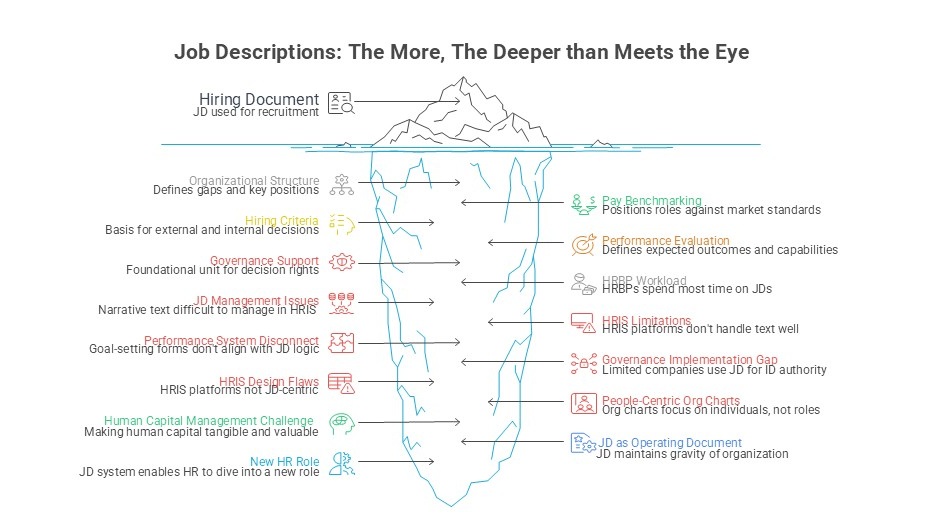
Even a simple list of the key functions in a JD at a global company shows how broad its scope really is.
1. Confirming and defining the organizational structure. It helps identify the gap between the current and future state of the organization while also clarifying key positions for succession planning.
2. Benchmarking pay and treatment. It supports positioning a role against both market and internal organizational standards.
3. Clarifying the criteria for hiring and internal appointment. It provides a basis not only for external hiring, but also for internal promotion and transfer decisions.
4. Serving as a blueprint for performance evaluation and talent development It defines what outcomes are expected from the role and what capabilities should be developed.
5. Supporting governance. It can serve as a foundational unit for decision rights, segregation of duties, IT governance, and even internal ID administration.
And the function that spends the most time creating and revising these JDs is often the HRBP.
Here, the JD we are talking about is not simply a position title and a short job summary used in a hiring advertisement. It is the basic unit of organizational operation: a document that defines why a position exists, what responsibilities it carries, what authority it holds, and how it connects and collaborates with other positions in the organization.
Yet very few global companies have JDs that fully satisfy all five of these functions across all positions. One major reason is that JDs are usually written as narrative text, which makes them difficult to manage and analyze within HRIS platforms.
Most current HRIS environments do not handle unstructured text well. Narrative text is often treated more like a record than as data for macro-level analysis. This is easy to understand if we look at performance systems: what gets analyzed is usually structured data, such as ratings, not the narrative content of a JD itself.
As a result, JDs are used primarily for hiring and, to a lesser extent, succession planning. Even then, they are often maintained comprehensively only for manager-level roles and above. In talent management, companies more often rely on job-family-based grade definitions than on JDs themselves. Positions are then mapped to a matrix of job families and grades. Ideally, those positions would be linked directly to the underlying JD, but in practice, few organizations are that well integrated.
The same issue appears in job evaluation, grading, and salary range design. Many organizations still rely on job evaluation tools provided by consulting firms such as Mercer or Korn Ferry. In practice, however, the process remains highly manual and judgment-based: someone reads a narrative JD and scores it against the evaluation framework’s dimensions. While the exercise is presented as a comparison against both market and internal benchmarks, its interpretation remains highly dependent on individual expertise.
Few companies also use JDs effectively for performance management and talent development. One reason is that the goal-setting forms used in HRIS often do not align with the JD’s logic. If role definition and performance management are disconnected, the JD may exist at the system’s entrance but never become part of day-to-day talent operations.
From a governance perspective, the number of companies that use JD as the foundational unit for authority design and ID management is still limited. Yet this is precisely where its importance is likely to increase.
As DX advances and organizations rely more heavily on SSO and multiple SaaS platforms, managing access rights based on individual email addresses alone becomes increasingly unsustainable. What should be governed is not who the person is, but which role the person occupies. In that sense, the JD is no longer merely a hiring document. It is increasingly becoming a governance document.
In theory, this is the ideal model. In practice, however, current systems make it difficult to realize. Today’s HRIS platforms are not necessarily designed around JD and position as their core organizing logic. Organizational charts, too, are usually presented in a people-based format.
But once names and photos are placed at the front of the chart, viewers are naturally drawn to the person rather than to the role or the authority attached to it. And once that happens, the organization chart ceases to be a design map of roles and becomes merely a placement chart of people.
How to make the idea of human capital management tangible and translate it into enterprise value is an unavoidable challenge for HR.
In our view, what matters most in human capital management is not simply evaluating people. What matters is giving people the right place in the organization—the right “box”—or defining that box properly within the current structure. And even more importantly, it is not enough to think about each box in isolation. The real task is to clarify how those boxes connect with one another so that the organization can generate value.
A position may be thought of as a rock floating in the universe of the organization. It may sound like an unusual metaphor, but perhaps the real role of HR is not merely to place those rocks one by one, but to maximize the gravitational force that emerges from them—and to make that force sustainable.
But gravity does not come from the boxes alone. It comes from a solid axis and a well-designed orbit.
The axis is the principle that defines the value the organization is meant to create and the priorities it prioritizes in decision-making. The orbit is the design through which roles connect with one another—how responsibilities, authority, and information flow across the organization.
In other words, a good JD is not a document that simply explains what one person does. It is a document that defines how a role is anchored to the axis and placed on the orbit of value creation.
In organizations that look at people first, the box follows the person. But in reality, it should be the other way around. There should first be the right box, then the right linkage among boxes, and only then the placement of people within them.
Only at that point does human capital cease to be mere headcount and begin to function as real capital that creates value.
A Job Description is not a hiring notice. It is an operating document that supports the organization’s axis and orbit.
And once we look at it from this perspective, we may begin to see a new role emerging within the HR function—one that has not existed in quite the same form before. And AI may be what gives that role its first real chance to become operational. (Originally posted on LinkedIn on 26-03-28)
About Errand Consulting
Errand Consulting explores organizational transformation
through the ERR& Philosophy.
Learn more → www.hrfd3.com
ERR&TIPs|Job Descriptionは採用票ではない
― 人的資本経営を支える「箱」と「軌道」の設計 ―
企業の人事部門に所属する人間にとって、Job Description は就業規則の次になじみの深い文書の一つだと言える。 とりわけグローバル企業のHRBPにとっては、ほぼ毎週のように新しいJDが生み出すさまざまな仕事に追われているはずである。
Job Description は、採用時に企業と応募者をつなぐための書類として理解されることが多い。 しかし、その機能的な役割はそれだけにとどまらない。
グローバル企業におけるJDの代表的な機能を挙げるだけでも、その射程は非常に広い。
① 組織構造の確認と定義 現状とあるべき姿のギャップを確認し、サクセッションプランニング上のキーポジションを明確にする。
② 給与・処遇のベンチマーク マーケット基準と組織内基準の双方を踏まえ、ポジションの相対価値を整理する。
③ 採用・社内登用の基準の明確化 外部採用だけでなく、社内登用や異動の判断基準を示す。
④ 評価・人材開発のブループリント 何を成果として期待し、どの能力を育成すべきかを定義する。
⑤ ガバナンス 権限設定、職務分掌、さらにはITガバナンスや社内ID管理の基礎単位となる。
そして、このJDの作成に最も多くの時間を費やしているのがHRBPである。
ここで私たちが定義しているJDは、採用広告に掲載するポジションタイトルと簡単な職務内容ではない。 そのポジションが何のために存在し、どの責任を負い、どの権限を持ち、組織内で他のポジションとどう接続・連携するのかを示す、組織運営の基本単位である。
しかし実際には、こうした5つの機能をすべて満たすJDを、全ポジションについて整備しているグローバル企業は稀である。 その大きな理由の一つは、JDが多くの場合ナラティブなテキストとして作成されており、HRIS上での管理や分析が難しいことにある。
現行のHRISでは、規則性のないテキストデータは単なるログとして扱われやすく、マクロ分析の対象になりにくい。 これは評価システムを考えると分かりやすい。分析の対象になるのは、多くの場合レーティングなどの構造化データであって、JD本文そのものではない。
その結果、JDが主に活用されるのは採用、次いでサクセッションプランニングであり、しかも網羅的に整備されるのはマネージャー以上のポジションに限られることが多い。 タレントマネジメントにおいては、JDよりもジョブファミリーごとの等級定義書が用いられる場合が多く、ジョブマップとグレードのマトリクスにポジションが紐づけられる。 このポジションからリンクでJDに飛べる仕組みがあれば理想的だが、そこまで整備されている企業は多くない。
また、等級と給与レンジを設計する職務評価においては、外部コンサルティング会社(多くの場合 Mercer や Korn Ferry )の職務評価ツールが用いられる。 しかし実態としては、ナラティブなJDを読み込み、その内容を評価ツールの各項目に当てはめて点数化するという、極めて属人的な方法が今も広く使われている。 実務上はマーケット比較と社内比較の両方を行っているが、その前提となる読み解き自体は、依然として人の経験に依存している。
評価と人材開発の領域でJDが十分に使われている企業も少ない。 その理由は、人事が運用しているHRIS上の目標管理シートとJDの内容に平仄が合っていないからである。 役割の定義と評価の運用がつながっていなければ、JDは制度の入口にはいても、日常運用の中心にはなれない。
さらにガバナンスの観点から見ると、JDを組織の権限設定やID管理の基礎単位としている企業もまだ少ない。 しかしこの点は、今後ますます重要になる。 DXが進み、SSOや各種SaaSが広がる現在、権限やアクセスを個人のメールアドレスベースで管理することには限界がある。 本来管理すべきなのは「誰か」ではなく、「どの役割に就いているか」である。 この意味において、JDはもはや採用票ではなく、ガバナンス文書としての性格を強めている。
理論的にはこれは理想形である。 しかし現行システムでの実現が難しいことが、その普及を妨げている。 現実のHRISは、必ずしもJDとポジションを中核にして設計されていない。 組織図も多くの場合、人ベースで表示される。 だが、人の名前や顔写真が前面に出ると、見る側は役割や権限ではなく、その人自身に引っ張られてしまう。 すると組織は、役割の設計図ではなく、人員配置図になってしまう。
人的資本経営という概念をどのように具現化し、企業価値の向上につなげていくか。 これは、その所管部門である人事部門にとって避けて通れない課題である。
私たちは、人的資本経営で本当に大切なのは、人を評価することだけではないと考えている。 重要なのは、人に正しい組織上の居場所、すなわち「箱」を与えること、あるいは現行組織の中でその箱を正しく定義することである。 そしてさらに重要なのは、その箱を単体で捉えるのではなく、箱同士の連動によって組織が価値を生む構造を明確にすることである。
ポジションは、組織という宇宙に浮かぶ岩石のようなものかもしれない。 やや突飛な比喩ではあるが、人的資本経営において人事部門が担うべき役割とは、その岩石同士がただ漂うのではなく、価値を生み出す引力を最大化し、それを持続させることではないだろうか。
ただし、引力は箱だけでは生まれない。 引力を生む源泉は、しっかりした軸と軌道にある。
軸とは、その組織が何の価値を生み、何を優先して意思決定するのかという原理である。 軌道とは、役割同士がどう接続され、責任・権限・情報がどう流れるのかという設計である。
つまり、良いJDとは「この人が何をするか」を書いた書類ではない。 その役割がどの軸に支えられ、どの軌道の上で価値創出に参加するのかを定義する文書である。
人を先に見る組織では、箱は人に従う。 しかし本来は逆である。 正しい箱があり、正しい連動があり、その上に人が配置される。 その時はじめて、人的資本は単なる人員ではなく、価値を生む資本になる。
Job Description は採用票ではない。 それは、組織の軸と軌道を支える運用文書である。 そしてこの視点に立ったとき、人事部門の中にこれまでとは異なる新たな役割が見えてくるのではないだろうか。(Originally posted on LinkedIn on 26-03-28)
About Errand Consulting
Errand Consulting explores organizational transformation
through the ERR& Philosophy.
Learn more → www.hrfd3.com


コメント