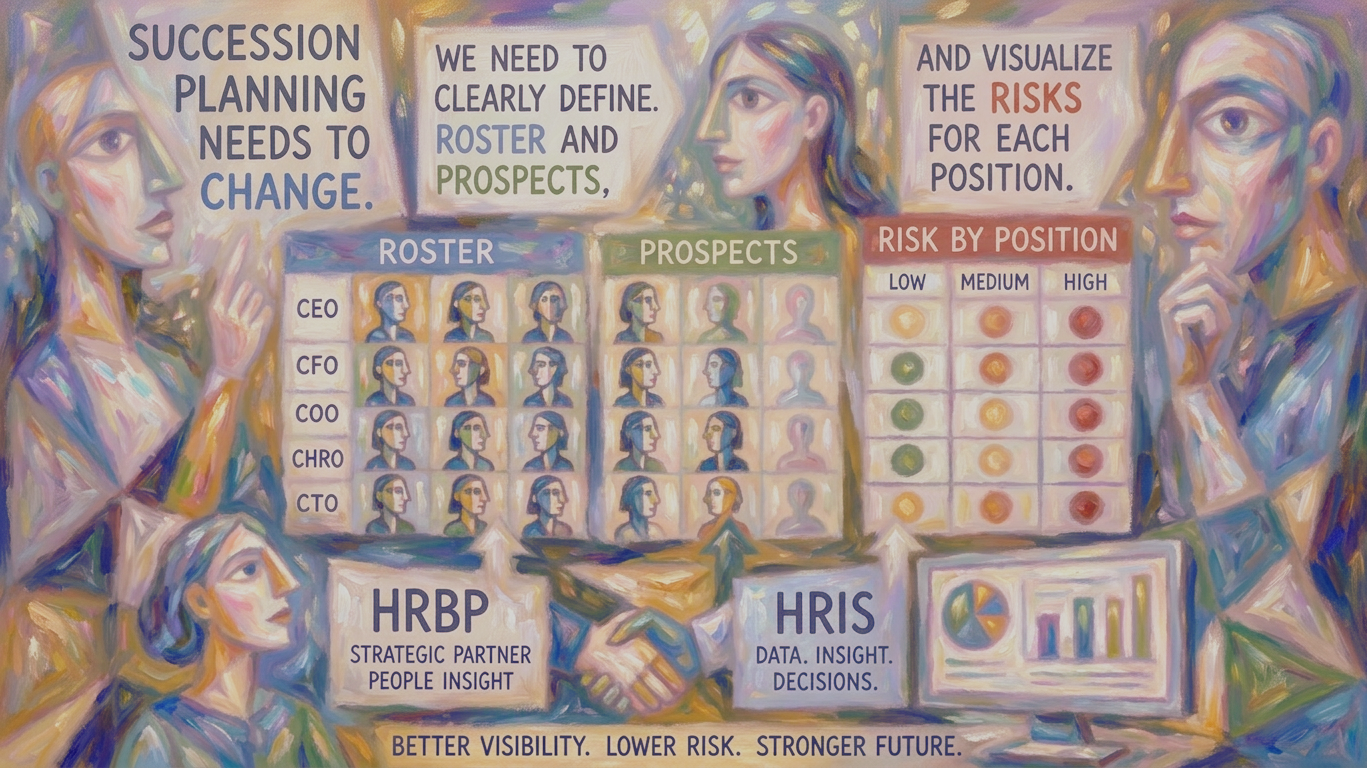
Separating roster planning from prospect planning
Succession planning is an important agenda for any company.
For HR in particular, it requires a systematic view of key positions, successor candidates, readiness, development needs, mobility, and organizational risk.
In many companies, these elements are discussed together under the broad label of succession planning.
However, when succession planning is operated in practice, confusion often arises.
There may be a gap in time horizon.
There may be a gap between how people are viewed and how the organization is viewed.
There may also be bias in how candidates are selected.
One reason for this confusion, we believe, is that succession planning often mixes together things that should be considered separately.
One is roster planning.
Roster planning is about the positions required to execute the current or near-term business plan, and the talent pool available to fill those positions.
The other is prospect planning.
Prospect planning is about the pool of people who may become future core talent for the organization.
Traditional succession planning has often discussed these two together, usually under the concept of career paths.
A company may assume a fixed career path in advance, and then try to place people on that track or pipeline.
By doing so, it attempts to decide both the roster and the prospects at the same time.
The succession plan is then completed by listing incumbents and potential successors.
This may have been the common approach in many organizations.
However, the succession planning we would like to propose here is slightly different.
Roster planning is about deciding who should be placed in which critical position, either now or in the near future.
Who should be placed where?
If one person is moved, where will another gap open?
Which position would create a serious business impact if it became vacant?
Which placement would be most reasonable for the organization as a whole?
This is close to organizational operating decision-making.
Prospect planning, on the other hand, is about identifying and developing future candidates.
Who may become a future candidate?
What experience is still missing for that person?
Which role would increase their readiness?
For which key positions is the candidate pool too thin?
This is closer to talent management and people development.
If these two are not separated, a company may end up with a list of successor candidates, while actual organizational risks and development needs remain unclear.
Succession planning is not simply about deciding whom the successor is for a given position.
It is a mechanism for making visible where the organization is vulnerable and which people should be developed as future prospects.
For that reason, roster and prospect should first be separated.
In roster planning, HR needs to look at the organization.
Key positions.
Vacancy risk.
Availability of successor candidates.
Availability of ready-now candidates.
Availability of ready-soon candidates.
Single-person dependency.
Dependence on external hiring.
Knock-on risk created by internal movement.
These risks cannot be seen from a simple list of successor candidates.
For roster planning, a heat map is useful.
Which positions are truly critical?
Where is succession risk concentrated?
If one person is moved, where will another organizational gap appear?
Which function depends too heavily on one individual?
By layering this information on top of the organization chart and position data, roster discussions can move beyond simple people selection and become a discussion about organizational risk.
In prospect planning, HR needs to look at people.
However, looking at people does not mean that HR owns people.
HR’s role is not to hold the right to decide assignments.
Rather, HR should help the organization make future candidates visible.
For which role is this person a prospect?
What experience is missing for that role?
What assignment should this person experience next?
Is the candidate pool thick or thin?
Are future candidates being developed in specific businesses or functions?
Continuously looking at these questions is the essence of prospect planning.
Then, how should HR operate this kind of succession planning in practice?
We believe two things are especially important.
The first is to clarify the role of HRBP.
The second is to design how HRIS should be used.
When HRBPs are involved in succession planning, their roles can be broadly divided into three types.
The first is HRBP as an organizational arranger.
In this case, the HRBP looks more closely at the roster.
However, this does not mean that HRBP decides the roster.
The role of HRBP is to visualize the organizational risks associated with placement decisions.
Where does the organization need people?
Which positions should be prioritized?
If one person is moved, which organization will be affected?
Where could knock-on risk occur?
This role is close to organizational operation.
The second is HRBP as a development partner.
In this case, HRBP looks at prospects.
Who may become a future candidate?
What experience is missing?
Which assignment would be effective for development?
Which candidate pool is too thin?
This role works closely with Talent Management and HR COE.
The third is HRBP as an agent.
In this case, HRBP connects people with opportunities.
Where is the next opportunity that fits this person?
Are there internal candidates being overlooked for this position?
Where can individual growth and organizational needs meet?
This is close to the idea of an internal talent marketplace.
There is no single correct model.
However, if the role of HRBP remains unclear, succession planning becomes confused.
Is HRBP looking at organizational risk in the roster?
Is HRBP identifying prospects?
Is HRBP connecting people with opportunities?
If this is not clarified, succession planning meetings easily become a mixture of candidate lists, development plans, and placement discussions.
How HRIS should be used also depends on the role of HRBP.
Today’s HRIS already contains a large amount of data.
People.
Positions.
Organization charts.
Grades.
Performance evaluations.
Mobility history.
Skills.
Learning history.
Career aspirations.
Successor candidates.
Readiness.
However, data alone does not make succession planning work.
Whether HRIS can be used effectively depends on how KPIs are designed.
Many companies already have KPIs for individual performance management.
Goals.
Achievement levels.
Performance ratings.
Evaluation comments.
However, these KPIs are mainly for tracking individual progress and performance.
Succession planning requires something more.
The KPIs discussed here are not scores for labeling people.
They are indicators for sharing organizational risks and development needs that should not be overlooked.
Roster planning requires KPIs that help the organization see organizational risk.
Successor coverage for key positions.
Availability of ready-now candidates.
Availability of ready-soon candidates.
Business impact of vacancy.
Single-person dependency.
Secondary gaps caused by internal movement.
Dependence on external hiring.
These are KPIs for understanding organizational vulnerability.
Prospect planning requires KPIs that help HR and leadership see development progress.
Depth of prospect pools.
Experience gaps.
Next required assignments.
Change in readiness.
Retention risk.
Progress of candidate development.
These are KPIs for understanding whether future organizational capability is being developed.
When HRIS is introduced, companies are sometimes told:
Let us first accumulate data.
Then we can think about how to use it.
This may sound reasonable.
However, from the perspective of succession planning and organizational visibility, it is not enough.
Data does not automatically become a KPI simply because it is accumulated.
If the purpose of the data is not defined at the time of implementation, it becomes difficult to later turn HRIS into an information foundation that can support organizational judgment.
Of course, companies do not need to design perfect KPIs from the beginning.
The first KPIs can be hypotheses.
When a company introduces management accounting for the first time, it often goes through confusion around allocation, KPIs, accountability, and how to read the numbers.
The same can happen with HRIS.
There may be confusion around prospects, key positions, readiness, and organizational vulnerability.
But this confusion is not necessarily bad.
It means that the way people and the organization have been understood through tacit knowledge and experience is finally becoming a subject of organizational discussion.
Here, an important comparison can be made with management accounting.
A company is not managed by the management accounting system itself.
Management accounting does not replace management.
However, management accounting allows leaders to see revenue, profit, inventory, cost, cash flow, and business-unit profitability through a shared management view.
The same kind of visibility is needed for people and the organization.
HRIS does not decide succession.
AI does not decide successors.
However, key positions, succession risk, prospects, development needs, and organizational vulnerability should be visible to management, the business, and HR through a shared view.
The role of HRIS in succession planning is not to decide people.
Its role is to visualize people and the organization at a level that can support management judgment.
DX-AI also has an important role in this context.
In our view, DX-AI can serve as a supporting line to check risks and biases in succession planning, which can otherwise become overly dependent on individual judgment.
AI should not provide the final answer to succession planning.
AI should not decide that “this person should be the successor.”
However, AI can help identify overlooked risks and generate KPI hypotheses from HRIS data.
Common experiences among people who were promoted in the past.
Patterns of people who struggled after moving into higher roles.
Career paths of people who reached key positions.
Structural reasons why certain departments do not develop enough candidates.
Organizational impact created by moving a particular person.
AI can explore these patterns and draw supporting lines for seeing people and the organization.
Still, what is ultimately necessary is the view that management and HR hold about people.
If there is someone in the organization with an exceptional eye for talent, that person is probably looking at things such as who does not run away from difficult situations, who can move people across functions, and who may struggle in a higher-level role.
That kind of judgment cannot be directly embedded into a system from the beginning.
However, it can be verbalized, placed as a KPI hypothesis, and tested through HRIS and AI.
Before succession planning, can we see both people and the organization?
This question should be asked before creating a list of successor candidates.
Are roster and prospect considered separately?
Is the role of HRBP clear?
Is the roster visible through a heat map?
Are prospects visible through development KPIs?
Does HRIS have the data and KPI design needed for these purposes?
Only after these questions are addressed can DX-AI be implemented properly in succession planning.
Succession planning is not about listing names of successor candidates.
It is a mechanism for connecting roster, prospects, organizational risk, and development needs so that future organizational capability does not stop.
Building that mechanism.
And visualizing people and the organization at a level that can support management judgment.
This may be one of the important roles required of Strategic HR going forward.(Originally posted on LinkedIn on 2026-08-04)
About Errand Consulting
Errand Consulting explores organizational transformation
through the ERR& Philosophy.
Learn more → www.hrfd3.com
ERR& Tips Vol.4
サクセッションプランの前に、「人」と「組織」は見えているか?
ロースターとプロスペクトを分けて考える
サクセッションプランは、企業にとって重要なテーマです。
とりわけ人事部門にとっては、キーポジション、後任候補、Readiness、育成課題、異動可能性、組織上のリスクなどを体系的に整理した上で、具体的なロードマップをデザインする必要があります。
そして多くの企業では、これらを一つのサクセッションプランとして議論しています。
しかし、サクセッションプランニングを実務で回していくと、時間軸のズレ、人と組織のズレ、そして選択のバイアスに起因する意思決定の混乱に遭遇することがあります。
その主な理由は、サクセッションプランの中で、本来分けて考えるべきものが混ざっているからではないかと私たちは考えています。
一つは、ロースタープランニングです。
これは、現在または近い将来の事業計画を完遂するために必要なポジションと、そのポジションを埋めるための人材プールを考えることです。
もう一つは、プロスペクトプランニングです。
これは、将来の中核人材となり得る候補者のプールを考えることです。
従来のサクセッションプランニングでは、キャリアパスという概念のもとで、この二つを一緒に議論する傾向がありました。
あらかじめ固定的なキャリアパスを想定し、そのレールやパイプラインに誰を当てはめるかを考えることで、ロースターもプロスペクトも同時に決めようとするやり方です。
そして、現職者と後任候補をリスト化することで、全体のサクセッションプランを完成させる。
このような形が一般的だったのではないかと思います。
しかし、私たちが今回提唱したいサクセッションプランニングは、少し異なります。
ロースタープランニングとは、現在または近い将来、どの重要ポジションに誰を配置するのかを考えることです。
誰をどこに置くのか。
誰を動かすと、どこに穴が開くのか。
どのポジションが空くと、事業に大きな影響が出るのか。
どの配置が、組織全体として最も合理的なのか。
これは、組織運営上の意思決定に近い領域です。
一方で、プロスペクトプランニングとは、将来の候補者を見立て、育成していくことです。
誰が将来の候補になり得るのか。
その人には、どの経験が不足しているのか。
どの役割を経験すれば、Readinessが上がるのか。
どのキーポジションに対して、候補者プールが薄いのか。
これは、タレントマネジメントや人材育成に近い領域です。
この二つを分けないままサクセッションプランを議論すると、後任候補者リストはできても、実際の組織リスクや育成課題は見えにくくなります。
サクセッションプランは、単に「このポジションの後任は誰か」を決める作業ではありません。
それは、組織のどこに脆弱性があり、どの人材を将来のプロスペクトとして育てるべきかを見えるようにする仕組みです。
そのためには、まずロースターとプロスペクトを分けて考える必要があります。
ロースタープランニングでは、組織を見る必要があります。
キーポジション。
空席リスク。
後任候補の有無。
Ready now候補の有無。
Ready soon候補の有無。
単独依存。
外部採用依存。
異動による玉突きリスク。
これらは、個別の後任候補リストだけでは見えません。
ロースタープランニングでは、ヒートマップが有効です。
どのポジションが重要なのか。
どこに後継リスクが集中しているのか。
どの人を動かすと、別の組織に穴が開くのか。
どの機能が、特定の人に依存しているのか。
こうした情報を組織図やポジション情報の上に重ねて見ることで、ロースターの議論は、単なる人選ではなく、組織リスクの議論になります。
一方で、プロスペクトプランニングでは、人を見る必要があります。
ただし、人を見るとは、人事が人を所有することではありません。
人事が担うべきなのは、配置権を持つことではなく、将来の候補者を組織として見える状態にすることです。
この人は、どの役割のプロスペクトなのか。
その役割に対して、どの経験が足りないのか。
次に経験させるべきアサインメントは何か。
候補者プールは厚いのか、薄いのか。
特定の事業や機能で、将来の候補者が育っているのか。
これらを継続的に見ていくことが、プロスペクトプランニングです。
では、このようなサクセッションプランニングを実務で運用していくためには、何が必要なのでしょうか。
私たちは、重要なのは二つだと考えています。
一つは、HRBPの役割を明確にすることです。
もう一つは、HRISをどのように活用するかを設計することです。
まず、HRBPがサクセッションプランに関わる場合、その役割は大きく三つに分かれます。
一つ目は、編成担当としてのHRBPです。
この場合、HRBPはロースターに近いところを見ます。
ただし、HRBPがロースターを決めるという意味ではありません。
HRBPが担うべきなのは、配置判断に伴う組織リスクを可視化することです。
組織のどこに人を配置する必要があるのか。
どのポジションを優先すべきなのか。
誰を動かすと、どの組織に影響が出るのか。
どこに玉突きのリスクがあるのか。
これは、組織運営にかなり近い役割です。
二つ目は、育成担当としてのHRBPです。
この場合、HRBPはプロスペクトを見ます。
誰が将来候補になり得るか。
どの経験が不足しているか。
どのアサインメントが育成上有効か。
どの候補者プールが薄いか。
これは、Talent ManagementやHR COEと連携する役割です。
三つ目は、エージェントとしてのHRBPです。
この場合、HRBPは人材と機会をつなぎます。
この人に合う次の機会はどこか。
このポジションに対して、社内に見落としている候補者はいないか。
本人の成長と組織ニーズが合う機会はどこか。
これは、社内タレントマーケットのような発想に近い役割です。
どの役割が正しいということではありません。
しかし、HRBPがどの役割を担っているのかを曖昧にしたままサクセッションプランを運営すると、混乱が起こります。
HRBPがロースターの組織リスクを見ているのか。
プロスペクトを見立てているのか。
人材と機会をつないでいるのか。
ここを明確にしなければ、サクセッションプランは、候補者リスト、育成計画、配置議論が混ざった会議になってしまいます。
そして、HRISをどう使うかも、このHRBPの役割によって変わります。
現在のHRISには、多くのデータがあります。
人。
ポジション。
組織図。
等級。
評価。
異動履歴。
スキル。
研修履歴。
キャリア希望。
後任候補。
Readiness。
しかし、データがあるだけでは、サクセッションプランは機能しません。
HRISを活用できるかどうかは、KPIをどのように設定できているかによって決まります。
個人評価のためのKPIは、多くの企業に存在します。
目標。
達成度。
評価レーティング。
評価コメント。
しかし、それは主に、個人の進捗管理や業績評価のためのKPIです。
サクセッションで必要なのは、それだけではありません。
ここでいうKPIは、人を点数化するためのものではありません。
組織として見落としてはいけないリスクや育成課題を共有するための指標です。
ロースタープランニングには、組織を見るKPIが必要です。
キーポジションの後継充足率。
Ready now候補の有無。
Ready soon候補の有無。
空席時の事業影響。
単独依存度。
異動による二次的な穴。
外部採用依存度。
これらは、組織の脆弱性を見るためのKPIです。
プロスペクトプランニングには、育成を見るKPIが必要です。
プロスペクトプールの厚み。
経験ギャップ。
次に必要なアサインメント。
Readinessの変化。
リテンションリスク。
候補者の育成進捗。
これらは、将来の組織能力が育っているかを見るためのKPIです。
HRIS導入時に、「まずデータをためましょう。その後で使い方を考えましょう」という進め方が取られることがあります。
しかし、サクセッションや組織可視化の観点では、それだけでは不十分です。
データは、目的なく蓄積すれば自然にKPIになるわけではありません。
何を見るためのデータなのかを決めずに導入したHRISは、後から組織判断に耐える情報基盤に変えることが難しくなります。
もちろん、最初から完璧なKPIを作る必要はありません。
むしろ、最初のKPIは仮説でよいと思います。
管理会計を初めて導入した会社が、配賦、KPI、責任範囲、数字の読み方をめぐって試行錯誤するように、HRISでも、プロスペクト、キーポジション、Readiness、組織脆弱性の見方をめぐって混乱は起こります。
しかし、その混乱は悪いことではありません。
それまで暗黙知や経験則で処理されていた人と組織の見方が、初めて組織の議論の対象になるからです。
ここで重要なのは、管理会計の仕組みが経営そのものを代替しているわけではないという点です。
管理会計があるから経営が行われるわけではありません。
しかし、管理会計があることで、経営層は売上、利益、在庫、コスト、キャッシュフロー、事業別収益性などを、共通の視界で見ることができます。
同じことが、人と組織にも必要なのではないでしょうか。
HRISがサクセッションを決めるわけではありません。
AIが後任者を決めるわけでもありません。
しかし、キーポジション、後継リスク、プロスペクト、育成課題、組織上の脆弱性を、経営、現場、人事が同じ視界で見られる状態にすることは必要です。
サクセッションプランにおけるHRISの役割は、人を決めることではありません。
人と組織を、経営判断に耐える粒度で可視化することです。
そして、DX-AIをどのように使っていくかも、ここで重要になってきます。
私たちの考えでは、DX-AIは、属人的になりがちなサクセッションプランニングに対して、見落とされているリスクや判断の偏りを確認するための補助線になり得ます。
AIは、サクセッションの答えを出すものではありません。
AIが「この人を後継者にすべき」と決めるべきではありません。
しかし、AIはHRIS上のデータから、見落とされているリスクやKPI仮説を示すことはできます。
過去に昇格した人の共通経験。
上位職で失速した人のパターン。
キーポジションに到達した人の職務経路。
特定部門で候補者が育たない構造。
ある人を動かした場合の組織上の影響。
AIは、これらを探索し、人と組織を見るための補助線を引くことができます。
ただし、最後に必要なのは、経営層とHRが人をどう見るかという考え方です。
仮に名伯楽のような人が組織にいれば、その人はおそらく、誰が修羅場で逃げないか、誰が部門を越えて人を動かせるか、誰が上位職で失速しそうかを見ています。
その見立てを、いきなりシステムに入れることはできません。
しかし、それを言語化し、仮説KPIとして置き、HRISとAIを使って検証していくことはできます。
サクセッションプランの前に、「人」と「組織」は見えているか。
この問いは、後任候補者リストを作る前に問われるべきものです。
ロースターとプロスペクトは分けて考えられているか。
HRBPの役割は明確になっているか。
ロースターはヒートマップで見えているか。
プロスペクトは育成KPIで見えているか。
その上で、HRISには、そのためのデータとKPIが設計されているか。
ここまで確認して初めて、DX-AIをサクセッションプランニングに正しく実装できる可能性が高まります。
サクセッションプランは、後任候補者の名前を並べることではありません。
それは、将来の組織能力を止めないために、ロースター、プロスペクト、組織リスク、育成課題を接続して見る仕組みです。
その仕組みをつくること。
そして、人と組織を経営判断に耐える粒度で可視化すること。
それが、これからのStrategic HRに求められる役割ではないでしょうか。(Originally posted on LinkedIn on 2026-08-04)
About Errand Consulting
Errand Consulting explores organizational transformation
through the ERR& Philosophy.
Learn more → www.jp.hrfd3.com
Comments
Comments settings

LikeCommentShare
Add a comment…
Open Emoji Keyboard
No comments, yet.
Be the first to comment.Start the conversation


コメント