— The Utility That AI Orchestration Brings into View —
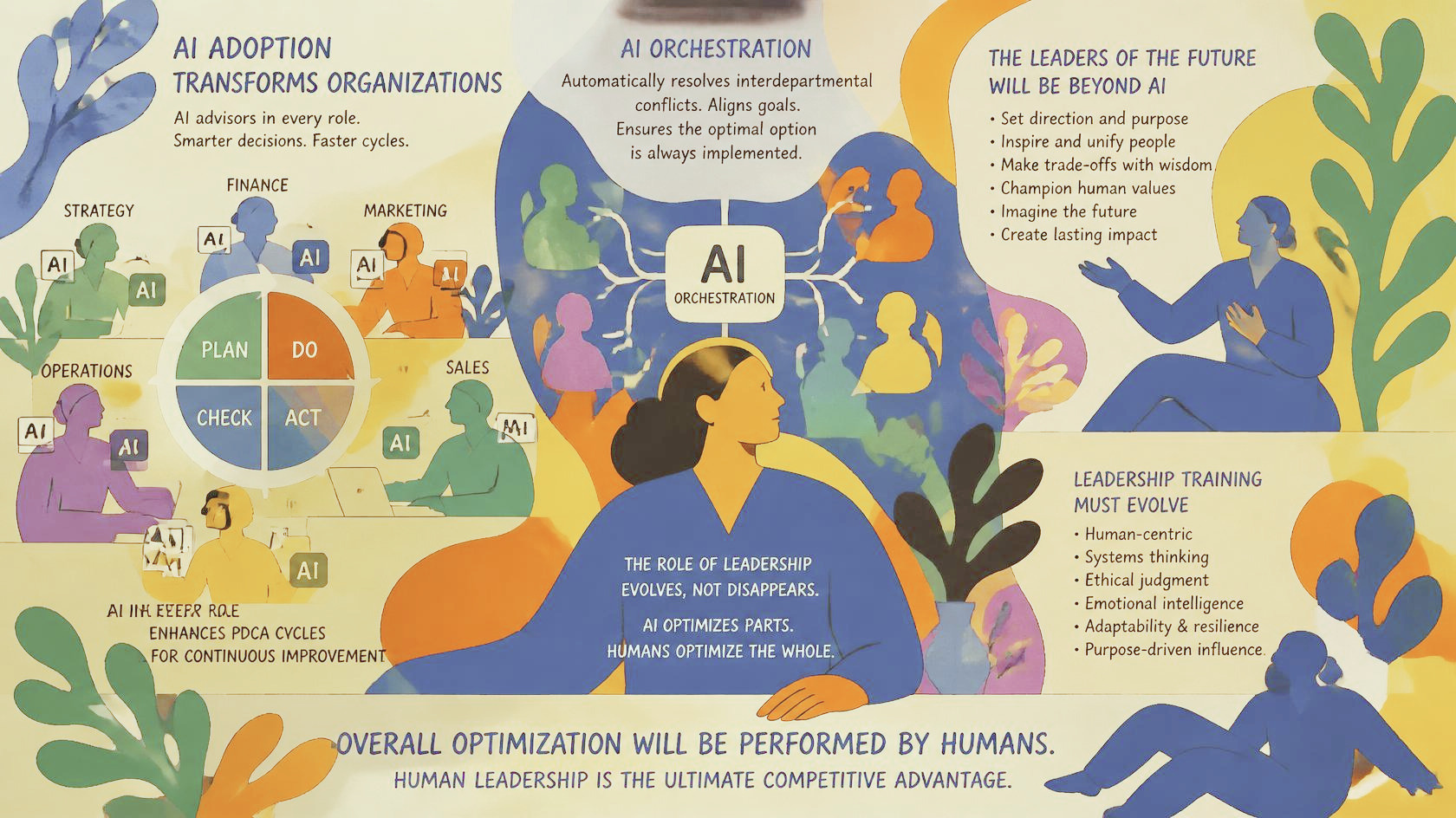
In our previous ERR& Insight Vol.23, How Will AI Orchestration Change Organizations? Part 2, we explored AI Orchestration and its implications, particularly for Management Architecture.
Our perspective was:
Being able to orchestrate AI Agents and Workflows is not the same as orchestrating the enterprise itself through AI.
AI can increase the Speed of Management.
It can provide a certain level of Accuracy.
It can expand the Reach of Execution.
But that does not mean Management or Leadership itself becomes unnecessary.
In fact, as AI Orchestration becomes more sophisticated, organizations may face increasingly visible questions about their Management Architecture.
How far should we delegate to AI?
Where should Professionals be given discretion?
Where should Management itself take responsibility for Judgment?
We believe these questions will become more, not less, important.
At the end of that Insight, we also proposed one hypothesis about Leadership Development.
The age of AI may not require us to invent an entirely new form of Leadership.
Instead, perhaps we need to revisit and re-establish one of Management’s longstanding responsibilities:
See people. Give them difficult assignments. Observe what they do. And choose the next Leader based on the result.
This Missing Link continues from that discussion.
After completing the previous piece, another question emerged.
We often hear that as AI reduces Routine Work, people will be able to focus on more Strategic work.
But will that necessarily happen?
What actually remains for people once AI takes over Routine Work?
AI will increasingly be able to generate Options for what and how at unprecedented Speed.
But why should a particular Option be chosen?
How should that choice be interpreted within the Business Context?
And who ultimately takes responsibility for the outcome?
Management Judgment and Accountability still remain.
This may provide one starting point for reconsidering Leadership Training in the age of AI.
AI Reduces Routine. But What Remains?
AI is highly effective at work that can be formally defined.
Collecting information.
Making comparisons.
Creating Documents.
Moving Workflows forward.
Making decisions according to defined Rules.
Standardizing Processes.
In these areas, AI will likely eliminate a significant amount of Routine Work.
But if we look carefully at what people actually do inside organizations, these are not the only activities that make an Organization work.
Someone connects one Function with another.
Someone translates Management Intent into language that the frontline can act on.
Someone moves people who cannot be moved through Formal Authority alone.
Someone temporarily takes ownership of a seemingly minor issue that isn’t in anyone’s Job Description.
Someone handles exceptions that existing Processes cannot resolve.
Someone decides whether to step in when no one is clearly responsible.
Or, even when something technically falls within their Role, someone deliberately chooses not to intervene and allows another Professional to act.
Organizations contain a great deal of this work.
And somewhat paradoxically, as AI reduces Routine Work, the proportion of this kind of work may actually increase.
AI can reduce Routine Work.
But that does not automatically mean it reduces the “work between the gaps” that people deal with every day.
It is well understood in Management that the sum of local optimization does not necessarily produce enterprise optimization.
As AI penetrates individual Functions and Jobs, the Speed of local optimization may increase.
The work required to connect those locally optimized pieces back into the whole may therefore increase as well.
That is our hypothesis.
In other words:
AI reduces routine work, but it does not necessarily reduce utility work.
As Routine disappears from individual Jobs, the Utility Roles people carry may actually increase.
This may be an issue that has received relatively little attention.
What Exists Between Jobs?
We want to call this Functionality that cannot be fully explained by Formal Jobs or Roles:
Utility.
By Utility, we do not simply mean being useful or being a convenient person to have around.
Utility is what makes the organization work beyond its formal design.
It is the additional Functionality that fills the gaps when Formal Jobs, Roles, Processes, and Decision Rights alone are insufficient for the Organization to function.
And delivering this Utility requires more than expertise in a single discipline.
First comes Multidisciplinary Understanding.
A person needs to understand not only their own field, but also the logic through which different Functions and Professionals operate.
Second is Role & Context Awareness.
A person needs to understand not only their own Role, but also the Roles of others — including the constraints, expectations, and Accountability surrounding them.
Third is Timing Judgment.
When should I act?
When should I deliberately not act?
Finally comes Action Selection.
Should I support?
Coordinate?
Challenge?
Temporarily take responsibility?
Or leave the issue to another Professional?
The right Action depends on the Situation.
Utility, therefore, can be understood as:
the Functionality that enables an Organization to work beyond its Formal Design by understanding multiple disciplines, reading the Roles and Context of others, and choosing the right intervention at the right time.
And in many cases, people with this Utility perform that Functionality across multiple Situations simultaneously.
Is Much of Leadership Actually Utility?
Now let us consider Leadership.
If we look at the way the word Leadership is used, an extraordinary number of adjectives appear in front of it.
Transformational Leadership.
Situational Leadership.
Servant Leadership.
Adaptive Leadership.
Strategic Leadership.
Inclusive Leadership.
Cross-cultural Leadership.
Why does Leadership require so many adjectives to explain what it means?
One hypothesis is that Leadership itself does not have a stable Task Set.
Finance has Finance work.
Engineering has Professional Engineering work.
But Leadership cannot be fully explained as a Job attached to one particular Function.
In Transformation, Leadership appears within the Context of Transformation.
In Crisis, within the Context of Crisis.
In Cross-functional problems, between Functions.
Leadership becomes necessary when Formal Structure and Process alone are not enough to make the Organization work.
If so, another interpretation becomes possible:
A significant part of Leadership may actually be Utility exercised between Jobs and between Roles.
In this article, we would like to call the Leadership that enables an Organization to function through this Utility:
Leadership Utility.
Leadership Utility does not simply mean occupying a Leadership Position.
Leadership Functionality becomes visible when Formal Jobs and Roles alone are insufficient.
Reading the Context.
Understanding the Roles of others.
Judging when to act.
Selecting the appropriate Action.
And making the Organization work.
This may also explain why Leadership Training repeatedly addresses subjects such as:
Communication.
Influence.
Coaching.
Conflict Management.
Stakeholder Management.
Delegation.
Decision Making.
These are not merely Technical Skills required to perform a particular Job.
They also act as the lubricant that allows people in Leadership Positions to reduce organizational friction and make an Organization function beyond its Formal Structure.
In that sense:
Leadership Training develops the utility that allows leadership positions to function effectively.
And this is where our main question begins.
Can Leadership Utility Be Taught?
There is a problem.
Leadership Utility is difficult to teach as a simple Skill.
People can attend the same Training and still demonstrate very different levels of Leadership Utility.
Even when faced with the same Situation:
One person recognizes the right moment to intervene.
Another intervenes too much.
One person knows when to trust another Professional.
Another takes everything onto themselves.
Leadership Utility is not simply Knowledge.
It is Contextual Judgment formed through Experience.
And that Judgment is refined through many forms of feedback loops.
How did someone react after I intervened?
Did the meeting change?
Did the Project move forward?
Did my intervention create confusion instead?
Did I gain someone’s trust?
Or did I interfere too much?
Through repeated formal and informal Feedback, people gradually learn:
“This is a Situation where I should step in.”
“This is a Situation where I should stay out.”
In other words:
Experience creates Utility.
Feedback calibrates it.
And:
Reflection makes it visible.
Leadership Utility may not be something that can be taught in Training.
It may instead be something that is:
experienced, calibrated, recognized, and remembered.
Is More Feedback Always Better?
Leadership Development and Coaching repeatedly emphasize the importance of Feedback.
Feedback is, of course, important.
But does every kind of work require frequent Feedback?
In a Core Role in which someone is already highly proficient, the Outcome itself often provides important Feedback.
A Professional can usually perform a certain degree of Self-correction within their own field.
If a Manager or Coach constantly adds Feedback, it may sometimes encourage the person to conform to an external answer rather than strengthen their own Judgment.
Leadership Utility is somewhat different.
Because Leadership Utility is exercised through relationships with others and within a particular Context, the individual cannot always see the effect of their own Actions.
“Did I really need to speak at that moment?”
“By deliberately staying silent, did I allow another Manager to take responsibility?”
“Did my coordination actually make the Organization move?”
“Or did I take over someone else’s Role?”
These questions cannot always be answered through self-feedback alone.
Therefore, what Leadership Utility needs may not be:
Feedback, Feedback, Feedback
but rather:
Feedback where self-correction is difficult.
Self-feedback and Accountability
Accountability also matters.
In a typical Leadership Training environment, a Coach may say:
“You should have done more of this.”
“You should have spoken up in that situation.”
But the Coach does not necessarily hold Business Accountability for the consequences of that Action.
The participant may be operating within a Context the Coach cannot fully see.
Speaking up may mean taking ownership of the entire issue.
Choosing not to intervene may be an intentional attempt to allow another Leader to develop.
Decision Rights may belong to another Function.
All of these are possible.
This means that when we consider Leadership Utility:
Observation alone is not enough to make a Judgment.
We also need:
Role, Context, Timing, and Accountability.
For a Coach who does not hold Accountability for the Business Outcome, the role may therefore be less about providing the correct answer and more about encouraging Reflection.
“Why did you act there?”
“Why did you choose not to act?”
“What were you seeing?”
“What other Options were available?”
That may be where Self Coaching begins.
What Was Missing from Coaching?
In an earlier ERR& Insight,
The Myth of Coaching — How to Utilize Traditional Coaching in the Business Context
we divided Corporate Coaching into two broad categories.
The first was Control Coaching, which accelerates the PDCA Cycle in order to achieve a defined objective.
The second was Developmental Coaching, which develops the individual’s Capability.
Control Coaching primarily helps a Role function more effectively.
Developmental Coaching primarily develops the Person.
In other words:
Control Coaching → Role
Developmental Coaching → Person
But when we reconsidered Leadership through the lens of AI Orchestration, we realized that something was missing.
Not the Person.
Not the Role.
But something that enables:
the Organization itself to function.
That is Leadership Utility.
So we can now see three different layers:
Developmental Coaching → Person
Control Coaching → Role
and
Leadership Utility → Organization
We do not consider Leadership Utility to be a third form of Coaching.
It is not the same as developing a Person.
It is not the same as enabling a Role.
Leadership Utility operates in the gaps left by Formal Design and enables:
the Organization itself to function.
We believe this Leadership Utility may be the Missing Link that Leadership Development has not fully captured.
Another Role for Leadership Training
So how does Leadership Training relate to Leadership Utility?
Leadership Training has traditionally been viewed as a place to teach Leadership.
But if a significant part of Leadership is exercised through Utility, and Leadership Utility itself is formed through Experience, Leadership Training may have another purpose.
Participants reflect on their Experience.
What was the Context?
What was my Formal Role?
What could not be handled through the Formal Structure?
Why did I act?
What Judgment did I make?
How did others respond?
What changed?
Could I have chosen another Action?
Through Dialogue with Peers, Facilitators, and Coaches, Experiences that normally remain unspoken become Narratives.
Leadership Training therefore becomes not only a place to:
develop Leadership Utility
but also a place to:
make Leadership Utility visible.
And in the age of AI, Leadership Training may take on one additional role:
a place where the Organization can begin to remember Leadership Utility.
AI Can Remember Jobs. But Can It Remember Leadership Utility?
AI can connect many forms of information held by an enterprise.
Position.
Career History.
Performance.
Skill.
Assignment.
Project.
Training History.
These are relatively easy to record as Data.
But Leadership Utility is different.
“Why was this person able to make the Organization move in that Situation?”
“Why did this person take ownership of a problem that belonged to no Formal Role?”
“Why did this person intervene at that particular moment?”
“Why did this person deliberately choose not to act?”
These things rarely remain in a conventional Record.
The Outcome remains.
But:
What actually made the organization work?
often does not.
AI can see the Jobs that have been recorded.
But for AI to recognize the Leadership Utility that actually made the Organization function, that Experience first needs to become visible in some form.
This creates a new possibility for Leadership Training.
Instead of thinking only in terms of:
Learn → Practice → Improve
we may need to expand the Process to:
Experience → Reflect → Articulate → Remember
Leadership Experience that becomes articulated through this Process should not simply become another Training Record stating:
“Leadership Program Completed.”
It could instead become part of:
Organization Memory.
AI does not need to choose the Leader.
AI does not need to score Leadership.
Instead, AI can help ensure that when people reflect on their Experience and their Leadership Utility becomes articulated, the Organization doesn’t lose that knowledge.
What Should Leadership Training Really Preserve?
If this hypothesis is correct, what Leadership Training should preserve is not the Record that someone attended a Program.
It is the Experience of:
the Context they faced,
the Role they moved beyond,
the Judgment they made,
the Timing at which they chose to act,
and how they ultimately helped the Organization function.
AI may reduce Routine Work and allow people to spend more time on Strategic work.
That is one possibility.
But there is another.
As Routine disappears, the Utility that has traditionally remained hidden behind Formal Jobs may become increasingly important.
And the Leadership exercised through that Utility —
Leadership Utility
— may become increasingly important to organizations in the age of AI.
Yet Leadership Utility is difficult to capture in a Job Description.
It is difficult to capture in a Performance Record.
And it is rarely captured in conventional Training History.
That is why we believe Leadership Utility may be the:
Missing Link.
Leadership Training may not only develop leadership.
It may be one of the few places where Leadership Utility becomes visible — and where the organization can begin to remember it.
AI may not make Leadership Training into something entirely new.
Instead, AI Orchestration may reveal a value that Leadership Training has always had, but that organizations have not fully recognized.
If so, Leadership Training in the age of AI will no longer be merely a Learning Program.
It may become:
a Memory Mechanism through which an Organization preserves the Leadership Utility that actually made it work. (Originally posted on LinkedIn On 2026-09-11)
About Errand Consulting
Errand Consulting explores organizational transformation
through the ERR& Philosophy.
Learn more → www.hrfd3.com
- — The Utility That AI Orchestration Brings into View —
- AI Reduces Routine. But What Remains?
- What Exists Between Jobs?
- Is Much of Leadership Actually Utility?
- Can Leadership Utility Be Taught?
- Is More Feedback Always Better?
- Self-feedback and Accountability
- What Was Missing from Coaching?
- Another Role for Leadership Training
- AI Can Remember Jobs. But Can It Remember Leadership Utility?
- What Should Leadership Training Really Preserve?
- AI時代のLeadership Trainingはどうなっていくのか?
- ― AI Orchestrationが浮かび上がらせた、Organizationを動かす力 ― Utility
- AIはRoutineを減らす。しかし何が残るのか
- JobとJobの間にあるもの
- Leadershipの多くはUtilityなのではないか
- Leadership Utilityは教えられるのか
- Feedbackは多ければよいのか
- Self FeedbackとAccountability
- Coachingでは何が欠けていたのか
- Leadership Trainingのもう一つの役割
- AIはJobを記憶する。しかしLeadership Utilityは残るのか
- Leadership Trainingで本当に残すべきもの
AI時代のLeadership Trainingはどうなっていくのか?
― AI Orchestrationが浮かび上がらせた、Organizationを動かす力 ― Utility
前回のERR& Insight Vol.23 How Will AI Orchestration Change Organizations? Part 2
では、AI Orchestrationとその影響、特にManagement Architectureへの影響について考察しました。
私たちの考え方は、
AI AgentやWorkflowをOrchestrateできることと、AIによって企業そのものをOrchestrateできることは同じではない。
ということです。
AIはManagementのSpeedを高める。
一定のAccuracyを提供する。
ExecutionのReachを広げる。
しかし、それによってManagementやLeadershipそのものが不要になるわけではありません。
むしろAI Orchestrationが高度になるほど、
どこまでAIに任せるのか。
どこでProfessionalに裁量を与えるのか。
どこで経営者自身がJudgmentを引き受けるのか。
こうしたManagement Architecture上の課題が、Organizationの中でより鮮明に浮かび上がるのではないか。
私たちはそのように考えました。
そして最後に、Leadership Developmentについても一つの仮説を置きました。
AI時代だからといって、まったく新しいLeadershipを発明する必要があるわけではない。
むしろ、
人を見て、難しい仕事を任せ、その結果から次のLeaderを選ぶ。
という、かつてManagementが担ってきたProcessを、改めて評価し、Organizationの中に実装する必要があるのではないか。
今回のMissing Linkは、その延長線上にあります。
前回の議論を終えた後、私たちはもう一つの疑問を持ちました。
AIがRoutine Workを減らしていけば、人はよりStrategicな仕事へ集中できる。
AIについては、よくそのように言われます。
しかし、本当にそうでしょうか。
Routine WorkをAIが引き受けた後に、人に残る仕事は何なのでしょうか。
AIはWhatやHowについて、これまで以上のSpeedでOptionを提示できるようになります。
しかし、そのOptionをなぜ選ぶのか。
その選択をBusiness Contextの中でどう意味づけるのか。
そして、その結果を誰が引き受けるのか。
そこには依然としてManagementのJudgmentとAccountabilityが残ります。
私たちは、このことがAI時代のLeadership Trainingを考える一つの入口になるのではないかと考えています。
AIはRoutineを減らす。しかし何が残るのか
AIは、Formalに定義された仕事を非常に得意とします。
情報を集める。
比較する。
Documentをつくる。
Workflowを進める。
一定のRuleに従って判断する。
Processを標準化する。
こうした領域では、AIによって多くのRoutine Workが削減されていくでしょう。
しかし、企業の中で人が行っている仕事をよく見てみると、Organizationを実際に動かしているのは、それだけではありません。
FunctionとFunctionの間をつなぐ。
ManagementのIntentを現場の言葉へ翻訳する。
Formal Authorityでは動かない人を動かす。
誰のJob Descriptionにも明確に書かれていない、一見些細に見える問題を一時的に引き取る。
すでに定義されたProcessでは処理できない例外に対応する。
誰が動くべきか分からないSituationで、自分が動くべきかを判断する。
あるいは、自分のRoleとして定義されていても、あえて動かず、別のProfessionalに任せる。
こうした仕事は、実際のOrganizationには数多く存在します。
そして不思議なことに、AIによってRoutine Workが減るほど、こうした仕事の比率はむしろ高まる可能性があります。
AIはRoutine Workを減らすことはできても、それだけで、人が日々抱えている「隙間の仕事」を減らせるとは限らない。
部分最適の総和が、必ずしも全体最適にはならない。
そのことは企業経営ではよく知られています。
AIが個々のFunctionやJobに浸透するほど、それぞれの部分最適のSpeedは高まります。
その結果、部分最適と全体最適の間をつなぐ仕事が、むしろ増える可能性がある。
私たちはそのように予測しています。
言い換えれば、
AI reduces routine work, but it does not necessarily reduce utility work.
人のJobからRoutineが減ることで、一人ひとりが担うUtility Roleは、むしろ増えるかもしれない。
これは、これまであまり着目されてこなかった問題なのではないでしょうか。
JobとJobの間にあるもの
私たちは、このFormalなJobやRoleでは説明しきれない機能を、あらためて
Utility
と呼んでみたいと思います。
ここでいうUtilityとは、単なる「有用性」や「便利な人」という意味ではありません。
Utility is what makes the organization work beyond its formal design.
FormalなJob、Role、Process、Decision RightsだけではOrganizationが十分に機能しないときに、その隙間を埋め、組織を実際に動かすための追加的なFunctionalityです。
そして、このUtilityを発揮するためには、単一の専門能力だけでは十分ではありません。
まず必要なのは、Multidisciplinary Understandingです。
自分の専門だけではなく、複数のFunctionやProfessionalが、どのような論理で動いているのかを理解する。
次に、Role & Context Awareness。
自分だけではなく、他者がどのRoleを担い、どのような制約、期待、Accountabilityの中にいるのかを理解する。
そして、Timing Judgment。
いつ自分が動くべきなのか。
いつ動かない方がよいのか。
最後に、Action Selection。
支援するのか。
調整するのか。
異論を述べるのか。
一時的に責任を引き取るのか。
Professionalに任せるのか。
Situationに応じて適切なActionを選ぶ。
つまりUtilityとは、
複数の専門領域を理解し、他者のRoleとContextを読み、自分が介入すべきTimingとActionを選ぶことで、Formal Designを越えてOrganizationを機能させるFunctionality
と考えることができます。
そして多くの場合、このUtilityを持つ人は、一つの仕事だけではなく、複数のSituationで同時にその機能を果たしています。
Leadershipの多くはUtilityなのではないか
ここでLeadershipについて考えてみましょう。
世の中で使われているLeadershipという言葉を見ると、その内容を説明するために、驚くほど多くの言葉がその前に置かれています。
例えば、
Transformational Leadership。
Situational Leadership。
Servant Leadership。
Adaptive Leadership。
Strategic Leadership。
Inclusive Leadership。
Cross-cultural Leadership。
なぜLeadershipには、これほど多くの説明のための形容詞が必要なのでしょうか。
一つの仮説は、Leadershipそのものには安定したTask Setがないからです。
FinanceにはFinanceの仕事があります。
EngineeringにはEngineeringのProfessional Workがあります。
しかしLeadershipは、特定の機能に関するJobだけでは説明できません。
TransformationならTransformationというContextで。
CrisisならCrisisというContextで。
Cross-functionalな問題ならFunctionとFunctionの間で。
FormalなStructureやProcessだけではOrganizationが十分に動かないときに、Leadershipが必要になります。
そう考えると、
Leadershipのかなりの部分は、JobとJob、RoleとRoleの間に存在するUtilityとして発揮されているのではないか。
という見方ができます。
私たちは、こうしたUtilityを基盤としてOrganizationを機能させるLeadershipを、本稿では
Leadership Utility
と呼んでみたいと思います。
Leadership Utilityとは、単にLeadership Positionに就いていることではありません。
FormalなJobやRoleだけではOrganizationが十分に動かない場面で、
Contextを読む。
他者のRoleを理解する。
動くべきTimingを判断する。
適切なActionを選ぶ。
そして、Organizationを実際に機能させる。
そのLeadership Functionalityです。
Leadership Trainingで、
Communication。
Influence。
Coaching。
Conflict Management。
Stakeholder Management。
Delegation。
Decision Making。
といったテーマが繰り返し扱われる理由も、ここにあるのかもしれません。
これらは特定のJobを遂行するためだけのTechnical Skillではありません。
Leadership Positionにいる人が、Organizationの摩擦を減らし、Formal Structureだけでは動かない組織を機能させるための潤滑材でもあります。
つまり、
Leadership Training develops the utility that allows leadership positions to function effectively.
とも考えられます。
そして、ここからが本稿の本題になります。
Leadership Utilityは教えられるのか
ここで一つ問題があります。
Leadership Utilityは、単純なSkillとして教えることが難しい。
同じTrainingを受けても、同じLeadership Utilityを発揮できるとは限りません。
同じSituationを経験しても、
ある人は動くべきTimingを見つける。
別の人は動きすぎる。
ある人はProfessionalに任せる。
別の人はすべて自分で引き取ってしまう。
Leadership UtilityはKnowledgeだけではなく、Experienceの中で形成されるContextual Judgmentだからです。
そして、そのJudgmentはさまざまなFeedback Loopによって鍛えられます。
自分が動いた後に相手がどう反応したのか。
会議がどう変わったのか。
Projectが進んだのか。
逆に混乱したのか。
誰かから信頼されたのか。
あるいは介入しすぎたのか。
こうした有形無形のFeedbackが繰り返されることで、
「このSituationでは動くべきだ。」
「ここでは自分が出るべきではない。」
というJudgmentが形成されていく。
つまり、
Experience creates Utility.
Feedback calibrates it.
そして、
Reflection makes it visible.
なのではないでしょうか。
Leadership UtilityはTrainingで直接教えるというより、
experienced, calibrated, recognized, and remembered
されるものなのかもしれません。
Feedbackは多ければよいのか
Leadership DevelopmentやCoachingでは、Feedbackの重要性が繰り返し強調されます。
もちろんFeedbackは重要です。
しかし、すべての仕事に対して頻繁なFeedbackが必要なのでしょうか。
すでに本人が熟達しているCore Roleでは、Outcomeそのものが重要なFeedbackになります。
Professionalであれば、自分の仕事について一定のSelf-correctionができます。
そこへ常に上司やCoachがFeedbackを加えることは、場合によっては本人のJudgmentを鍛えるよりも、外部の正解へ合わせる行動を増やしてしまうかもしれません。
一方、Leadership Utilityは少し違います。
Leadership Utilityは他者との関係やContextの中で発揮されるため、本人からは自分のActionの影響が見えにくい。
「あのとき発言したことが本当に必要だったのか。」
「あえて発言しなかったことで、別のManagerが責任を引き受けられたのか。」
「自分が調整したことでOrganizationが動いたのか。」
「あるいは、自分が他人のRoleを奪ってしまったのか。」
こうしたことは、本人だけでは分からないことがあります。
だからLeadership Utilityに必要なのは、
Feedback, Feedback, Feedback
ではなく、
Feedback where self-correction is difficult.
なのではないでしょうか。
Self FeedbackとAccountability
ここではAccountabilityも重要になります。
典型的なLeadership Trainingでは、Coachが、
「もっとこうした方がよい。」
「この場面では発言すべきだった。」
とFeedbackすることがあります。
しかし、そのActionを実行した結果に対して、CoachがBusiness Accountabilityを持つとは限りません。
本人には、Coachには見えていないContextがあるかもしれません。
そこで発言すれば、自分がその問題をすべて引き取ることになる。
あえて動かないことで、別のLeaderを育てようとしていた。
そのDecision Rightsは別のFunctionにある。
そうした可能性があります。
つまりLeadership Utilityについて考えると、
ObservationだけではJudgmentできない。
そこには、
Role、Context、Timing、そしてAccountability
が必要になります。
だからAccountabilityを持たないCoachの役割は、正解をFeedbackすることよりも、
「なぜそこで動いたのか。」
「なぜ動かなかったのか。」
「何を見ていたのか。」
「他にどんなOptionがあったのか。」
とReflectionを促すことなのかもしれません。
そこからSelf Coachingが始まります。
Coachingでは何が欠けていたのか
私たちは以前、
ERR& Insight “The Myth of Coaching — How to Utilize Traditional Coaching in the Business Context”
で、企業におけるCoachingを大きく二つに分けて考えました。
一つは、目標達成のためにPDCA Cycleを速める Control Coaching。
もう一つは、本人のCapabilityを高める Developmental Coaching です。
Control Coachingでは、Roleをより効果的に機能させることが中心になります。
Developmental Coachingでは、Personそのものの成長が中心になります。
つまり、
Control Coaching → Role
Developmental Coaching → Person
です。
しかし今回、AI OrchestrationとLeadershipについて考えたことで、ここに一つ足りないものがあったことに気づきました。
Personでもない。
Roleでもない。
Organizationそのものを機能させるもの。
それがLeadership Utilityです。
つまり、
Developmental Coaching → Person
Control Coaching → Role
そして、
Leadership Utility → Organization
です。
Leadership Utilityは、第三のCoachingではありません。
Personを育てることとも違う。
Roleを機能させることとも違う。
Formal Designの隙間で必要なUtilityを発揮し、
Organizationそのものを機能させるLeadership
です。
私たちは、この Leadership Utility こそが、これまでLeadership Developmentで十分に捉えられてこなかった
Missing Link
なのではないかと考えています。
Leadership Trainingのもう一つの役割
では、Leadership TrainingはLeadership Utilityとどのように関係するのでしょうか。
Leadership Trainingは、Leadershipを教える場所だと考えられてきました。
しかし、Leadershipのかなりの部分がUtilityとして発揮され、そのLeadership UtilityがExperienceの中で形成されるのであれば、Leadership Trainingには別の意味が生まれます。
参加者はTrainingの中で、自分のExperienceを振り返ります。
どんなContextだったのか。
自分のFormal Roleは何だったのか。
何がFormal Structureでは処理できなかったのか。
なぜ自分が動いたのか。
何を判断したのか。
誰がどう反応したのか。
何が変わったのか。
そして、別のActionはあり得たのか。
Peer、Facilitator、CoachとのDialogueを通じて、普段は言語化されないExperienceがNarrativeになります。
つまりLeadership Trainingは、
Leadership Utilityを育てる場所
であると同時に、
Leadership Utilityを可視化する場所
でもある。
そしてAI時代には、さらにもう一つの役割を持つ可能性があります。
Leadership UtilityをOrganizationとして記憶する場所。
です。
AIはJobを記憶する。しかしLeadership Utilityは残るのか
AIは、企業が持つ多くの情報をつなげることができます。
Position。
Career History。
Performance。
Skill。
Assignment。
Project。
Training History。
これらはDataとして比較的記録しやすい。
しかし、
「なぜこの人があのSituationでOrganizationを動かせたのか。」
「誰のRoleでもなかった問題を、なぜこの人が引き取ったのか。」
「なぜこのTimingで介入したのか。」
「なぜ逆に動かなかったのか。」
というLeadership Utilityは、通常のRecordには残りません。
Outcomeは残る。
しかし、
What actually made the organization work?
は残らない。
AIは記録されたJobを見ることはできます。
しかし、Organizationを実際に機能させたLeadership Utilityを見るためには、そのExperienceが何らかの形で言語化されていなければなりません。
だからLeadership Trainingには、新しい可能性があります。
Trainingの目的を、
Learn → Practice → Improve
だけで考えるのではなく、
Experience → Reflect → Articulate → Remember
へ広げる。
そこで言語化されたLeadership Experienceを、単なる
“Leadership Program Completed”
というTraining Recordではなく、
Organization Memory
として残す。
AIがLeaderを選ぶのではありません。
AIがLeadershipをScore化するのでもありません。
人が自分のExperienceを振り返り、Leadership Utilityが言語化された瞬間を、Organizationが失わないようにする。
そこにAIを使う。
Leadership Trainingで本当に残すべきもの
もしこの仮説が正しければ、Leadership Trainingで本当に残すべきなのは、Trainingを受講したというRecordではありません。
その人が、
どのようなContextで、
どのようなRoleを越え、
どのようなJudgmentを行い、
どのTimingでActionを選び、
Organizationをどう機能させたのか。
そのExperienceです。
AIによってRoutine Workが減れば、人がよりStrategicな仕事へ集中できる。
それは一つの可能性です。
しかし、もう一つの可能性があります。
Routineが減るほど、これまでFormal Jobの陰に隠れていたUtilityが、より重要になる。
そして、そのUtilityを基盤として発揮されるLeadership、つまり
Leadership Utility
こそが、AI時代のOrganizationにとって重要になるのかもしれません。
しかし、それはJob Descriptionにも、Performance Recordにも、通常のTraining Historyにも残りにくい。
だからこそ、私たちはLeadership Utilityを今回の
Missing Link
と考えています。
Leadership Training may not only develop leadership.
It may be one of the few places where Leadership Utility becomes visible — and where the organization can begin to remember it.
AIによってLeadership Trainingがまったく新しいものになるのではないのかもしれません。
むしろAI Orchestrationによって、Leadership Trainingがこれまで持っていたにもかかわらず、十分に認識されてこなかった価値が見えてきた。
もしそうであるなら、AI時代のLeadership Trainingは、単なるLearning Programではありません。
それは、
Organizationが、自らを動かしてきたLeadership Utilityを失わないためのMemory Mechanism
になるのかもしれません。(Originally posted on LinkedIn On 2026-09-11)
About Errand Consulting
Errand Consulting explores organizational transformation
through the ERR& Philosophy.
Learn more → www.jp.hrfd3.com


コメント